
AI Transforms How Architects and Designers Work, but Creativity Remains Essential
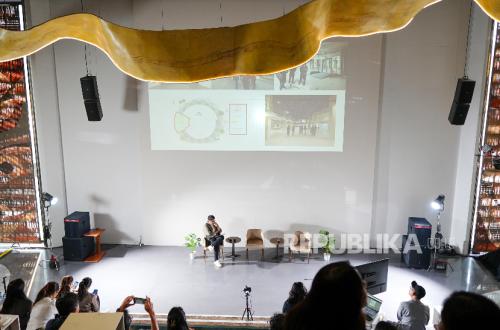
The development of artificial intelligence (AI) is increasingly transforming the way architects and designers work. While AI opens new possibilities in design, creativity, intuition, and the human touch remain vital components of architecture. This shift was a central theme in the ‘MM Talk: AI Webinar’ organised by MM Galleri.
The webinar featured Tim Fu, Founder & Director of Studio Tim Fu, who joined virtually from London, UK. The discussion also included Peter S Tjioe, Founder & Creative Director of MM Galleri Group; Hengky Djaja, Director of MM Galleri Jakarta & Bali; and architectural photographer Mario Wibowo.
In his presentation, Tim Fu demonstrated how AI can assist architects in exploring more possibilities in a shorter timeframe, ranging from initial ideas and forms to materiality and design development. According to Fu, the advancement of AI does not mean humans are losing their role in the design process.
On the contrary, humans need to be increasingly active in directing technology to produce outputs that align with design needs and objectives. “Guiding it is always better than not guiding it because, ultimately, I think at this stage of AI, it still requires significant human input to provide better results,” Tim Fu stated in a press release in Jakarta on Tuesday.
In practice, Studio Tim Fu utilises AI as part of the exploration, refinement, and design development process. The technology helps accelerate the iteration process, while decisions regarding concept, function, context, materials, and design feasibility still require human consideration.
Meanwhile, Peter S Tjioe views AI as a tool to expand human creativity. He noted that technology enables designers to generate concepts and visualisations at speeds previously unimaginable. However, producing a design digitally and realising it as a physical work are two different matters.
This is where materials, craftsmanship, and the human touch continue to play a crucial role. “Technology can be a very powerful tool, but a work of art still requires soul and a sense of beauty. There is a feeling and artistic value that comes from humans,” said Peter.