
AI Technology Speeds Up Assessments, but Decisions Still Require Human Assessors
JAKARTA — Artificial intelligence is beginning to be used in companies’ talent-assessment processes, particularly to help collect and analyse behavioural data at greater scale. However, using AI does not automatically make assessment results more valid or fair, as interpretation and decisions still require human judgement.
The shift comes as organisations seek to make faster, evidence-based decisions about talent. Assessments are used not only for individual development but also to determine a person’s suitability for a role, including leadership positions, promotions and succession.
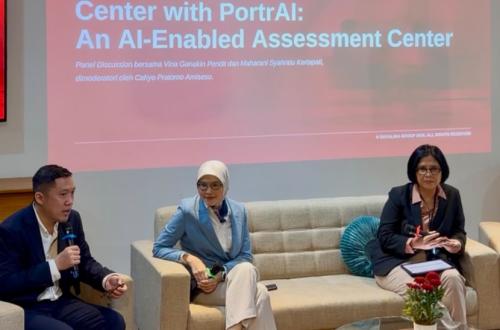
Daya Dimensi Indonesia has introduced PortrAI, an AI-enabled Assessment Centre approach developed to produce behavioural evidence more dynamically while shortening the assessment process. The technology was unveiled at the “From Talent Decisions to Business Performance” forum on 7 October 2026.
Daya Dimensi Indonesia co-founder Vina G. Pendit said assessment quality was directly linked to organisational decisions about placing people in particular roles. The tools used must therefore uphold measurement principles and ensure that results can be accounted for.
“Assessing people to select the right person to lead is part of risk mitigation. We therefore need relevant tools that still uphold the principles of what should be measured and how that evidence can be accounted for,” Vina said in a press release on Thursday (15 October 2026).
Changes in working patterns resulting from AI are also making it necessary for assessments to consider a person’s ability to use technology, make decisions and handle more complex work demands. Assessments can no longer focus solely on an individual’s abilities in isolation from the technological context in which they work.
Under PortrAI, participants undertake work simulations whose responses can evolve according to their behaviour and decisions during the assessment. The resulting behavioural traces are then used as one source of data for assessors.
Technology is also used to help organise and analyse larger volumes of information. However, the processed results do not automatically become the final decision.
Daya Dimensi Indonesia’s head of Future of Work, Maharani Syahratu Kertapati, said technological capability must be distinguished from the validity of its use in assessments. An AI system’s ability to perform a function does not necessarily mean that the function is appropriate as a basis for decision-making.
“AI can do many things in the assessment process, but capability is not the same as validity. The key question is not only whether the technology can do something, but whether its use is scientifically appropriate for the assessment’s purpose and whether the resulting decisions can be justified,” Maharani said.
Under this approach, AI helps generate and organise evidence, while decisions remain with human assessors. Assessors are responsible for understanding the context, integrating different forms of evidence, interpreting the findings and applying professional judgement.
Fairness also remains a concern. The use of AI does not automatically make assessments fairer, as results still depend on the assessment design, how evidence is collected, the analytical methods used and the decision-making process.
PortrAI is intended for talent identification, leadership assessment, promotions and succession. The approach is also used to help organisations understand how prepared their talent is for a working environment that increasingly makes use of AI.
Kapal Api Group human resources director Rafael Widya Wiryawan said assessments played an important role in determining whether a person was suited to a particular position. He said the use of technology could be one development in that process.
“For us, assessments play an important role in a range of talent-related decisions. They are not only for development; they also help organisations understand whether someone is suited to the position they hold. That is why the use of technology such as PortrAI is an interesting development in the assessment process,” Rafael said.
AI’s entry into assessment processes expands organisations’ ability to analyse behavioural data and speeds up the process. But the quality of decisions still depends on the validity of the methods, the work context and assessors’ ability to justify the final outcome.