
AI technology expands access to smart sports in China
Beijing (ANTARA) - Sports fans have grown accustomed to the use of artificial intelligence (AI) to assist refereeing at major events such as the FIFA World Cup and Grand Slam tennis tournaments.
Now, similar technology is becoming more accessible to fitness enthusiasts in everyday sporting activities. Fitness lovers are finding it increasingly easy to access AI-based technology in their daily exercise routines, which is also helping to drive the digitalisation of China’s sports sector.
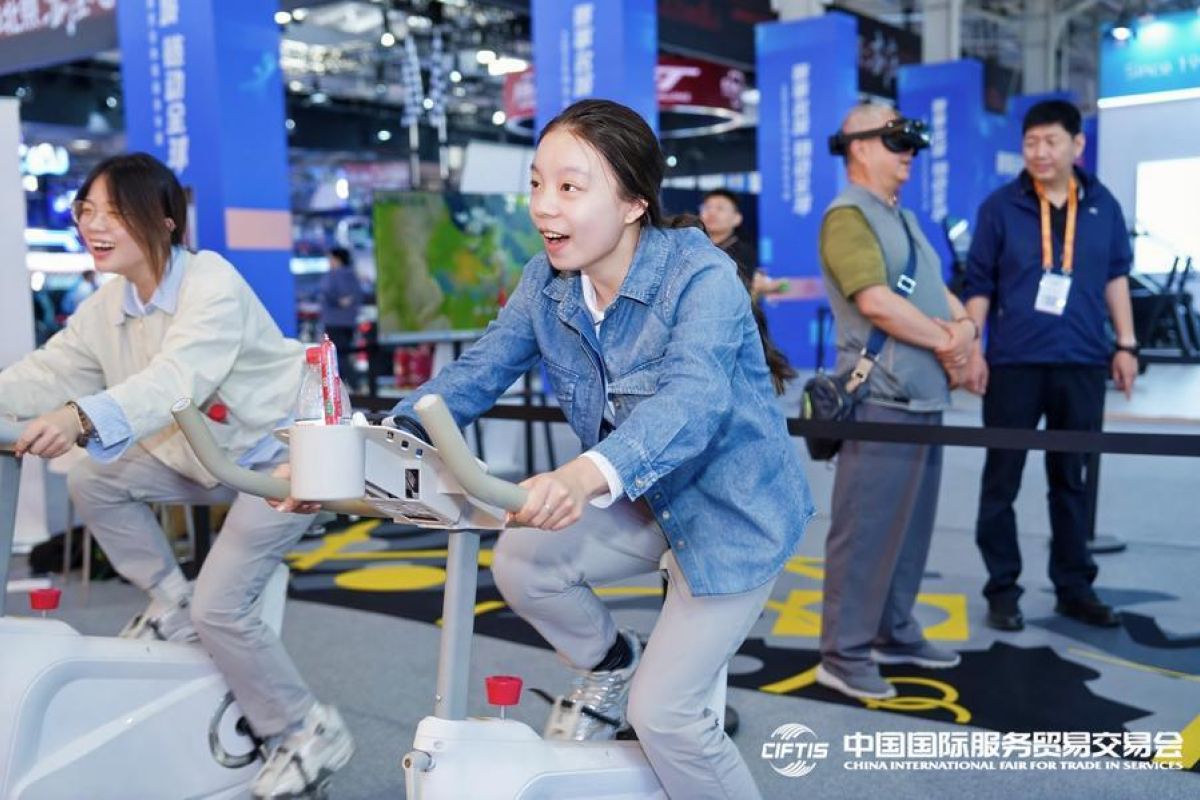
At the 2026 China International Fair for Trade in Services (CIFTIS), held at Shougang Park in Beijing this week, the organisers transformed the sports services exhibition area into a fully functional sports arena to demonstrate how AI is being applied in training, refereeing, and fitness.
At an indoor tennis court, visitors queued to try out an AI-based system that tracks players’ movements, ball trajectories, bounce positions, and stroke speed.
“Cameras on site record live footage of every rally. Whether in training or competition, these intelligent agents generate in-depth performance analyses and highlight videos based on that data,” said Gao Kai, product operations manager for the Smartshot system.
“This intelligent system changes the way players train, compete, and hone their game. It has been deployed in various cities across China, including Beijing, Guangzhou, Shenyang, and Yinchuan. The technology has also been gradually introduced to Canada, Australia, and other markets,” Gao added.
In 2023, FIFA confirmed that Rigour’s VAR and offside technology had been tested and certified in accordance with FIFA standards.
“Human referees have limitations in terms of vision and reaction time, making it difficult to catch every detail in a fast-paced match. This intelligent system offers objective replays,” said Wu Guoyu, a project manager at Rigour Technology.
For offside decisions in football, for instance, the system analyses camera footage using deep learning AI models and image processing algorithms. Once an offside is detected, the system generates a precise offside line on the live broadcast to assist the referee.
While such technology has been used in elite competitions, developers have also begun introducing it to grassroots and youth sports. A report on China’s sports services trade and development released during CIFTIS showed that the country’s major sports services imports and exports totalled 74.875 billion yuan (1 yuan = IDR 2,624) in 2025, up 7.98 per cent year on year.
“Many amateur tournaments lack professional referees and may rely purely on trust, meaning decisions on whether a ball is in or out are left to the players to agree among themselves. That often leads to disputes,” said Wu. “A more accessible intelligent refereeing system is something the public greatly needs.”
AI and digital technology are also expanding possibilities in recreational fitness. Sports such as rowing and canoeing traditionally require access to open water, whilst skiing requires snow and specialised facilities. Virtual sports can simulate these activities across a much wider range of locations.
“Virtual sports arenas can serve as everyday fitness centres whilst also hosting virtual sports events to inject energy into people’s lives,” said Mei Zijia, one of the exhibitors. “Sports services are no longer just about selling goods, but about providing a suite of solutions tailored to various sporting scenarios.”
“China’s sports services trade has reached a higher level, with significant improvements in its trade structure and the sports economy,” said Yang Xuedong, director of the economy department at the General Administration of Sport of China.
“We will accelerate the application of big data and artificial intelligence to empower the sports industry through technological innovation,” he said, as reported by Xinhua.