
AI Technology Could Solve Rural Blackouts
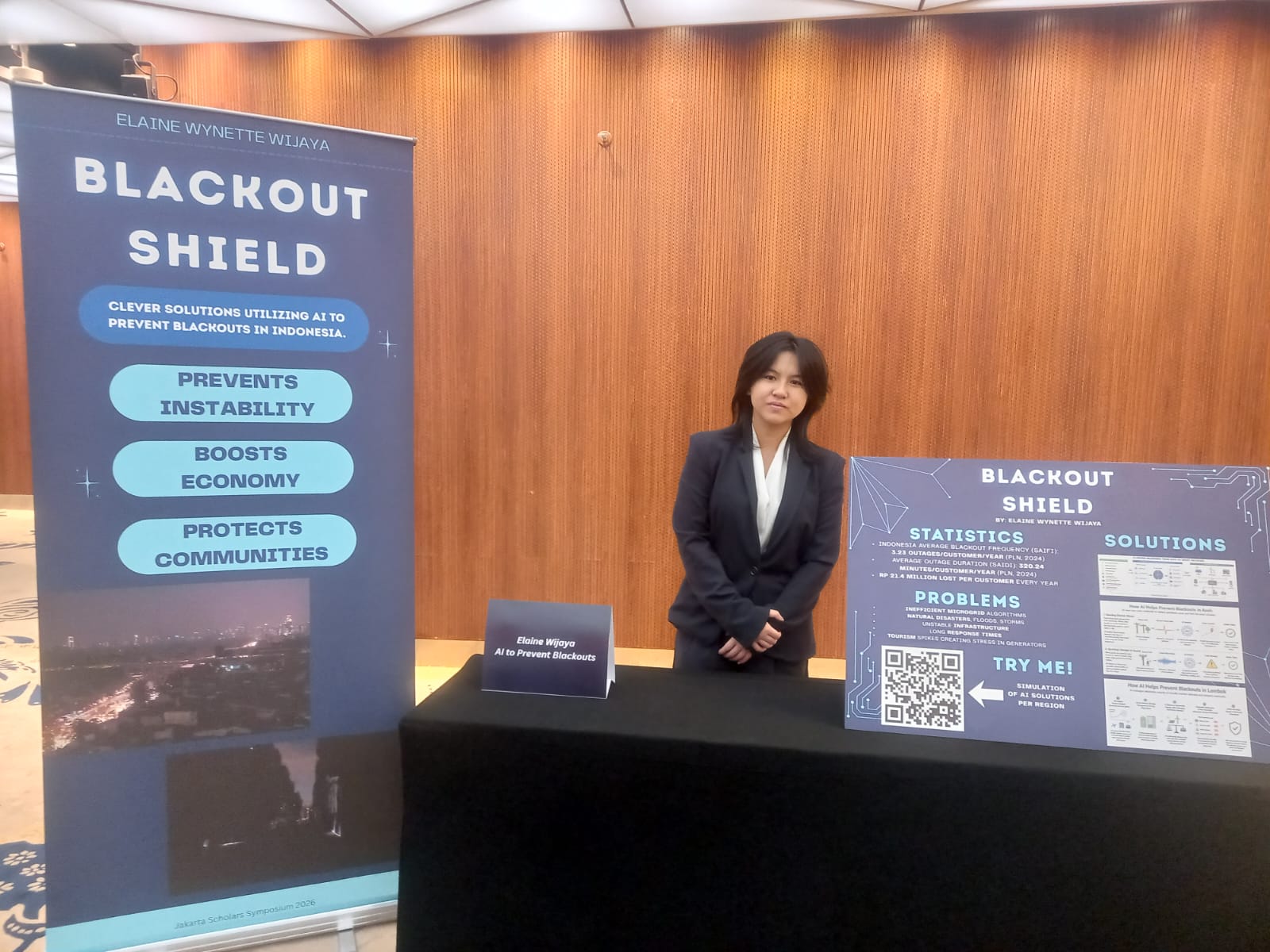
Amid rising power outages in rural areas, a high school student has proposed an artificial intelligence (AI)-based solution at a Jakarta-level student innovation forum.
Speaking at the Jakarta Scholars Symposium (JSS) 2026, Elaine Wynette Wijaya, a student from Pelita Harapan Senior High School in Karawaci, presented research on using AI to prevent large-scale blackouts in villages.
She highlighted outages in regions such as Papua, Aceh, and Lombok.
According to her research, challenging geography, fragile transmission infrastructure, and high reliance on microgrids make many villages prone to recurring blackouts.
“Power outages are not just about lack of lighting but have become a multidimensional crisis hindering economic productivity, healthcare services, and education in rural communities,” Elaine said in Jakarta on Wednesday (27 May 2026).
Through AI approaches using machine learning, deep learning, and reinforcement learning, she explained that smart systems can predict energy consumption patterns, detect grid faults within seconds, and automatically adjust power distribution.
Elaine stated that applying AI to rural power systems could reduce outage frequency by up to 15% and cut operational costs by 25.6%. The technology is also expected to speed up power restoration after grid damage.
“AI offers real hope to end the long-standing cycle of outages that burden rural communities,” Elaine said.
She noted that one challenge in developing the technology is limited data access from various regions in Indonesia. Data is crucial for creating accurate AI models to support the national power system.
“I hope to collaborate with NGOs or the government to gain data access from other cities to develop AI models, particularly through microgrid development,” Elaine said.
She also urged direct testing of AI microgrid systems in villages to prove their effectiveness on the ground.
She explained that microgrids can help stabilise and improve energy distribution, especially in areas prone to power disruptions.
“With AI support, the system is expected to predict faults, manage energy distribution, and reduce blackout risks more quickly and effectively,” she said.
Elaine is optimistic her idea can be implemented in Indonesia as similar technologies are already used in countries like Australia. “However, collaboration with experts is key to developing this technology. I need to work with professionals in this field,” she added.
Elaine also recommended that the government strengthen collaboration between universities, researchers, and local authorities to support AI development in the energy sector.
“Indonesia has many professors and intellectuals. By partnering with universities and governments in various cities, we can combine data to create practical solutions,” she said.
Furthermore, she hopes her research will benefit not only Indonesia but also be applicable globally.
“I hope this research, particularly the low-cost AI models and sensor systems, can help not just our country but others worldwide. The main issue so far has been the high cost of AI and sensors. With more affordable technology, I hope countries can connect and collaborate better,” she concluded.
JSS is an independent forum providing a platform for students to present innovative ideas and projects on key issues in Indonesia. This year, JSS featured nine students covering topics from the environment, health, energy, to social empowerment. (H-2)