
AI Superiority Is Not Determined by Technology, but by How Organisations Use It
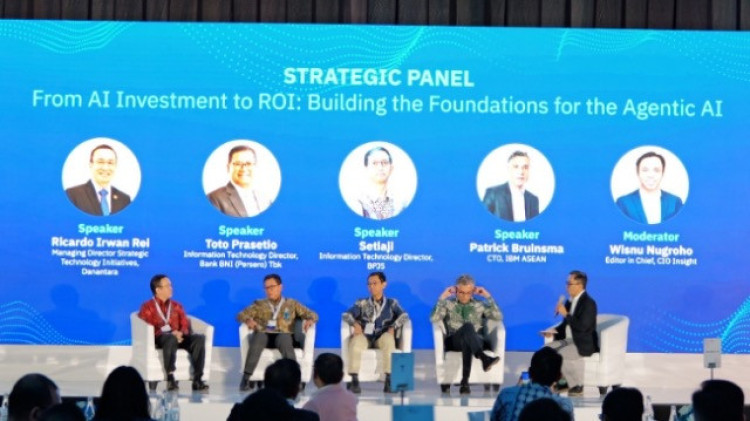
Artificial Intelligence (AI) utilisation is considered to have entered a phase of strategic implementation, no longer just a trial stage. This technology is projected to change the way companies operate, make decisions, and build new business models to win the competition. This view emerged at the AI Leadership Exchange 2026, a collaboration between IBM Indonesia and CIO Insight Indonesia. In a panel titled “From AI Investment to ROI: Building the Foundations for Agentic AI”, technology leaders, industry players, and regulators discussed strategies for maximising AI utilisation across various sectors. Setiaji, Information Technology Director of BPJS Kesehatan, stressed that organisations should not adopt AI solely because of a fear of missing out (FOMO). Without clear business objectives, AI investment risks becoming an expensive project without generating real impact. In line with that, Toto Prasetio, Information Technology Director of Bank BNI, assessed that transformation is not only determined by technology, but also by human resource readiness and the organisation’s ability to build an adaptive work culture. Meanwhile, Patrick Bruinsma, CTO of IBM ASEAN, encouraged companies to abandon partial or project-by-project AI implementation approaches. According to him, a strong operational foundation will enable various future AI initiatives to be executed more quickly, securely, and efficiently. From the investment and technology development side, Ricardo Irwan Rei, Managing Director of Strategic Technology Initiatives at Danantara, affirmed that his party will continue to utilise AI to improve the performance and competitiveness of state-owned enterprises (BUMN). Ricardo also assessed that Indonesia needs to start building its own AI development capabilities, as China has done through DeepSeek and Qwen. In the long term, this step is considered important to strengthen technology sovereignty. In the banking sector, AI is increasingly viewed as a strategic capability. If digitalisation previously allowed customers to carry out various activities independently through applications, AI development is expected to bring organisations into an era of increasingly autonomous operations. This view emerged in a discussion guided by Juvanus Tjandra, Country Managing Director of IBM Indonesia, with Rico Usthavia Frans, Operations, Technology, Analytics & AI Director of PT Bank CIMB Niaga Tbk, and Jayaprawirya Diah, Executive Vice President of Corporate & Strategic Planning, CFO Office of PT Bank Central Asia Tbk. However, building AI capability is no easy matter. Besides being required to continually innovate, financial institutions must also maintain data security, comply with various regulatory requirements, and ensure operational resilience is maintained. Therefore, AI adoption cannot be done hastily. Throughout the forum, one message stood out: superiority is not determined by who can access the latest AI technology the fastest, but by the organisation’s ability to integrate AI into business processes, work culture, governance, and decision-making. Thus, the biggest challenge today is no longer building AI, but building an organisation that is ready to work alongside AI.