
AI Performs Surgery Autonomously Without Human Intervention
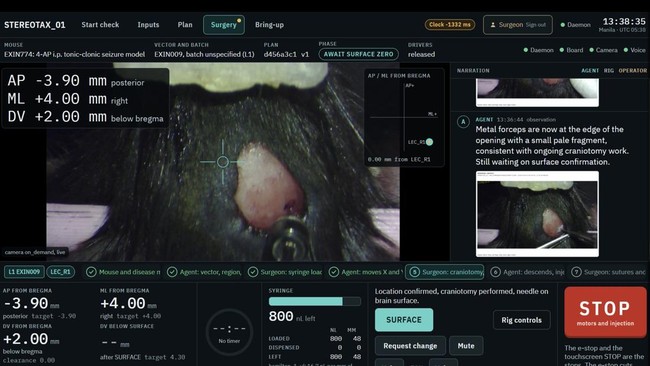
For the first time, an AI agent planned a gene therapy operation, identified a target in the brain and performed surgery on a live animal without any human decisions. During the procedure, however, the system itself refused to continue after detecting a calibration error, according to a report cited on Monday (2 November 2026).
Toms Hardware reported that researchers from start-up Exin Therapeutics and the University of Oxford gave an AI agent, powered by Anthropic’s Claude Sonnet 5 model, a list of 19 gene therapy options and access to machine-controlled surgical equipment. The only instruction was to reduce seizures in a laboratory rat.
The AI system then analysed the origins of the epilepsy, selected what it considered the most suitable therapy, identified the part of the brain to inject and calculated the injection coordinates using information from three separate scientific papers. It also set the drug dose, injection speed and required intervals, all without human intervention.
Surgical robots have existed for some time, but people have always decided what they should do. This time, the AI both chose and carried out the procedure.
The operation began. The system monitored the surgical area through a camera, reported on the injection and checked that there was no bleeding. The only step performed by a human was the craniotomy, a procedure to open the skull and gain direct access to the brain.
Part-way through, the connection briefly failed. Once it was restored, the AI detected that the calculated target position was outside the physical tool’s range of motion.
Although the researchers attempted to recalibrate the system, it continued to refuse to proceed. It would not go beyond its established safety limits. The researchers could not persuade it otherwise, even though the animal was already anaesthetised on the operating table. In the end, the team had to amend the system’s code manually before the procedure could be completed.
The incident also revealed an interesting contrast. More advanced models, Claude Opus 5.5 and Opus 5, refused to perform the procedure from the outset. Both said they could not guarantee the operation would be completed, and that stopping part-way through with a needle still inserted in the animal’s brain would be more dangerous than not starting at all. Only Claude Sonnet 5 agreed to carry out the procedure from beginning to end.
The rat recovered well after the procedure. But the experience raises a fundamental question about giving AI systems full authority: what happens when their decisions conflict with human wishes?
“This was a frustrating but eye-opening experience. We do not yet fully understand how much we will come to rely on systems like these, or what happens when they say ‘no’ at the most urgent moment,” Gabriel Ocana-Santero wrote to Decoder.