
AI innovations open new opportunities for smart living in China
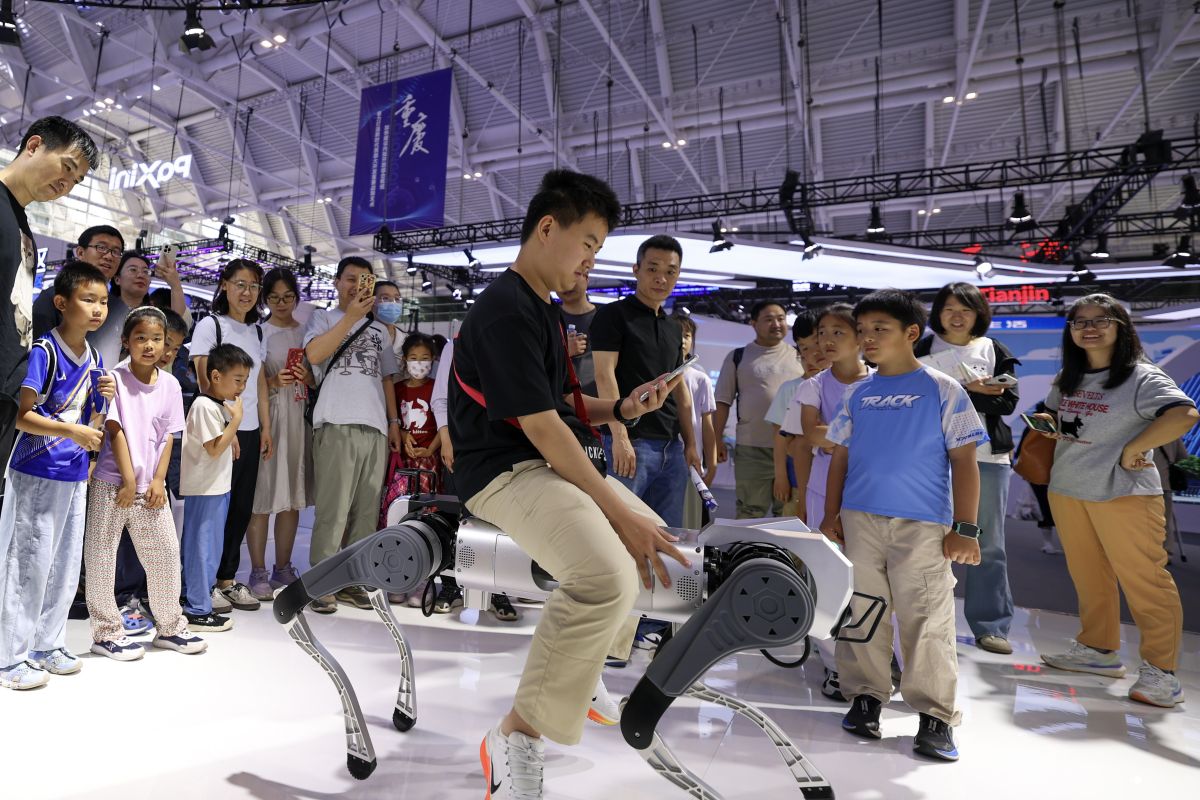
At the 2026 World Intelligence Expo in northern China’s Tianjin, a smart mirror can instantly display a person’s health condition, robotic arms deftly prepare delicious Chinese crepes, while a robot plays Go and tells stories to children, demonstrating that technologies once confined to science fiction are now increasingly part of everyday life in China.
The exhibition, which concluded on Sunday (31 May) after four days and featured over 700 exhibitors, showcased cutting-edge AI technologies, products, and various application scenarios.
Industry participants at the event stated that AI is accelerating its integration into education, public services, manufacturing, and daily life, boosting efficiency in traditional industries while creating new business models and economic growth opportunities.
At the iFLYTEK Co., Ltd. booth, a leading Chinese AI company focused on intelligent voice recognition and AI, the iFLYTEK AI Board smart whiteboard attracted widespread attention from visitors.
By combining traditional whiteboards with electronic displays, the device digitally transcribes handwritten equations in real time, transforming abstract mathematical concepts into clear visual representations.
Several AI-based applications are now entering classrooms.
In physical education classes at Tianjin Xinhua No. 2 High School, students perform squats, jumps, and landings following electronic guidance. Their jump distances are announced via voice system and uploaded in real-time to teachers’ devices, enabling immediate analysis of physical performance and fitness indicators.
“AI is transforming education in unprecedented ways,” said Dong Bin, general manager of the brand marketing centre at iFLYTEK.
“This technology frees teachers from repetitive tasks, allowing them to focus more on educational research, while helping students reduce excessive practice time and concentrate on meaningful personal development,” he added.
The company stated that iFLYTEK provides smart education products and solutions to over 50,000 schools across China, benefiting more than 130 million teachers and students.
In the embodied intelligence zone of the exhibition, various robots demonstrated real-life capabilities, from cooking and massage services to refuelling vehicles and musical performances.
One standout was the Aimoga Smart Police Robot, a wheeled traffic police robot that precisely moves its arms like an experienced officer while demonstrating traffic control in real-world conditions.
The robot has been deployed in several Chinese cities, including Hefei, Wuhu, and Changzhou, as an intelligent assistant for traffic police.
“Equipped with lidar and 360-degree cameras, the robot can autonomously navigate, perceive its environment, and interact with humans,” said Chen Gaoyuan, staff member at AiMOGA Robotics Technology Co., Ltd.
“It assists in traffic management and highway patrols, helps prevent traffic violations, and takes over repetitive and labour-intensive tasks during major events or peak holiday traffic periods,” Chen added.
By focusing on the development and commercial application of embodied intelligent robots, the company is accelerating the transition of robotics from technology demonstrations to real-world deployment.
Its humanoid robots, traffic police robots, and medical service robots have been exported to over 50 countries and regions, and are used in automotive dealerships, exhibition spaces, public service facilities, hospitals, and traffic management sectors.
Similar popularity was seen at the PaXini Technology booth nearby. The company, specialising in multi-dimensional touch sensor technology and humanoid robot development, has widely applied its products in precision manufacturing, automotive production lines, and medical rehabilitation.
The TORA series humanoid robots can perform various tasks, including preparing and delivering food, making coffee, cleaning tables, handling household chores, and other service functions, said Lin Tong, senior executive at PaXini Technology (Tianjin) Co., Ltd.
Lin added that the company has partnered with several leading international firms, with its products and solutions now serving markets in North America, Europe, and Asia-Pacific.
“China’s embodied intelligence industry has clear advantages in deployment speed, application diversity, and supply chain coordination,” Lin said.
“With the world’s most diverse manufacturing scenarios, comprehensive supply chains, and extensive robot deployment environments, China provides a natural real-world training ground for embodied intelligence development,” he added.
Behind this expanding array of applications lies sustained policy support.
China issued a new-generation AI development plan in 2017 and last year launched guidelines to further implement the “AI Plus” initiative. China’s 15th Five-Year Plan (2026-2030) also calls for full implementation of the initiative to drive AI-based development, spurring rapid AI innovation in the country.
According to the National Data Administration