
AI enhances speed and accuracy of sandstorm forecasting in China
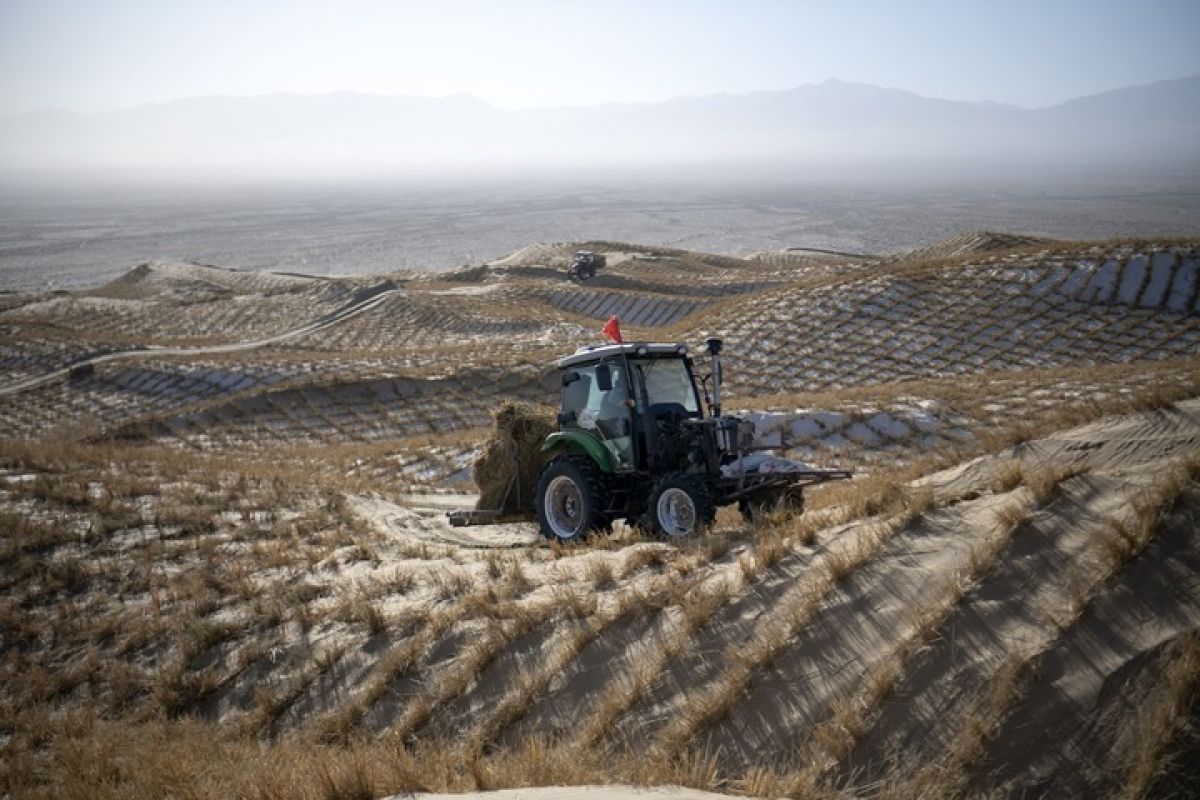
Lanzhou (ANTARA) - As spring arrives, residents in Gansu Province, northwest China, must prepare for sudden dust storms that shroud cities in yellow haze, causing travel disruptions and posing health risks. However, the people of Gansu are now far better prepared for these challenges than before. Days before a predicted storm hits, citizens receive accurate, real-time warnings rather than being caught off guard.
Simple preventative measures, such as wearing masks and rescheduling travel plans, can significantly mitigate the impact on public health and daily life. This shift has been driven by a technological breakthrough: the AI-driven Global Aerosol-Meteorology Forecasting System (AI-GAMFS).
Developed by a team of Chinese scientists, this artificial intelligence model significantly improves the accuracy and speed of dust and air pollution forecasts. According to Gui Ke, an associate researcher at the Chinese Academy of Meteorological Sciences (CAMS), traditional forecasting models often calculate meteorological elements separately from aerosols—microscopic solid particles or liquid droplets suspended in the atmosphere, such as dust, PM2.5 particles, and smoke.
“Aerosol forecasting is far more complex and requires much greater computing power than traditional weather forecasting. It requires the system to simultaneously analyse various aerosol sources, complex chemical transformations, and multi-scale interactions with weather systems,” said Gui.
He explained that the application of AI dynamically links suspended aerosol particles with meteorological factors, such as temperature, wind speed, and pressure, as a single, integrated unit. This holistic approach allows the system to simulate atmospheric evolution with much higher precision, thereby significantly enhancing forecast accuracy.
In addition to precision, the AI model offers unparalleled speed. Traditional numerical forecasting relies on massive supercomputer clusters to solve complex physical equations, often taking hours to run global weather forecasts that occur only a few times a day. In contrast, the AI-based system operates using graphics processing units and can generate global forecasts in just 36 seconds, more than 100 times faster than traditional methods.
This technology has moved from the laboratory to real-world application. According to Duan Haixia, a lead expert at the Lanzhou Institute of Arid Meteorology under the China Meteorological Administration (CMA), the institute has accurately predicted more than 10 major dust phenomena across northern China since late last year, utilising the model’s ability to provide high-precision environmental weather forecasts for the next three to five days.
The system does more than just track storms; it supports personalised public health warnings, such as advising allergy sufferers to wear N95 masks or helping hospitals prepare for surges in respiratory disease cases.
Currently, AI-GAMFS is operational at the China National Meteorological Centre and more than 10 provincial-level meteorological departments, including those in Gansu and Shaanxi. AI-GAMFS has also been integrated into the CMA’s “MAZU” public early warning cloud platform, a system designed to provide disaster warnings to the public. As a fully open-source system that complies with international standards, the model provides a low-cost, high-precision aerosol forecasting solution for developing nations globally.