
AI Discovers Seven New Cosmic Magnifying Glasses to Unlock Black Hole Secrets
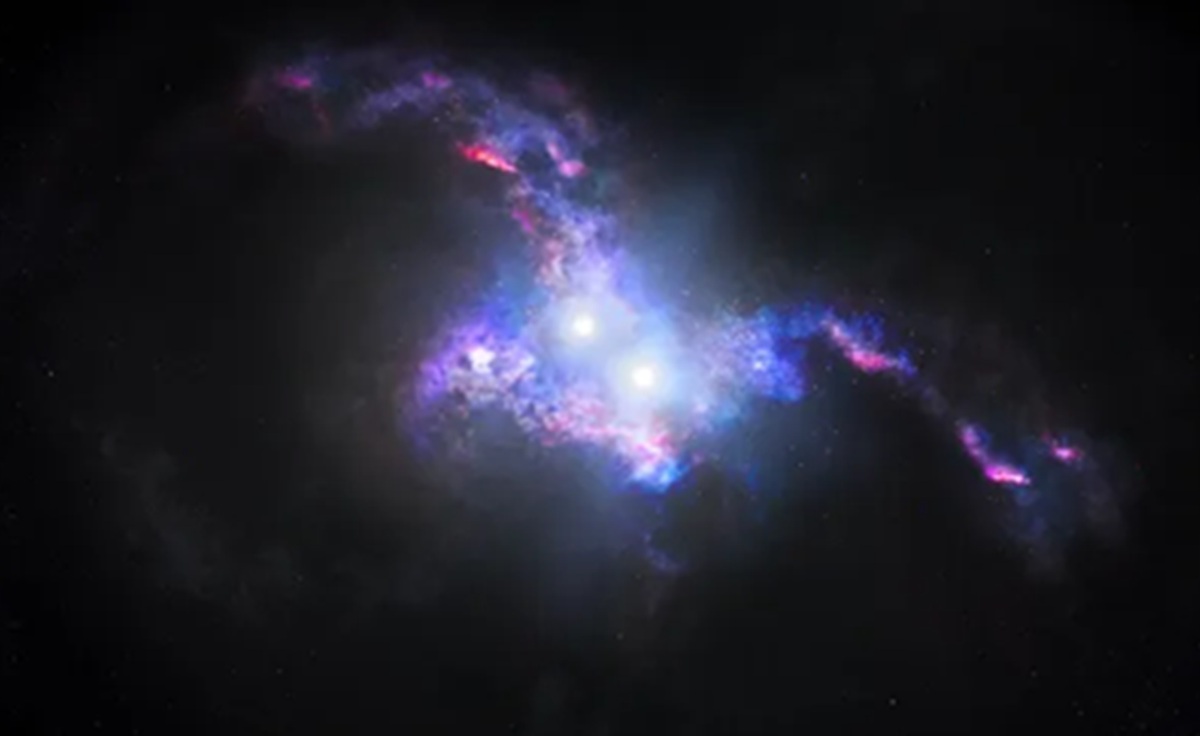
Some of the sharpest objects in the universe are thought to hold the key to understanding how galaxies evolve, particularly when gravity transforms them into giant cosmic magnifying glasses. By utilising artificial intelligence (AI) to process data from the Dark Energy Spectroscopic Instrument (DESI), astronomers have identified seven new quasar candidates that act as gravitational lenses. This phenomenon occurs when the gravity of a massive object bends and magnifies the light from an object located much further behind it.
According to an official statement from The Ohio State University, these rare systems could help researchers gain deeper insight into the evolution of actively growing supermassive black holes. “Quasars are like baby pictures of supermassive black holes,” said Everett McArthur, lead author of the study and a graduate student in astronomy at The Ohio State University. “So, studying how you go from a quasar to a black hole is really important.”
Quasars are extremely bright galactic centres powered by supermassive black holes actively consuming matter. Studying these objects helps researchers understand how black holes grow to the enormous sizes found in the modern universe. However, the process of accreting gas and dust releases so much energy that the quasar outshines its entire host galaxy, making the galaxy itself very difficult to observe. The rare condition where a quasar acts as a gravitational lens provides a solution, offering astronomers a unique opportunity to study both the quasar and the distant galaxy whose light is magnified by its gravity.
Finding these rare cosmic alignments is notoriously difficult. To uncover them, the research team started with a catalogue of approximately 800,000 quasars identified by DESI. They then used a machine learning model to search for subtle traces of gravitational lensing. Because so few lensed quasars exist, the researchers had limited real-world data to train the AI. Instead, they created simulated examples of these cosmic alignments for the algorithm to learn from before scanning the DESI catalogue. The algorithm narrowed the search down to about 200 candidates, which were then reviewed manually, yielding seven new quasar lens candidates. This discovery is expected to double the number of such systems found through survey methods and highlights the immense scientific potential hidden within modern astronomy’s vast datasets. Further observations are needed to confirm these newly identified candidates and study their properties in greater detail. If verified, these phenomena will provide astronomers with a powerful new way to investigate how supermassive black holes shape the galaxies around them.