
AI Data Centre Boom Raises Fears of Severe Air Pollution
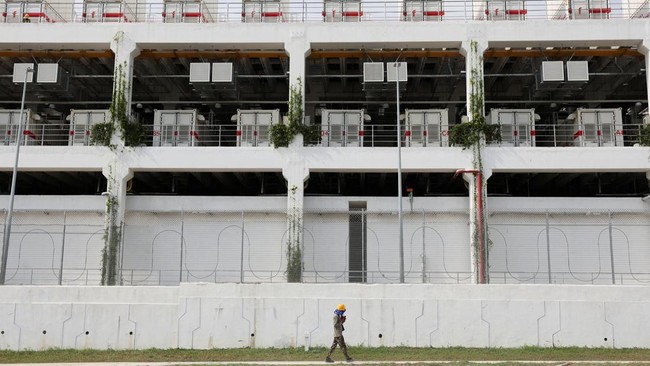
Jakarta, CNBC Indonesia – The rapid construction of data centres to support artificial intelligence (AI) in Texas, the United States, has prompted warnings about air pollution. A study by the Houston Advanced Research Center (HARC) estimates that the facilities’ soaring electricity demand could erase some of the progress Texas has made in reducing emissions over the past two decades.
Data centres are now spread across Abilene, Dallas-Fort Worth, San Antonio, Austin and West Texas, including projects linked to Google, Microsoft, Amazon and Oracle. This expansion is increasing electricity demand and could worsen air pollution, particularly if the energy supply continues to rely on fossil fuels.
Carlos Gamarra, HARC’s vice-president for Energy, Air and Digital Solutions and one of the study’s authors, said the environmental impact would depend greatly on the energy sources used.
“Projecting emissions based on the current electricity-grid mix, we see that, for various criteria pollutants, emissions would return to levels seen in the 2000s,” he said, as quoted by CBS on Wednesday (28 October 2026).
The study modelled the emissions impact of different electricity-supply scenarios through 2031, including nitrogen oxides (NOx), volatile organic compounds (VOCs), sulphur dioxide, fine particulate matter (PM2.5) and carbon dioxide.
Under a scenario in which the additional electricity demand is met by the Texas grid using its projected energy mix, NOx emissions in 2031 are estimated to be 136% higher than in a scenario with no new data centre construction.
The risk threatens Texas’s emissions-reduction gains between 2002 and 2024. During that period, emissions from power plants fell by 67% for NOx, 80% for sulphur dioxide, 37% for VOCs, 52% for carbon dioxide and 60% for PM2.5. HARC also estimates that, under a data-centre growth scenario, VOC emissions could exceed their 2002 levels by 32%.
Pollution could be even higher if data centres burn fuel on site to generate electricity. According to the HARC study, NOx emissions could be between two and 10 times higher than in a scenario using grid electricity supported by solar and wind power.
“Based on our analysis, it is clear that air pollutant emissions will increase as the data-centre industry develops,” Gamarra said.
Residents of Bastrop County have also complained about the impact of data-centre construction. Jay Mirabito, who lives in the Elm Ridge area, said construction of an EdgeConneX data-centre complex had caused noise, dust and concrete particles in his neighbourhood. He also said the value of his property had fallen by around US$70,000, equivalent to Rp1.267 billion.
In the same area, Pacifico Energy plans to build a natural-gas-fired power plant to supply a data centre near residential areas. Residents have asked the Texas Commission on Environmental Quality (TCEQ) to hold a meeting to discuss the project’s permit.
Meanwhile, Big Watt + Powerhouse said its facility in Taylor would use Selective Catalytic Reduction (SCR) technology to cut NOx emissions by 90% or more. Gamarra said technology choices, regulatory compliance and public oversight would determine the impact of the industry’s expansion.
“We just need to find a way to develop it sustainably,” he said.
Source: jawawa.id (https://jawawa.id/newsitem/ai-data-centre-boom-raises-fears-of-severe-air-pollution-1793191837)
Originally published by CNBC Indonesia (https://www.cnbcindonesia.com/tech/20261028180955-37-780345/pusat-data-ai-meledak-ancaman-polusi-udara-parah-ikut-melonjak), translated from Indonesian