
AI Boosts Precision and Efficiency in China’s Manufacturing Industry
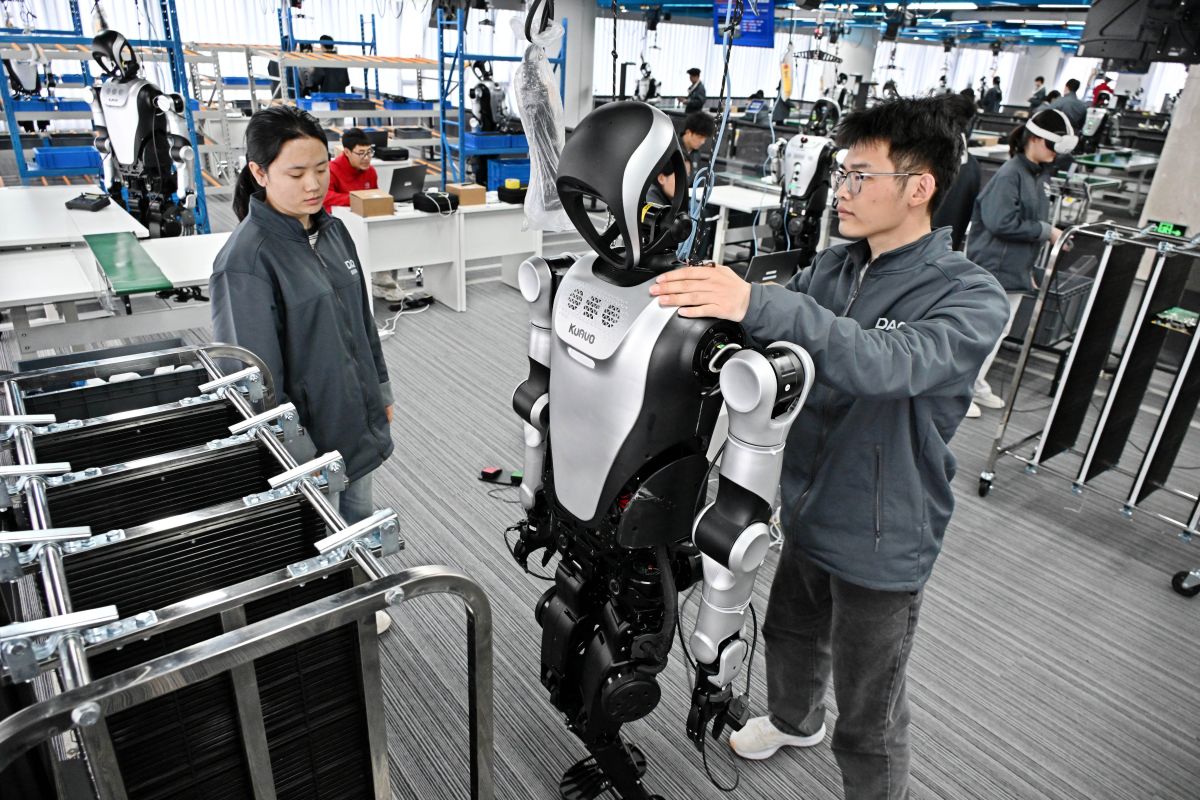
Jinan (ANTARA) – At a factory in Qingdao, in eastern China’s Shandong Province, artificial intelligence (AI) has been given a practical task: writing instructions for machines that make precision moulds.
The factory produces a range of components, including front panels for washing machines. In products such as these, even the slightest deviation from design specifications can leave a component below standard and waste money.
To address this, Qingdao Ruilijie Metal Co., Ltd. has integrated an AI-based programming system, helping to improve precision and efficiency.
Factory director Guo Weiwei said the system had shortened the development cycle for new orders by about a week, reduced the number of defective products and saved the company more than 3 million yuan (1 yuan = Rp2,712) a year.
Careful preparation of the data needed for the AI transition laid the foundation for those savings. A team of 80 people spent a year collecting, cleaning and standardising technical drawings to build a dataset for the system.
Mould-making is largely a customised business. Engineers have different design habits, and their technical drawings do not always follow the same conventions. Teaching AI to understand these differences was no easy task.
When the system was first deployed last July, it produced components that were 0.2 millimetres too large because it relied on three-dimensional drawings without cross-checking the corresponding two-dimensional plans. Engineers then added an automatic verification function, and the system has since been adopted by other mould manufacturers.
The Qingdao project points to a potential advantage for China in AI: the country has a large number of practical tasks that the technology can take on.
As the world’s largest manufacturing country, China has an extensive network of factories and suppliers, supported by strong engineering expertise. This industrial base offers opportunities to develop and refine AI tools for specific tasks.
Official data released in October showed that AI adoption in key application scenarios among large-scale manufacturing companies had exceeded one-third. Since the government launched its “AI Plus” initiative in 2024, provinces and businesses have stepped up efforts to develop AI tools tailored to sectors such as mining, ports and logistics.
In other sectors, AI is taking on work in places that are difficult for people to reach. Around Mount Tai in Shandong, steep slopes make inspections of electricity transmission lines difficult and hazardous. State Grid Tai’an, a power supplier, now uses AI to examine drone images and detect 12 types of damage.
Yu Tao, an employee in State Grid Tai’an’s digitalisation department, said the company’s AI system had helped detect and address 31 potential hazards at the Mount Tai tourist attraction this year, making inspections six times more efficient.
AI is also beginning to be used beyond factories in healthcare. At West China Hospital of Sichuan University, an AI-powered system now manages patient follow-ups across 43 clinical departments.
In Guangzhou, the First Affiliated Hospital of Guangzhou Medical University and its partners developed an AI model that can analyse digital pathology images and predict the likelihood of mutations in 12 genes associated with lung cancer in just one minute. The model is designed to help doctors identify patients who could benefit from targeted therapy, with genetic testing used to confirm its predictions.
A study published in September by the International Labour Organization (ILO) found that some manufacturers in China reported production-efficiency gains of 20 to 30 per cent after adopting AI.
Miao Yanliang, chief economist at China International Capital Corporation, said China’s vast domestic market, comprehensive industrial base and engineering capabilities could give the country an advantage as AI is directed towards broader applications.
The Qingdao model has already been deployed at four mould-making companies. Its developers hope to reach 100 small and medium-sized enterprises by the end of this year, making AI tools that were once beyond the means of small workshops accessible to them.
Source: jawawa.id (https://jawawa.id/newsitem/ai-boosts-precision-and-efficiency-in-chinas-manufacturing-industry-1794318706)
Originally published by Antara (Indonesian) (https://www.antaranews.com/berita/5844895/ai-tingkatkan-presisi-dan-efisiensi-industri-manufaktur-china), translated from Indonesian