
AI Boom Turns Threat: Why Korean and Taiwanese Markets Are Vulnerable
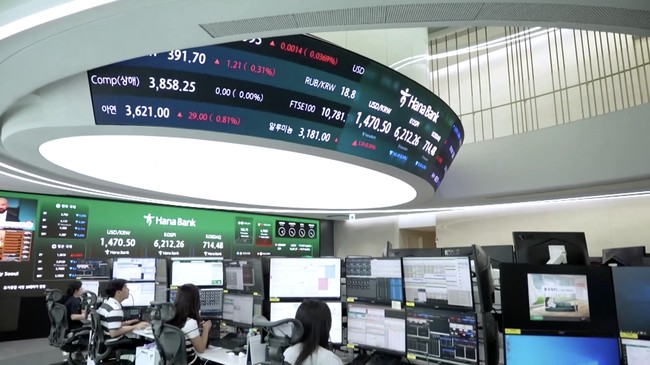
Jakarta, CNBC Indonesia — South Korean and Taiwanese stock markets have once again experienced extreme volatility. The trigger came from Wall Street after Nvidia shares closed down almost 5% on Monday (27/7/2026), followed by massive selling of Asian semiconductor shares.
On Tuesday (28/7/2026), South Korea’s Kospi index closed down 10.84%. Samsung Electronics fell around 14%, whilst SK hynix slumped 14.7%. Pressure continued on Wednesday (29/7/2026), when the Kospi briefly lost 12.6% and triggered a temporary trading halt before eventually closing down 5.98% at 5,663.24.
Taiwan was not immune either. The Taiex index closed 3.76% lower at 40,039.18 on Wednesday, with TSMC also down around 3.5%. These movements demonstrate that when sentiment towards Nvidia and artificial intelligence (AI) investment shifts, the impact can escalate rapidly in South Korea and Taiwan.
Nvidia as the Trigger
Nvidia’s decline came after reports emerged that the company was discussing providing financing guarantees of around US$250 billion for data centre projects to be used by OpenAI in Ohio. Nvidia was also said to be discussing financing support for chip purchases on a far larger scale.
The information came from a Wall Street Journal report cited by Reuters, which Reuters has not independently verified. Nevertheless, the market responded immediately, as the scheme revived concerns about circular financing within the AI industry.
Investors questioned whether AI chip demand is entirely underpinned by customers’ economic needs, or whether it partly depends on financing from companies that also have an interest in selling the chips.
Such a model is not inherently problematic, but it increases risk if the revenue generated by AI data centres is not commensurate with the debt and capital expended.
Because Nvidia serves as the primary barometer of global AI trading, its decline was read as a signal to reduce exposure across the entire semiconductor supply chain.
Kospi Too Dependent on Two Shares
The impact in South Korea was far greater because the Kospi’s structure is highly concentrated. Based on CNBC Indonesia’s calculations using market capitalisation at the close of 29 July 2026, Samsung Electronics is estimated to represent around 28.3% of Kospi market capitalisation, whilst SK hynix accounts for roughly 22.8%.
Combined, the two chipmakers control approximately 51.1% of Kospi market capitalisation. In other words, more than half of the South Korean market’s direction is heavily influenced by just two shares.
This calculation used Samsung Electronics’ closing price of 208,500 won, SK hynix’s closing price of 1,401,000 won, the number of ordinary shares in each company, and total Kospi market capitalisation of around 4,365.6 trillion won. The figures are estimates and do not include Samsung’s preferred shares as part of Samsung Electronics in the chart.
This concentration explains why a decline of nearly 5% in Nvidia could translate into a far deeper Kospi correction. When Samsung and SK hynix fall simultaneously, shares in other sectors lack sufficient weight to hold up the index.
South Korea has also become a proxy for AI trading because SK hynix is the main supplier of high-bandwidth memory (HBM) for AI accelerators. Samsung Electronics, meanwhile, has expanded its investment in AI memory chips. Consequently, any doubts about global data centre spending directly affect the two companies’ revenue expectations.
Taiwan Faces Similar Risks
Taiwan has a comparable concentration problem. TSMC represents more than 40% of Taiwan’s stock market capitalisation and is the producer of advanced chips for Nvidia and other global technology companies.
When investors reduce their positions in AI shares, TSMC weakness drags the Taiex down almost automatically. However, pressure on Taiwan during this period remained smaller than in Korea, because the Korean market faces additional risks from retail investor leverage and leveraged single-stock ETF products.
Big Profits No Longer Enough
Volatility also arose because expectations for semiconductor companies had already climbed too high. SK hynix reported second-quarter 2026 operating profit of 60.5 trillion won, surging 557% year on year and setting a record.
Even so, the result still fell short of market estimates of around 64 trillion won. Its revenue also missed forecasts, partly because HBM4 shipments ran slower than expected.
The market’s reaction signals a regime change. Investors are no longer merely asking whether a company’s profits are growing, but whether that growth is large enough to justify the preceding surge in share prices. When even very strong results fall slightly below expectations, profit-taking can turn into heavy selling.
Leverage Magnifies the Fall
The Kospi’s earlier rally was also supported by retail investors’ use of borrowed funds and leveraged ETFs. The value of margin-financed investments in Kospi shares approached 30 trillion won at the end of June 2026.
Leverage magnifies gains when prices rise. Conversely, when prices fall, investors must post additional collateral or face forced selling. Such selling pushes prices lower, triggering new margin calls and creating a downward spiral.
The South Korean government and regulators are now evaluating oversight of leveraged single-stock ETFs, many of which are tied to Samsung and SK hynix. This technical factor explains how a fundamental correction could develop into double-digit index moves within a single session.
China Threat Changes the Narrative
Pressure has also come from advances in China’s semiconductor industry. Investors are monitoring developments at memory producer CXMT as well as reports of progress in China’s domestic lithography equipment.
Korean companies still lead in HBM technology, but the market has begun to price in the risks of competition, capacity expansion and the possibility of oversupply. In addition, the emergence of more efficient AI models has raised questions over whether computing demand will continue to grow as aggressively as previously projected.
Source: jawawa.id (https://jawawa.id/newsitem/ai-boom-turns-threat-why-korean-and-taiwanese-markets-are-vulnerable-1785379853)
Originally published by CNBC Indonesia (https://www.cnbcindonesia.com/research/20260730080803-128-754949/ledakan-ai-berbalik-jadi-ancaman-mengapa-bursa-korea-taiwan-rentan), translated from Indonesian