
AI and Hybrid Working Are Changing How Companies Lease Office Space
The development of artificial intelligence (AI), hybrid working patterns, and increasing global economic uncertainty are changing the way companies view their office space requirements. Where firms previously tended to commit to long-term lease contracts, a growing number of corporations are now opting for flexible workspaces deemed more adaptable to business changes.
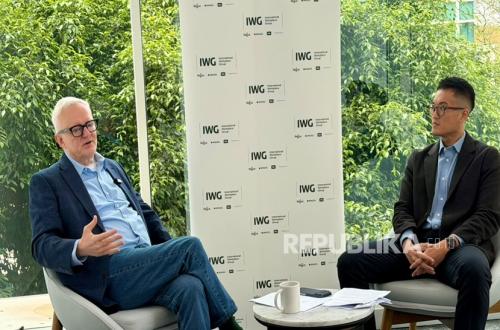
Senior Vice President of IWG Asia Pacific, Lars Wittig, assesses that this transformation is no longer just a post-pandemic trend but a structural change that will shape the future of work. He estimates that within less than a decade, around a third of workspaces worldwide will have shifted to a flexible model. “Today, perhaps less than five per cent of all office space is flexible. In less than 10 years, about a third of workspaces will be flexible in one form or another,” Wittig told Republika.
He explained that the change is driven by the increasingly widespread adoption of hybrid working patterns. Employees no longer need to commute to a central headquarters every day, as many tasks can be completed from locations closer to home or from shared workspaces that offer professional facilities. According to Wittig, this shift is also evident in Indonesia. IWG, which operates several flexible workspace brands such as Regus, Signature, HQ, and Spaces, has been present in Indonesia for two decades. The company currently operates 56 business centres and is targeting an increase to 62 locations by the end of the year.
For Wittig, this growth reflects a change in the behaviour of both companies and workers in choosing where to work. He cited the example of many workers living in Jakarta’s satellite cities who previously had to spend hours commuting to the central business district. With the expansion of flexible workspaces in various locations, workers now have alternatives that allow them to work in a professional environment without undertaking long journeys every day.
Beyond providing flexibility for workers, the change is also influenced by the accelerating pace of business dynamics. Wittig noted that companies today find it far more difficult to predict their business needs compared to a decade ago. Technological change is a primary factor, and he assessed that the impact of AI is even greater than the combined effect of the personal computer, internet, and mobile phone revolutions in recent decades. “AI is bringing more change in a much shorter time than all previous technological changes combined. The speed of change right now is extreme,” he said.
In addition to technological developments, the business world is also facing various geopolitical and global economic uncertainties, ranging from trade wars to shifting trade policies between countries. These conditions are making companies more cautious about making long-term investment decisions, including those related to office space provision. According to Wittig, in such a situation, companies can no longer accurately predict how many employees or how much workspace they will need in one, three, or even five years’ time. Flexible workspaces are therefore seen as a solution that allows companies to adjust office capacity in line with business developments without being burdened by long-term contracts.
Wittig revealed that this phenomenon is no longer confined to start-up companies but is now also occurring among large global corporations. He disclosed that around 83 per cent of Fortune 500 companies have used IWG services in various countries. “In the past, flexible workspaces were synonymous with start-ups or companies testing new markets. Now, large companies are also using them because they can no longer predict the future with certainty,” he said.
Wittig believes this change will continue as the need for more agile business models grows. In a rapidly changing economic environment, the ability to adapt is becoming a crucial factor in maintaining competitiveness. He is convinced that the future of work will no longer be determined by the size of an office building a company owns, but by the organisation’s ability to provide a work environment that is flexible, collaborative, and capable of keeping pace with technological changes and employee needs.