
AHY optimistic that Wonolopo People's School construction will be completed on time
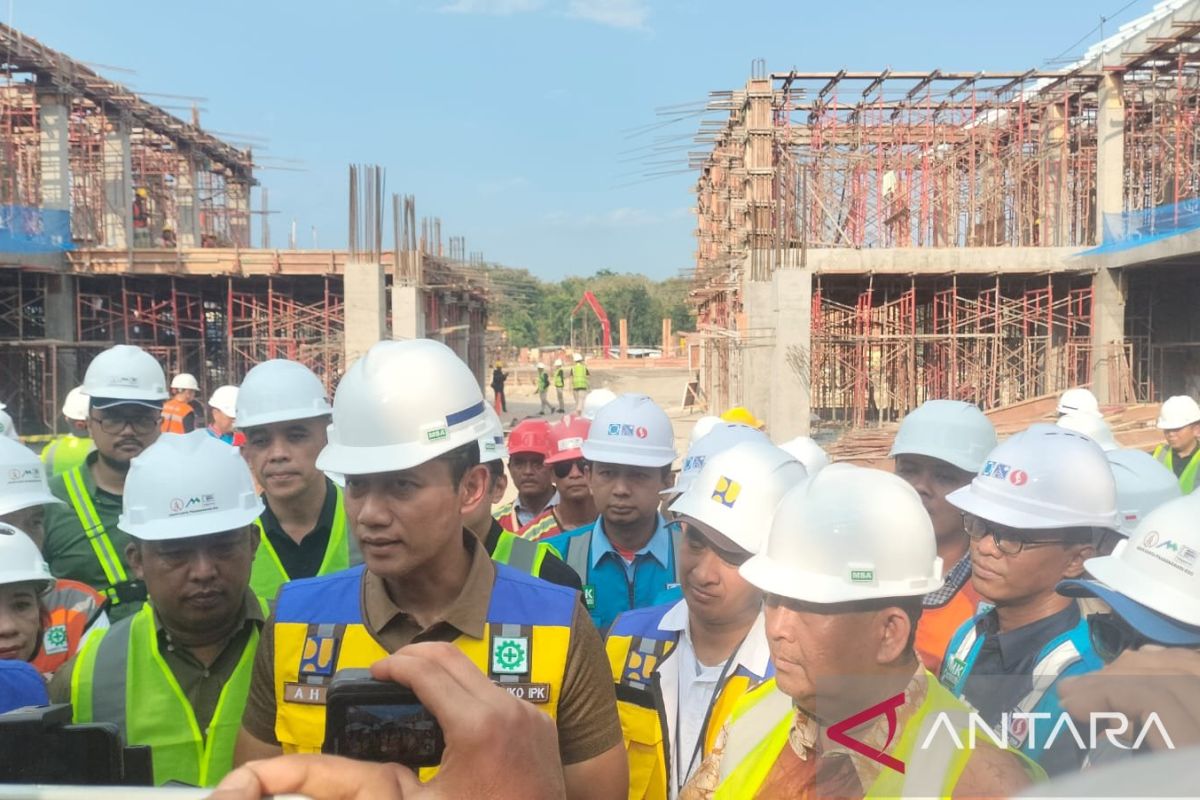
Yogyakarta (ANTARA) - Coordinating Minister for Infrastructure and Regional Development Agus Harimurti Yudhoyono (AHY) is optimistic that the construction project of the Wonolopo People’s School in Kulon Progo Regency, Special Region of Yogyakarta, can be completed on time in June 2026. “We need to push further. We want to accelerate it; there is a slight delay of about 4.5 per cent deviation, which we are currently addressing,” AHY said during his inspection of the Wonolopo People’s School construction in Kulon Progo, DIY, on Friday. According to him, the technical challenges in the construction process include one solution of increasing the number of workers. “We are also maximising heavy equipment, and hopefully with all that, I asked earlier and am optimistic that we can still catch up according to the timeline in June,” he said. He stated that the Wonolopo People’s School is the only people’s school currently under construction in DIY, built on an area of approximately 7.1 hectares. The school is located in Gulurejo Village, Lendah Sub-district. The Wonolopo People’s School is an integrated complex of buildings for primary school (SD), junior high school (SMP), and senior high school (SMA). It includes school rooms, dormitories, and various supporting facilities from canteens to sports facilities, including football fields, basketball courts, and others. “This is a concept that truly serves as a solution to alleviate poverty in various regions in line with President Prabowo Subianto’s vision and mission that the People’s School is present to break the chain of intergenerational poverty in various regions across Indonesia,” he said. AHY said that in the second phase of the People’s School construction, there are 104 schools being built in various regions of Indonesia, including this one. “We hope that in a not too long time, the timeline is June 2026, it can be completed as reported by the Head of the Satker that there are several challenges here and there but overall this is being worked on intensively morning, afternoon, evening together with Abadi Karya Pradanaraya. We want this to be completed well,” he said. On that occasion, AHY also emphasised that safety factors in carrying out the construction project remain a priority, and visually, the fastest progress is in the primary school building. “The roof is already at level, and once again, looking at the existing contours, what we need to add is the number of workers. Earlier, approximately 840 workers have been deployed and may be increased soon so that we can meet the established timeline,” he said. The construction of the Wonolopo People’s School is estimated to have reached 38 per cent currently, with a budget of approximately Rp214 billion until completion. The school will eventually accommodate 1,080 students, plus around 1,200 teaching staff. Thus, we hope that the community, especially from pre-prosperous families and low-income communities, can entrust and school their children at this People’s School without burdening the family because everything is covered; it’s free. The school is free, meals are free, uniforms, books, and other school equipment are also provided,” he said. He stated that teachers will also be prepared to focus their attention on the students. With all this, it is hoped that it can produce children with excellence and achievements, who can continue to university after graduating from high school or directly enter the workforce. He also appreciated that this school project absorbs local labour, some local materials, and empowers the community economy. “We ensure that the materials I asked about are already present on site, including sand, stone, cement, and others. Some are mostly from Kulon Progo, but others can be brought from or sourced from other places. The workforce is similar, many local people and hundreds of workers from various regions; this will also enliven the village or surrounding area, the local economy, MSMEs, accommodation, residents’ houses turned into lodgings; this can grow well,” he said.