
AHY Inaugurates Bekasi Extension Station, Emphasises Economic Impact of Transit-Oriented Development
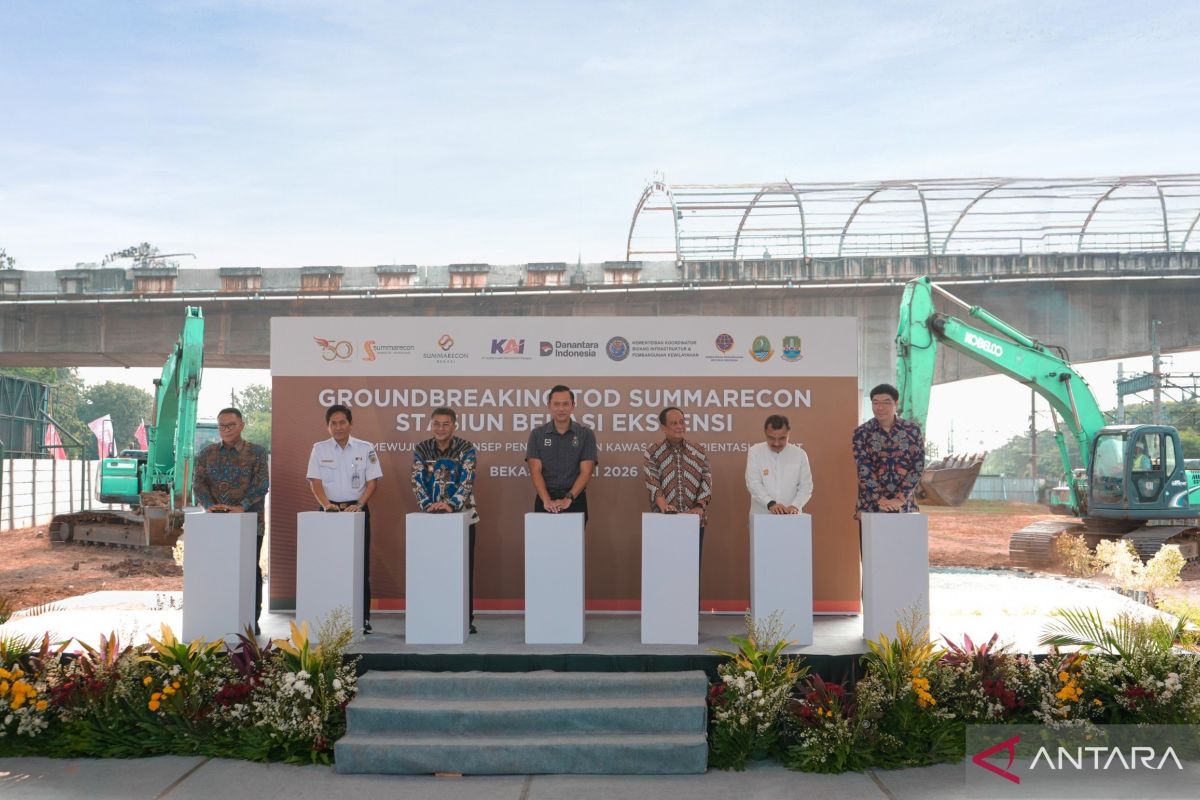
Coordinating Minister for Infrastructure and Regional Development Agus Harimurti Yudhoyono (AHY) has inaugurated the construction of the transit-based Bekasi Extension Station, a strategic step to strengthen connectivity while opening up broader access to opportunities for increased economic activity.
AHY said the development of the area, which forms part of the Summarecon Transit Oriented Development (TOD), represents a development approach that integrates transport, spatial planning, economic activity centres and community living spaces.
“We warmly welcome this initiative. The presence of the Bekasi Extension Station is not merely physical infrastructure development. It is hoped to become an increasingly productive area supporting mobility, ease of community activity, and to be developed in line with Indonesia’s TOD principles,” AHY said in Bekasi, West Java, on Friday.
He said strengthened connectivity means it will be easier for people to reach workplaces, education centres, healthcare services and various business opportunities, so that the benefits of development can be felt more evenly.
According to AHY, the TOD concept is not only about providing a more integrated public transport system, but must also be able to create new spaces for economic activity by delivering positive impacts for business development, the business world, including micro, small and medium enterprises (MSMEs).
“What is the point of having a grand concept if it does not deliver economic impact, open up jobs, and increase people’s income and purchasing power,” he said.
In his view, infrastructure development that integrates access for passengers of Bekasi commuter rail station and LRT Jabodebek, along with feeder bus networks and pedestrian walkways, is effective in shifting mobility away from private vehicles towards public transport.
AHY assured that the government is paying serious attention to the development of this integrated transport area, continuing to encourage collaboration across all relevant sectors so that wider benefits can be delivered to the public.
“The presence of the Summarecon TOD Bekasi Extension Station is a concrete example of how the private sector and government work together to create spatial order through the efficiency of residents’ mobility,” he said.
Adrianto P Adhi, President Director of PT Summarecon Agung Tbk, expressed gratitude for the opportunity to contribute to meeting the needs of the Indonesian people, particularly in the Bekasi area, through synergy with the government in improving mass rail transport access services.
The Bekasi Extension Station is a transit-oriented area development concept built on 7,038 square metres of land with a building area of 6,733 square metres, comprising a three-storey building plus additional infrastructure in the form of a connecting corridor and Sky Bridge.
The construction of the Bekasi Extension Station marks the initial phase of TOD area development, which will continue with the development of a mass transport route connecting the northern part of Bekasi City, passing through the Summarecon Bekasi area and the TOD, and then continuing to the LRT Jabodebek Station over a distance of five kilometres.
“The Bekasi Extension Station was built to prevent overcrowding, as it will serve passengers from the west and south. The existing Bekasi Station will serve more passengers from the north and east. This initiative supports more efficient mobility, improves connectivity and creates a more sustainable urban environment,” he said.
Deputy Minister of Transportation Suntana said the construction of the Bekasi Extension Station is a strategic step in the development of the railway network as well as a major leap towards realising a TOD-based area, assessed as capable of improving the quality of urban spatial planning and encouraging people to switch to mass transport.
“Through this Bekasi Station expansion, we are weaving a more modern future of urban connectivity to accommodate rising service capacity and intermodal integration. This station is expected to accommodate surges in Commuter Line and long-distance rail passengers with far higher standards of comfort,” he said.