
AHY Identifies Initial Locations for Giant Sea Wall Project; Groundbreaking Date Pending
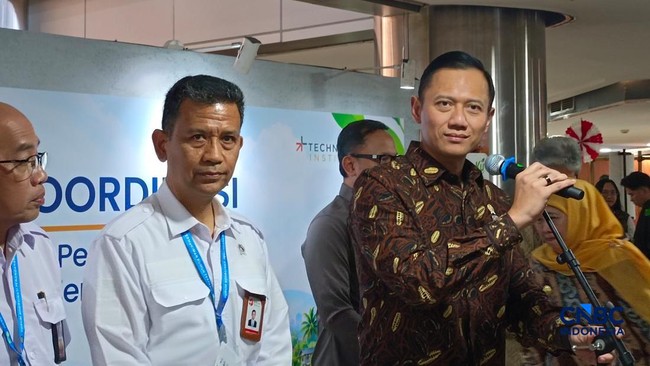
The Coordinating Minister for Infrastructure and Regional Development (Menko IPK), Agus Harimurti Yudhoyono (AHY), has revealed several highly vulnerable points that are the priority focus for the Giant Sea Wall project, which spans 575 kilometres along the North Coast (Pantura) of Java.
AHY stated that the government is still finalising the project’s master plan. Given the massive 575 km scale, the construction of the Giant Sea Wall is considered an exceptionally large-scale undertaking, prompting the government to prioritise the most vulnerable areas.
“What is clear is that we are currently continuing to mature the master plan. This 575 km is an extraordinarily large project. However, I also remind everyone that we will start with the most vulnerable area, which is Jakarta Bay,” AHY said during a press conference at the BRIN Auditorium, Jakarta, on Monday (14/09/2026).
AHY noted that the construction of the Giant Sea Wall will be carried out in stages. For the Central Java region, the government identifies the Semarang, Kendal, and Demak areas as being most affected by land subsidence and tidal flooding.
“This is a collaboration with the Jakarta Provincial Government, with Governor Pramono Anung, for example. In Central Java, the areas most impacted by land subsidence and tidal flooding are certainly Semarang, Kendal, and Demak,” he said.
Following these priority areas, construction will be divided into several segments from west to east.
“The remainder will be divided into segments, from segment 1 up to various others, moving from west to east,” he added.
Regarding the construction timeline, AHY explained that the government has several stages to complete before physical construction begins. Currently, the government is still refining the project plans.
“This is still being finalised. Although there is a planned ‘groundbreaking programme’, physical groundbreaking will only follow after that,” he explained.
Consequently, AHY has not yet provided certainty regarding the start date for the physical groundbreaking of the Giant Sea Wall. He stated that further updates regarding the schedule will be provided by the Java North Coast Management Authority (BOPPJ).
“We will continue to oversee this first; the next updates regarding the timeline will be provided by the BOPPJ,” said AHY.
Beyond mere embankment construction, AHY emphasised that the Giant Sea Wall project is not solely about physical infrastructure. Addressing tidal flooding and land subsidence requires measures from upstream to downstream.
“Clearly, this is not just a matter of physical infrastructure. Building coastal embankments and sea walls, including river normalisation, is a massive undertaking from upstream to downstream,” he said.
According to him, the government also needs to prevent land subsidence from worsening, one way being by reducing groundwater exploitation. Additionally, upstream regional management is necessary to prevent floodwaters from being sent downstream.
“Preventing tidal flooding and land subsidence is not just about building embankments, but also ensuring, for example, that we prevent land subsidence from getting worse by reducing groundwater exploitation. Furthermore, preventing downstream flooding means the upstream areas must also be managed. I repeat, spatial planning must not be ignored,” he noted.
Downstream, AHY mentioned that rising sea levels due to global warming is one of the issues that must be anticipated.
“Then we talk about the downstream. The downstream is indeed an impact of global warming—the rising sea level,” he said.
To tackle these issues, he noted that not all areas will require embankments. The government will also consider nature-based solutions.
“Therefore, there are certain sectors where embankments must be built. For the rest, we will use nature-based solutions; the best nature-based solution we can use is mangroves, which is something we can implement more quickly,” he concluded.