
AHY: Giant Sea Wall Not a 'Roro Jonggrang' Project
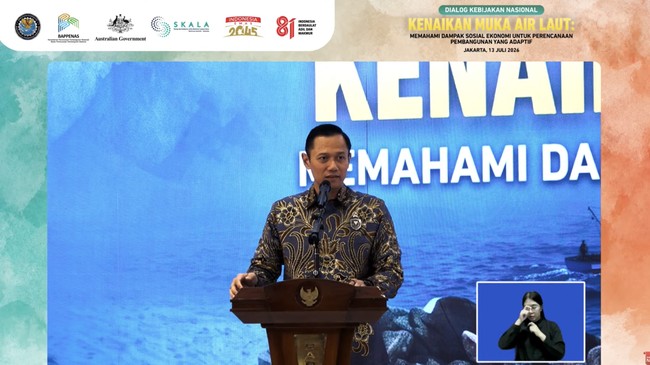
Coordinating Minister for Infrastructure and Regional Development Agus Harimurti Yudhoyono has stated that the Giant Sea Wall programme is not a Roro Jonggrang project, but a collective national endeavour. AHY said the construction of the sea wall must use a scientific and technocratic approach to ensure it is built appropriately.
“We need collective awareness from everyone to make this a success. This is not a Roro Jonggrang project; this is a project based on evidence, science and technocracy,” AHY said at Bappenas in Jakarta on Monday (13/7/2026).
Previously, AHY said the construction of the giant sea wall is a long-term undertaking spanning 10 to 20 years, as it requires a substantial budget and the construction process must proceed with caution.
He added that although construction will be carried out in stages, in Jakarta and Semarang — including the Kendal and Demak areas — the giant sea wall must be accelerated, as these are the worst-affected regions, where the ground surface has already fallen below sea level.
AHY explained that the danger of rising sea levels stems from global warming, which is causing Antarctic ice to melt. At the same time as sea levels rise, AHY said, there is another threat in the form of land subsidence.
“In Jakarta Bay, including Semarang, Demak and Kendal, the land can sink by an average of 5, 10, 15 or even 20 centimetres per year,” AHY said.
“So over 10 years, our land could sink by more than 2 metres,” he continued.
AHY said this land subsidence phenomenon is suspected to be caused by communities still drawing groundwater for clean water. Meanwhile, water demand in urban areas will grow heavier, as the population is expected to increasingly concentrate in cities.
“There are still tens of millions of families or households that draw their clean water from the ground, alongside the heavy burden of urban development. It is projected that 70% of Indonesians will live in large cities. This is something we need to mitigate together,” he said.
According to data from the IPCC, the Intergovernmental Panel on Climate Change, AHY said there are several scenarios resulting from rising sea levels. First, if sea levels rise by up to 0.6 metres, more than 22,000 square kilometres of Indonesia’s coastline could be affected and potentially submerged.
“Even worse, if sea levels rise by up to 1.2 metres, more than 49,000 square kilometres of land could be affected. This projection indeed extends to the year 2100,” AHY said.
Meanwhile, over the next 50 years, Indonesia could experience land subsidence of 0.74 centimetres per year, which is more severe than the global average of 0.4 centimetres per year.
“For Indonesia, whereas the global average is 0.4 centimetres per year, in Southeast Asia it is 0.5 to 0.7 centimetres per year. Indonesia, across a number of islands, could experience up to 0.74 centimetres over the next 50 years,” AHY explained.