
AHY and Ahmad Luthfi Plant Mangroves in Demak to Tackle Coastal Erosion
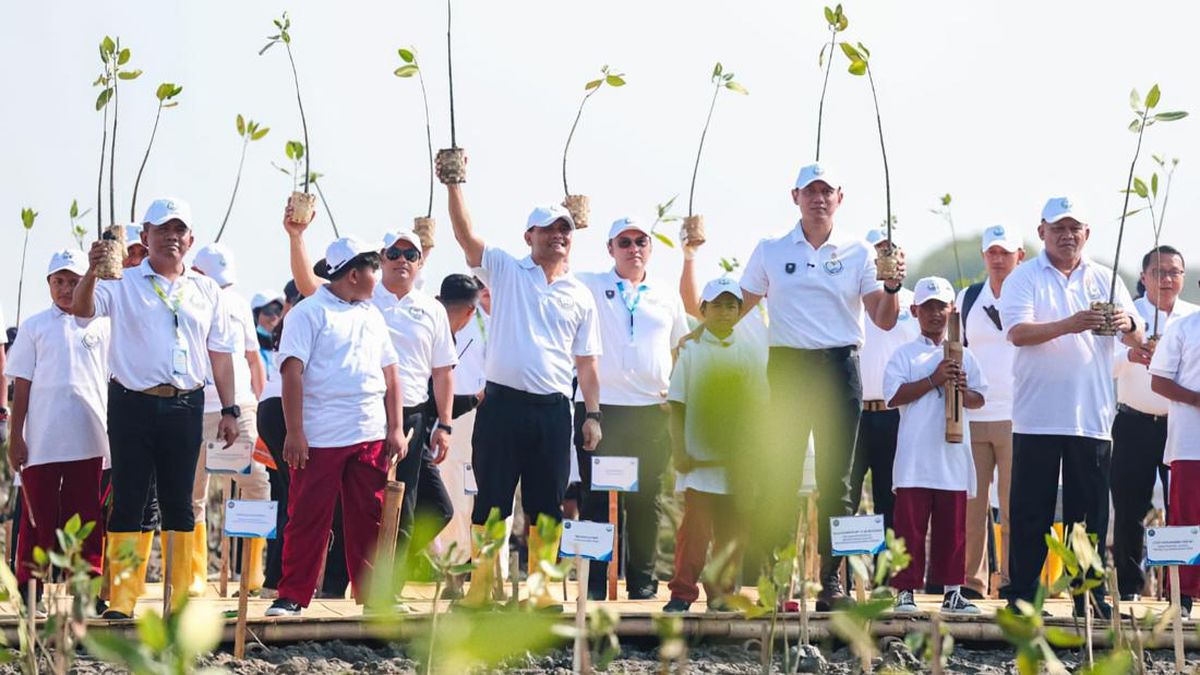
The government is stepping up efforts to protect the northern coast of Java (Pantura) from erosion, tidal flooding and land subsidence. One measure combines mangrove planting with the use of HexBricks technology.
Coordinating Minister for Infrastructure and Regional Development Agus Harimurti Yudhoyono (AHY) and Central Java Governor Ahmad Luthfi planted mangroves in Timbulsloko village, Sayung sub-district, Demak regency, on Monday (19 October).
The planting is part of the implementation of nature-based solutions (NbS) to strengthen coastal protection. HexBricks technology is being used to support more effective mangrove ecosystem restoration.
“Today’s effort is a preventive measure, namely planting mangroves,” Luthfi said.
He explained that Central Java has 651 kilometres of northern coastline spanning 17 regencies and municipalities.
The area faces various problems, from coastal damage and tidal flooding to land subsidence, and therefore requires an integrated response.
The Central Java provincial government has also previously launched the Mageri Segoro movement to strengthen coastal protection.
In 2025, the programme recorded the planting of around 2.34 million mangroves across 257 hectares in 107 villages, 54 sub-districts and 17 regencies and municipalities.
Luthfi said he hoped the use of HexBricks would help ensure the success of mangrove restoration along the coast.
HexBricks is an innovation developed by the National Research and Innovation Agency (BRIN), consisting of modular structures designed to support mangrove restoration.
The technology is being used alongside raised earth embankments and bamboo structures to develop a pilot site in Timbulsloko.
The site covers 6.56 hectares of mangrove area, with an initial planting covering 1,200 square metres.
Its effectiveness will be assessed by monitoring mangrove growth, sedimentation, the performance of the structures and benefits to the community.
AHY said mangroves help absorb the energy of sea waves, thereby reducing the impact of coastal erosion.
He said the use of HexBricks also offered economic benefits because the modules are produced by local residents.
“This also means creating jobs and providing income for people living in coastal areas,” he said.
According to AHY, protection of the Pantura coast will take a hybrid approach, combining physical infrastructure such as coastal and sea walls with nature-based solutions.
The approach forms part of a strategy to address rising sea levels and land subsidence, which threaten settlements and economic activity in coastal communities.
Didit Herdiawan Ashaf, head of the North Java Coast Management Authority (BOPPJ), said the work in Timbulsloko was a demonstration plot intended to explore how coastal protection can be adapted to local natural conditions.
“This may not necessarily be done in the same way elsewhere, because we need to study the different characteristics of each area together,” Didit said.
He also stressed that coastal protection along the Pantura must take account of people’s livelihoods, particularly those of fishers and fish farmers. Access to the sea and fish ponds will not be entirely blocked.
Source: jawawa.id (https://jawawa.id/newsitem/ahy-and-ahmad-luthfi-plant-mangroves-in-demak-to-tackle-coastal-erosion-1792396303)
Originally published by CNN Indonesia (https://www.cnnindonesia.com/nasional/20261019134605-25-1417038/ahy-ahmad-luthfi-tanam-mangrove-di-demak-untuk-atasi-abrasi-pantura), translated from Indonesian