
Ahead of Trump-Xi Meeting, US Experts Reveal China's Silent Strategy to Dominate AI
The competition for artificial intelligence (AI) supremacy between the United States and China is no longer merely about who can build the most sophisticated models. A number of experts in the US are warning that Beijing may be narrowing Washington’s technological advantage through a much quieter strategy: studying the capabilities of American AI models, deploying low-cost or free open-source models, and then expanding their use across various economic and security sectors.
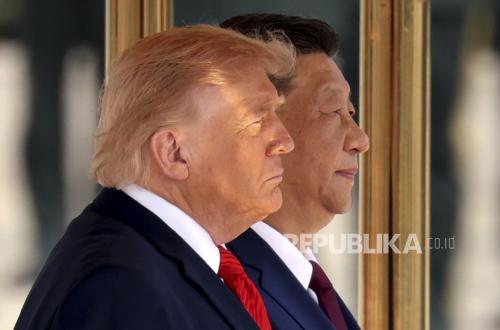
These warnings emerge ahead of Chinese President Xi Jinping’s visit to Washington to meet US President Donald Trump. AI is expected to be a key issue in the meeting between the two leaders amidst intensifying technological competition between the two nations. The Los Angeles Times reported that Washington and Beijing had actually agreed to discussions regarding AI security since Trump’s visit to Beijing in the spring, but progress has been slow.
Fox News Digital reported that several experts view this competition as more than just a conventional technological race. Leah Siskind, an AI researcher from the Foundation for Defense of Democracies (FDD), described it as a competition occurring across multiple fronts.
“I don’t think ‘race’ is the right metaphor to describe this,” Siskind told Fox News Digital. “I think it is more like a war on many fronts. In some places we are winning, while in others we are losing.”
According to Fox News, there are at least three primary concerns for the interviewed experts. First, the ability of Chinese companies to acquire knowledge from American AI models. Second, the expansion of Chinese open-source AI models that can be used at a much lower cost. Third, the potential use of AI for strategic interests, including cognitive warfare and systems operating in the physical world.
China’s Weapon Named ‘Free’
One battlefield attracting significant attention is open-source AI models. While US tech companies invest massive funds to develop cutting-edge AI systems, Chinese companies are also offering relatively cheap and open models to global users.
The Los Angeles Times reported that AI models created by Chinese companies have evolved into powerful systems that, in some cases, are cheaper to use than products from US-based companies. Beijing is also attempting to position itself as a supporter of the open-source AI community and promote a global AI governance framework.
Siskind believes this cost disparity could become a strategic issue for the US. Companies prioritising cost efficiency, she noted, might choose to use Chinese models.
“How can you compete with something that is free when American technology is very, very expensive?” Siskind asked.
She also questioned whether users can ensure that Chinese open-source models are free from government censorship or hidden vulnerabilities. This concern represents Siskind’s assessment and is not evidence that all Chinese open-source models contain backdoors.
China expert Gordon Chang, also interviewed by Fox News Digital, compared this strategy to the development of the solar panel industry. According to him, price and availability can be used by China to expand market share, eventually strengthening the position of Chinese companies within the global AI ecosystem.
“This is the tactic China used for solar panels,” said Chang.
The Issue of Knowledge Distillation
The competition also extends to how an AI model acquires capabilities from another. One term now drawing attention in Washington is ‘knowledge distillation’.
Generally, distillation is a technique that allows the capabilities of a larger model to be transferred or learned by a smaller model. The distillation technique itself is not inherently an illegal practice. The issue arises when the US accuses certain companies of using this method aggressively to extract exclusive capabilities from American AI models.
The Los Angeles Times reported that the FBI, National Security Agency (NSA), and Cybersecurity and Infrastructure Security Agency (CISA) issued a joint cybersecurity warning accusing Chinese AI developers of attempting to extract or distill the capabilities of several advanced US AI models.
Siskind stated that this technique could help Chinese companies shorten development processes that require massive computational costs. She pointed to the emergence of DeepSeek in 2025 as an example of how a Chinese company could demonstrate competitive AI capabilities with fewer resources compared to several US developers.
However, Washington’s accusations have been denied by Beijing. China’s Ministry of Commerce called the US allegations baseless, stating that distillation is a common technique used by many AI companies. Beijing also accused Washington of attempting to maintain dominance in the AI industry.
These differing perspectives highlight a fundamental issue in the US-China AI competition. A technique that, in the research world, can be used to increase model efficiency is now being viewed through the lens of national security and geopolitical competition.
Source: jawawa.id (https://jawawa.id/newsitem/ahead-of-trump-xi-meeting-us-experts-reveal-chinas-silent-strategy-to-dominate-ai-1790203888)
Originally published by Republika (https://news.republika.co.id/berita/tltoyn451/jelang-pertemuan-trumpxi-pakar-as-ungkap-strategi-senyap-china-kuasai-ai), translated from Indonesian