
Ahead of the Planting Season, Pupuk Indonesia Prepares 1.81 Million Tonnes of Fertiliser Stocks
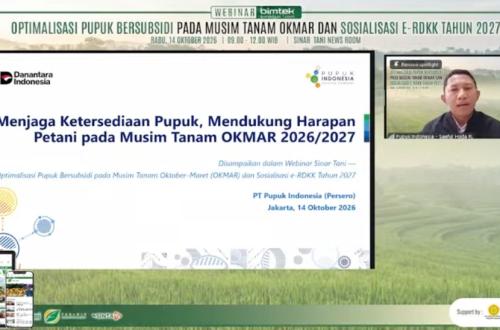
JAKARTA — State-owned fertiliser company PT Pupuk Indonesia (Persero) has confirmed that 1.81 million tonnes of fertiliser are available nationwide for farmers ahead of the October–March planting season. This includes 1.39 million tonnes of subsidised fertiliser, which is above the safety-stock threshold, and 420,000 tonnes of non-subsidised fertiliser available through authorised outlets across Indonesia.
“Subsidised fertiliser redemptions average around 30,000 tonnes a day, so the subsidised stocks we have prepared can meet the needs of registered farmers for the next 46 days. At the same time, we are continuing to build stocks to maintain supply throughout the October-to-March planting season,” said Saeful Huda Rijaludin, Pupuk Indonesia’s vice-president for retail sales planning. He was speaking at a webinar on optimising subsidised fertiliser during the October–March planting season and introducing the 2027 e-RDKK, organised by Sinar Tani on Wednesday (14 October 2026).
As of 12 October 2026, national subsidised fertiliser stocks comprised 838,825 tonnes of urea, 460,299 tonnes of NPK and 18,733 tonnes of special NPK fertiliser for cocoa. There were also 57,845 tonnes of organic fertiliser, 11,105 tonnes of SP-36 and 3,783 tonnes of ZA.
Non-subsidised stocks included 358,973 tonnes of urea, 22,912 tonnes of NPK and 37,669 tonnes of ZA. Farmers not listed in the electronic Definitive Group Needs Plan (e-RDKK) can make use of these non-subsidised stocks.
Pupuk Indonesia is making every effort to maintain supplies of subsidised fertiliser in accordance with government regulations, so that fertiliser is available at official subsidised-fertiliser distribution outlets (PPTS) and can be redeemed by farmers in line with the rules, Huda said.
The company is also seeking to ensure that subsidised fertiliser is distributed according to the “7T” principles: the right type, quantity, price, place, time, quality and target recipient. By 9 October 2026, national distribution had reached 7.1 million tonnes, or 72.11 per cent of the total allocation set by the government.
To strengthen oversight, Pupuk Indonesia operates a command centre that enables digital, real-time monitoring of fertiliser movements from factories to farmers. CCTV has also been installed at all warehouses to monitor conditions and actual stock levels. The company can additionally track redemption transactions using each farmer’s national identity number (NIK).
“We can monitor distribution from upstream to downstream and check for operational or administrative problems. We can also verify stocks properly,” Huda said.
Alongside stock and distribution preparations, Pupuk Indonesia is encouraging the optimisation of data entry for the 2027 e-RDKK. The data-entry period, open until 25 October 2026, is an important step in ensuring subsidised fertiliser is allocated to eligible farmers.
Huda said accurate farmer data was fundamental to ensuring that subsidised fertiliser reached the right recipients. He urged agricultural extension workers and other relevant parties to improve data collection and ensure farmers’ needs were recorded correctly.
“With stocks ready, distribution networks strengthened and digitally based oversight in place, Pupuk Indonesia is committed to carrying out the government’s mandate as effectively as possible. These efforts are expected to support farmers during the October 2026–March 2027 planting season and strengthen the drive towards national food self-sufficiency,” he said.
Meanwhile, Yustiana Retno Widjawati, head of the Subsidised Fertiliser Allocation Working Team at the Agriculture Ministry’s Directorate of Fertiliser, said farmers could still redeem 2,769,963 tonnes from the subsidised fertiliser allocation. To make the best use of the remaining quota, the government has reallocated it based on redemption rates in each province.
“Allocations from provinces with low redemption rates have been transferred to provinces where redemption is higher. This is to ensure that the available allocation is used as effectively as possible to meet farmers’ needs,” she said.