
Ahead of the Christmas and New Year Holidays, Trade Minister and Mayor Check Prices and Supplies at Beringharjo Market
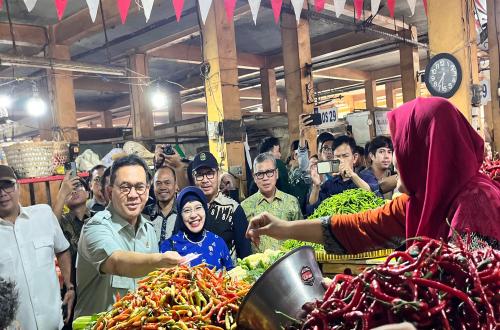
Hasto said prices for a number of staple goods at Beringharjo Market remained relatively stable and affordable. Checks conducted with the Trade Minister found that almost all food commodities sold by traders were below their maximum reference prices.
“We are grateful that market prices remain relatively stable as of today, 26 November 2026, as the Minister has just checked. Almost all the food prices here are below the maximum reference prices,” Hasto said in an interview at Beringharjo Market on Thursday (26 November 2026).
Hasto explained that Yogyakarta City Government was continuing efforts to maintain price stability, including through the Warung Masyarakat Lan Pedagang Tanggap Inflasi (Mrantasi) programme and Segoro Amarto kiosks. These outlets offer staple goods at reduced prices through government subsidies.
He said the outlets also provided an indicator of staple food prices in the wider market. When market prices rise, people usually switch to government-run shops offering more affordable prices.
“I checked the Segoro Amarto and Mrantasi outlets earlier, and they were not particularly busy. That is a good sign, because residents are still shopping at the market at normal prices. If market prices rise, people will go to our outlets, the local government’s outlets. That is what we need to monitor,” he said.
As well as monitoring prices, Hasto said he was ensuring that stocks remained available and supply chains operated smoothly. This work is carried out through regular meetings of the Regional Inflation Control Team (TPID) and monitoring involving several local government agencies, including the Agriculture Office.
Yogyakarta City Trade Office head Veronica Ambar Ismuwardani said several commodities were receiving particular attention ahead of the Christmas and New Year holidays. These included cooking oil, sugar and flour, which usually see increased demand during the holiday period.
To anticipate price volatility, the city government regularly monitors prices through the Market and Essential Goods Monitoring System (SP2KP). Staff are sent to check prices in person at markets every day.
“Every day, staff go to the market to ask about prices. They have to be at the market by 6 am, and their reports must be submitted by 7 am,” Veronica said.
SP2KP monitoring is also an important tool for the government to track daily movements in staple food prices. Staff continue to submit reports seven days a week.
“SP2KP in Yogyakarta City is still the best,” she said.
Based on checks at Beringharjo Market, Trade Minister Budi Santoso said several commodities were still priced below their reference levels. Shallots were selling for around Rp32,000-Rp33,000 per kilogram, against a reference price of Rp41,500 per kilogram.
Garlic was selling for around Rp37,000-Rp38,000 per kilogram, while unpeeled garlic was around Rp28,000 per kilogram. Bird’s eye chillies had risen slightly to around Rp60,000 per kilogram, above the reference price of Rp57,000.
Large red chillies were selling for around Rp36,000-Rp37,000 per kilogram, well below their reference price of Rp55,000. Eggs were around Rp25,000 per kilogram, compared with a reference price of Rp30,000, while chicken was around Rp35,000 per kilogram against a reference price of Rp40,000.
“So, in fact, prices are fairly stable,” Budi said.
To ensure supplies are distributed more evenly and prevent price increases in particular areas, the Trade Ministry is also expanding its Inter-Island Trade (PAW) programme, which facilitates the movement of commodities from surplus regions to areas in need.
Budi said the government had previously sent seven tonnes of chillies to North Halmahera. A similar measure would be taken for maize from West Nusa Tenggara (NTB), which is to be distributed to Central Java.
“We continue to help by using SP2KP data and Statistics Indonesia data, which allow us to see the situation,” he said.
He said inter-regional distribution was planned using data from SP2KP and Statistics Indonesia (BPS) to identify areas with surpluses or shortages. The government is also working with regional administrations and Bank Indonesia to help cover shipping costs and ensure that distribution runs smoothly.
“This means our goods can be distributed properly and prices can be even,” Budi said.
He added that the government had an online price-monitoring system, SP2KP, covering more than 500 markets in 514 regencies and cities. However, direct market inspections would continue to verify that conditions on the ground matched the reports received by the government.
BPS head Amalia Adininggar Widyasanti said BPS staff also monitored prices at Beringharjo Market every week.
Amalia added that the November 2026 Price Development Index (IPH) monitoring showed that prices for several commodities in Yogyakarta City were trending downwards.
Source: jawawa.id (https://jawawa.id/newsitem/ahead-of-the-christmas-and-new-year-holidays-trade-minister-and-mayor-check-prices-and-supplies-at-1795704676)
Originally published by Republika (https://rejogja.republika.co.id/berita/tp43lg291/jelang-nataru-mendag-danwali-kota-cekharga-dan-ketersediaan-bahan-pokok-di-pasar-beringharjo), translated from Indonesian