
Ahead of the 81st TNI Anniversary, How Strong is Indonesia's Military in ASEAN?
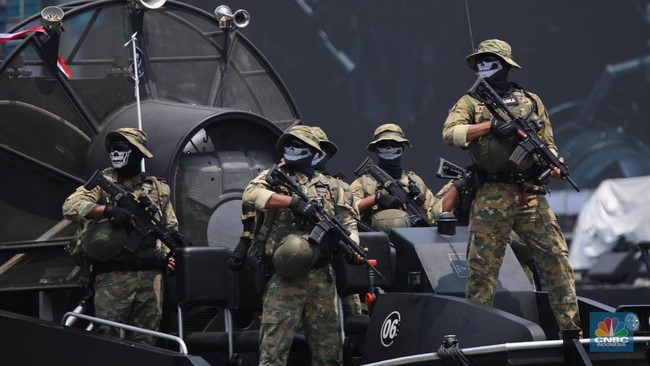
Ahead of the 81st anniversary of the Indonesian National Armed Forces (TNI) on Monday, 5 October 2026, it is worth examining Indonesia’s military strength in comparison to other Southeast Asian nations. For over eight decades, Indonesia’s defence capabilities have been continuously strengthened through personnel development, the modernisation of main weapon systems (alutsista), and increased strength across land, sea, and air domains.
Based on the latest Global Firepower (GFP) 2026 rankings, Indonesia ranks first as the strongest military power in Southeast Asia. Globally, Indonesia sits at 13th place out of 145 countries with a PowerIndex score of 0.2582, positioned just below Germany (12th) and above Pakistan and Israel (14th and 15th respectively). Global Firepower utilises over 60 indicators, including personnel, air, land, and sea strength, financial capability, natural resources, logistics, and geographical conditions. In the GFP calculation, a score closer to zero indicates a stronger conventional military capability.
Indonesia leads Southeast Asia, with Vietnam following closely in 23rd place globally with a PowerIndex of 0.4066. Thailand ranks 24th, followed by Singapore at 29th, Myanmar at 35th, the Philippines at 41st, and Malaysia at 42nd.
Despite being the overall leader, Indonesia does not lead in every individual indicator. Vietnam, Thailand, and Singapore each possess advantages in specific sectors. For instance, Vietnam possesses 450,000 active personnel and approximately 5 million reservists, the latter being the largest reserve force in the world according to 2026 GFP data. Vietnam also excels in land power, with 1,999 tanks and 69,914 military vehicles, meaning its tank count is nearly six times that of Indonesia. Thailand leads in military aircraft with 496 units, compared to Indonesia’s 460. Meanwhile, Singapore maintains the largest defence budget in the region at approximately US$18 billion and relies heavily on technology, boasting 100 fighter jets compared to Indonesia’s 41.
One of Indonesia’s most prominent strengths lies at sea. Global Firepower notes that Indonesia possesses 338 naval assets, the highest in Southeast Asia, ranking 5th globally in terms of fleet size. This fleet includes 10 frigates, 2lag corvettes, four submarines, 211 patrol vessels, and 10 minesweepers. In terms of tonnage, the Indonesian fleet reaches approximately 324,754 tonnes, ranking 11th globally. This maritime strength is driven by Indonesia’s status as an archipelagic nation with vast waters. Indonesia also boasts 123 ports and trade terminals, and a merchant fleet of 11,422 units, the largest among the 145 countries evaluated.
Indonesia’s naval strength has been further bolstered by the arrival of the KRI Sriwijaya-100, the first aircraft carrier to strengthen the Indonesian Navy. Formerly the Italian Navy’s ITS Giuseppe Garibaldi, the vessel is approximately 180 metres long and capable of operating helicopters and drones, enhancing capabilities for both defence and humanitarian missions.
In terms of human resources, Indonesia has approximately 404,500 active personnel, 401,000 reservists, and 250,000 paramilitary personnel, bringing the total estimated military and paramilitary strength to around 1.06 million people. Financially, GFP records Indonesia’s defence budget at approximately US$11.16 billion, the second largest in Southeast Asia, surpassed only by Singapore. Supported by a large population, naval strength, natural resources, economic capability, and an extensive logistics network, Indonesia remains the top military power in Southeast Asia according to the Global Firepower 2026 rankings.
Source: jawawa.id (https://jawawa.id/newsitem/ahead-of-the-81st-tni-anniversary-how-strong-is-indonesias-military-in-asean-1791035478)
Originally published by CNBC Indonesia (https://www.cnbcindonesia.com/research/20261003112632-128-773042/jelang-hut-tni-ke-81-seberapa-kuat-militer-indonesia-di-asean), translated from Indonesian