
Ahead of MSCI Announcement, Rupiah Plunges to Rp 17,500 Level
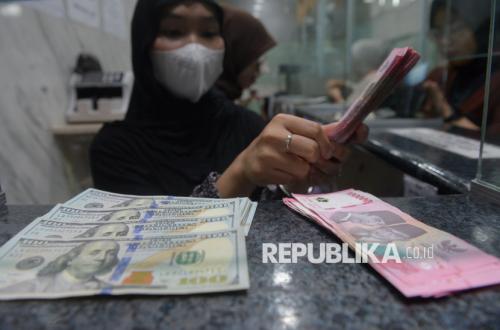
REPUBLIKA.CO.ID, JAKARTA – The rupiah exchange rate against the US dollar plunged towards the level of Rp 17,500 per US dollar on Tuesday (12/5/2026). The weakening of the Garuda currency occurred ahead of the Morgan Stanley Capital International (MSCI) announcement regarding the index rebalancing.
Citing Bloomberg, the rupiah weakened by 91 points or 0.52 percent to Rp 17,505 per US dollar in Tuesday’s trading (12/5/2026). In the previous trading session, the rupiah closed weaker at Rp 17,414 per US dollar.
It is known that MSCI will announce the index rebalancing, including the Indonesian capital market, scheduled for 12 May 2026 New York time or 13 May 2026 Indonesian time. The MSCI index serves as a primary benchmark in determining investment allocations for many global funds, making it quite crucial.
The MSCI index announcement some time ago significantly shook the Indonesian capital market. MSCI temporarily halted the increase in weight and the addition of Indonesian stocks to the global index.
The Composite Stock Price Index (IHSG) experienced a very deep fall as a result of that announcement. Even officials from the Indonesia Stock Exchange (BEI) and the Financial Services Authority (OJK) resigned.
This MSCI index announcement is also eagerly awaited by market participants. The regulator itself believes that reforms to the integrity of the Indonesian capital market will bring long-term benefits (long-term gain), even though it may trigger changes in the composition of stocks in the MSCI index in the rebalancing results.
“With the improvements and integrity reforms we are carrying out, there will certainly be impacts. And even if there are short-term adjustments, we see this as short-term pain, but InshaAllah long-term gain,” said OJK Commissioner Council Chair Friderica Widyasari Dewi to reporters at the BEI Building, Jakarta, on Monday (11/5/2026).
Friderica, often called Kiki, assessed that the potential change in the composition of Indonesian stocks in the MSCI index is a consequence of fundamental improvements to the capital market. This includes strengthening information transparency, market integrity, and law enforcement.
“Well, they (MSCI) have already said freeze, so no new stocks will enter the MSCI index, but the old ones might exit. But we’ll see, hopefully we can anticipate this well,” she said.
Kiki asked market participants not to overreact to the upcoming MSCI rebalancing results. According to her, potential index adjustments due to capital market reforms are short-term consequences that need to be viewed as part of strengthening the fundamentals of Indonesia’s financial market.
“So don’t let people keep getting panicked and so on. This is indeed a consequence of the improvements we are making,” said Kiki.
Regarding the potential downgrade of Indonesia’s status from emerging market to frontier market, Kiki said that decision will only be reviewed by MSCI in June 2026. Various improvements made by the regulator are hoped to be considered by MSCI to maintain Indonesia in the emerging market group.
According to her, Indonesia has good quality information transparency and data granularity, including in terms of market integrity which has long been a concern for global investors. Kiki also assured that the regulator continues to make fundamental improvements to the capital market through eight reform actions, including strengthening law enforcement, improving the quality of listed companies, and efforts to encourage more investors to enter the domestic capital market.
In addition, OJK continues to deepen the financial market through increasing the domestic investor base, both retail and institutional. Market deepening is seen as important to strengthen the resilience of the Indonesian capital market against global turbulence.
“Twenty years ago, if there was a global shock, everyone panicked because if there was an outflow, it was all foreign content. Now, our investors (domestic) are already 26 million and there are more and more investors, both retail and institutional, entering the Indonesian capital market,” said Kiki.