
Ahead of Jakarta's 500th Anniversary, Academics Highlight the 'Imperialism' of Foreign Languages in Public Spaces
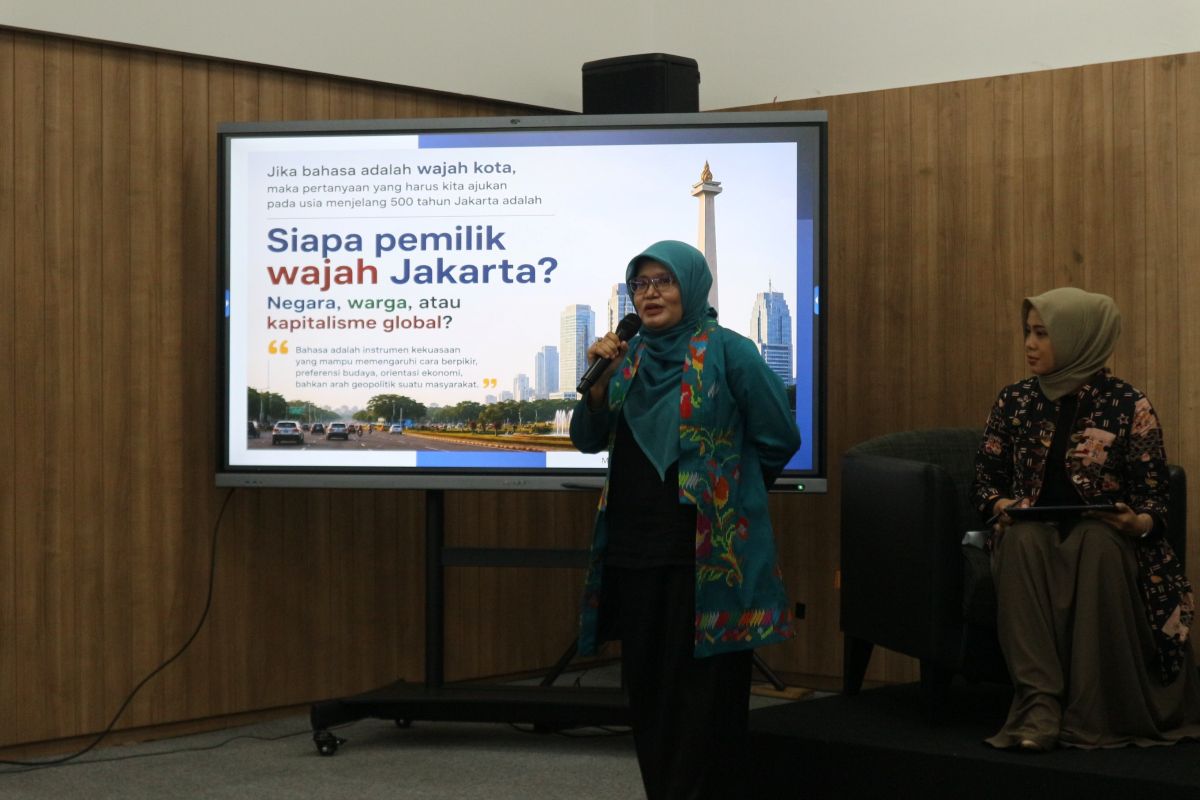
As Jakarta approaches the commemoration of its 500th anniversary, attention on the city’s development is turning not only to infrastructure, transport and the economy, but also to the linguistic identity that shapes the face of the capital. This was stated by Miftahulkhairah Anwar, a linguistics lecturer at Jakarta State University (UNJ), speaking at the Jakarta Cultural Symposium themed “Cultural Work Synergy Towards 500 Years of Jakarta”, held on 9 July 2026 at Artotel Taman Ismail Marzuki, Jakarta.
The event was organised by the DKI Jakarta Provincial Culture Office in cooperation with the Betawi Cultural Institute (LKB) and the Indonesian Literature Programme at Jakarta State University, as part of efforts to formulate the direction of Jakarta’s cultural development ahead of its 500th anniversary in 2027.
In her presentation, Miftahulkhairah Anwar revealed the findings of a linguistic landscape study showing the growing dominance of foreign languages in public spaces. The phenomenon is visible in the names of shopping centres, healthcare services, culinary establishments, trade, services, and even residential areas, which use far more foreign terms than Indonesian.
According to her, the linguistic landscape is not merely a collection of signboards or advertisements, but a representation of the city’s identity and a mirror of a society’s cultural direction.
“Language is the face of the city. When Jakarta’s public spaces are increasingly filled with foreign terms, we need to ask: whose face are we actually presenting as Jakarta approaches 500 years?” said Miftahulkhairah.
She explained that the massive use of foreign languages is not merely a matter of language choice, but can be read as a symptom of linguistic imperialism — a condition in which global languages gain legitimacy as more modern, professional, classy and economically valuable, while Indonesian and Betawi increasingly lose their space for representation in public spaces.
If this phenomenon continues without balance, she warned, various consequences may emerge, including a decline in the vitality of Indonesian vocabulary, reduced lexical productivity, the formation of language hierarchies in society, and the fading of Jakarta’s linguistic identity as the nation’s capital.
Nevertheless, Miftahulkhairah stressed that the solution is not to reject the use of foreign languages. On the contrary, Jakarta as a global city still requires openness to international languages. The main challenge is striking a balance between global competitiveness and the strengthening of national identity.
As a solution, she offered a Linguistic Entrepreneurship approach — a strategy for developing the Indonesian language through the creation of terms that are not only linguistically correct, but also possess aesthetic appeal, economic value and brand power capable of competing with foreign terms in public spaces.
Through this approach, Indonesian is positioned not merely as a language mandated by regulation, but as an economic and cultural asset capable of boosting the competitiveness of businesses while strengthening the city’s identity. She also proposed that the DKI Jakarta Provincial Government initiate the development of premium Indonesian equivalents for the business world, so that entrepreneurs have naming alternatives that are modern, elegant and highly commercially valuable without having to rely on foreign terms.
According to her, Jakarta’s development towards becoming a global city must go hand in hand with strengthening its linguistic identity.
“Becoming a global city does not mean making Indonesian and Betawi guests in their own land. A world-class city is precisely one that is able to go global without losing its linguistic identity,” she asserted.
Closing her presentation, Miftahulkhairah invited all stakeholders to make the momentum of Jakarta’s 500th anniversary a turning point for building a modern city rooted in national identity and local culture.
“Jakarta may speak to the world, but the world must also come to know Jakarta through its language,” she concluded.
Source: jawawa.id (https://jawawa.id/newsitem/ahead-of-jakartas-500th-anniversary-academics-highlight-the-imperialism-of-foreign-languages-in-public-spaces-1783673456)
Originally published by Media Indonesia (https://mediaindonesia.com/megapolitan/909539/jelang-500-tahun-jakarta-akademisi-soroti-dominasi-bahasa-asing-di-ruang-publik-sebagai-gejala-imperialisme-bahasa), translated from Indonesian