
Ahead of Eid al-Adha, Government Ensures Safe and Controlled Food Stocks
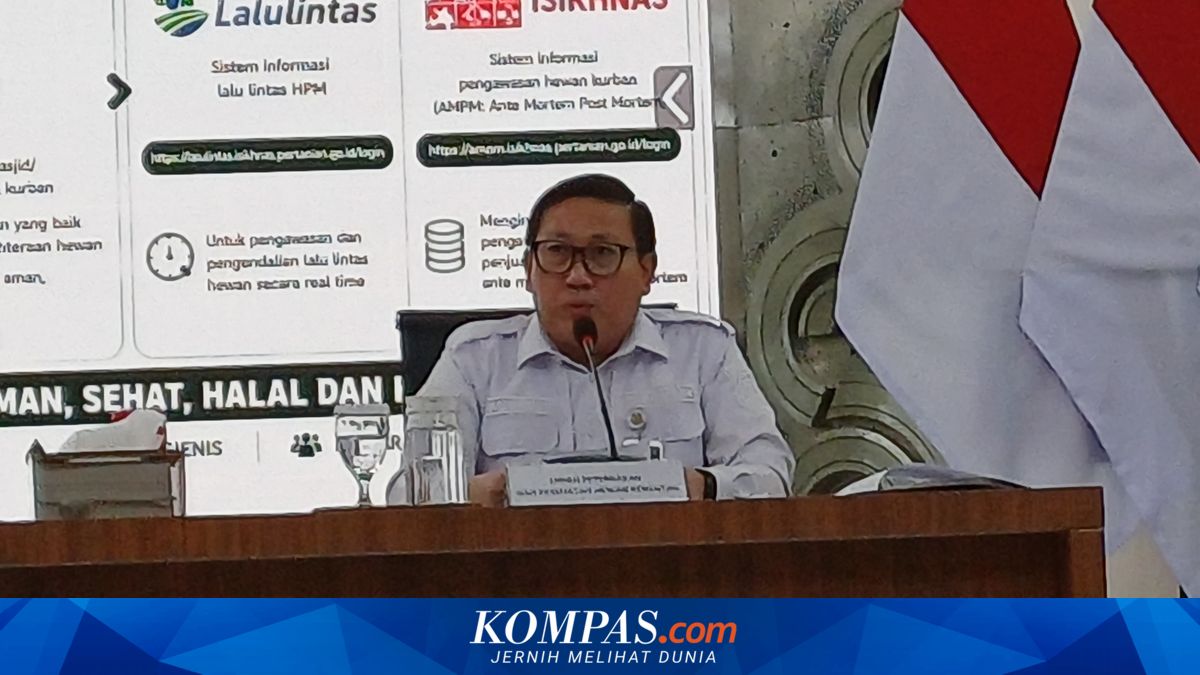
JAKARTA - The government, through the Ministry of Agriculture, has assured that food stocks ahead of Eid al-Adha 1447 Hijriah are in a safe and controlled condition.
Director General of Livestock and Animal Health (Dirjen PKH) of the Ministry of Agriculture (Kementan), Agung Suganda, stated that President Prabowo Subianto’s directives emphasise that food is a matter of national sovereignty.
“The availability of strategic food items such as rice, corn, soy, shallots, garlic, chillies, meat and chicken eggs, consumer sugar, and beef or buffalo is sufficiently safe and controlled,” Agung said during a press conference at the Office of the Indonesian Government Coordinating Agency, Gambir, Central Jakarta, on Wednesday (13/5/2026).
Meanwhile, the government’s rice reserve (CBP) currently stands at 5.29 million tonnes, the highest in Indonesia’s history.
He also mentioned that production of chicken meat, chicken eggs, and shallots is experiencing a surplus, with some portions already exported to various countries.
For Eid al-Adha 2026, the government records a potential availability of sacrificial animals reaching 3,246,790 heads, while the estimated need is around 2,355,470 heads.
“There is a surplus of about 891,320 heads, so nationally, the condition or availability of sacrificial animals is safe, sufficient, and controlled,” he stressed.
For buffalo, 33,952 heads are available against a need of 12,914 heads, resulting in a surplus of 21,038 heads.
Meanwhile, goat availability reaches about 1.4 million heads with a need of 1.08 million heads, or a surplus of 332,861 heads.
As for sheep, 935,690 heads are available with a need of 466,086 heads, thus a surplus of 469,604 heads.
He added that the need for sacrificial animals in 2026 is projected to increase by around 3.82 percent or 86,727 heads compared to the previous year.
“The government continues to regulate the distribution of sacrificial animals from production areas and surplus regions to areas that are still in deficit, so that supplies are evenly distributed and prices are also controlled,” he concluded.