
Ahead of COP31, Young People from 18 Provinces Urge Government to End Criminalisation of Environmental Activists
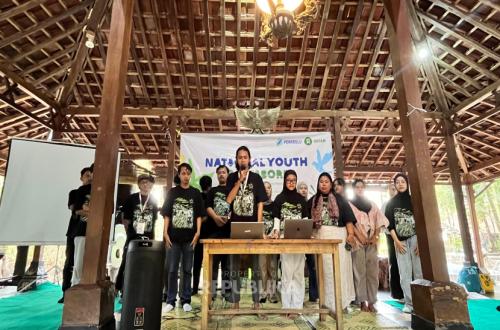
The demands were set out in a statement drafted at the National Youth Jamboree, held at Omah Petroek in Yogyakarta from 27 to 29 October 2026. The event brought together 31 participants from 18 provinces to discuss issues in their regions, ranging from environmental damage to social, economic and political conditions.
Krayon Ahmad Zulfikor, a facilitator at the jamboree, said the climate crisis could not be separated from questions of democracy and social inequality. Communities defending the environment, he said, often faced broader challenges, including development policies and extractive industries that threatened their livelihoods and living spaces.
He said young people therefore wanted to be involved in decisions affecting the environment and their future.
“What we want is for older people to listen to us and involve us in every decision-making process, because the future belongs to us and the generations after us,” Krayon said on Thursday (29 October 2026).
In their statement, the Indonesian Youth Network presented five demands to the government, the House of Representatives (DPR RI) and Indonesia’s COP31 delegation, each within their respective authority.
First, they called on the government to stop relying on false solutions to the climate crisis. They urged it to review policies presented as climate action but which, they said, perpetuated dependence on fossil fuels or created opportunities to exploit natural resources.
Second, they called for ecological justice through an end to exploitation and the restoration of communities’ living spaces. This included reviewing problematic business permits, restoring damaged areas and holding those responsible for environmental destruction to account.
Third, they urged the government to pass the Indigenous Peoples Bill without delay and recognise customary territorial rights. They said legal certainty was needed to protect Indigenous peoples’ land, forests and livelihoods.
Fourth, they called for an end to the criminalisation and discrimination of marginalised groups, human rights defenders and environmental activists. They urged the state to guarantee freedom of expression and protect communities defending their rights to land and a healthy environment.
Fifth, they demanded full investigations into environmental crimes and accountability for those responsible. Law enforcement, they said, should address forest and land fires, industrial pollution and forest destruction, alongside environmental restoration and the fulfilment of victims’ rights.
Krayon said the five demands were interconnected.
“They are all crucial. For us, there is no hierarchy of priorities among these issues; they are all equally important,” he said.
Opposition to extractive mining and plantation permits
Krayon said the jamboree had also discussed ending permits for extractive and exploitative mining and plantation operations.
Participants’ experiences from different regions showed, he said, that environmental damage was not an abstract issue but one that directly affected people’s lives. Among its consequences were forest and land fires that exposed residents to smoke.
Krayon recounted the experience of a participant from Kalimantan who was in the Kaliurang area of Yogyakarta.
“There are friends from Kalimantan. One of them told us, ‘Oh, so this is what fog feels like.’ Because we breathe smoke every day,” he said, quoting the participant.
That experience was one example of the environmental problems participants brought to the forum. They also discussed how development policies affected communities’ living spaces and the importance of pushing for policy changes in their respective regions.
Although the discussions covered a range of concerns, Krayon said the group did not treat any single issue as the sole priority. Environmental, democratic, social and economic problems, he said, were all urgent.
“We will voice the statement nationally. Then we will also promote it internationally through the Power to Voice platform, a social media platform for activists from across the world and every continent,” he said.
“We will do so using that platform and social media platforms, with the help of all our friends,” he added.
Riza Ihda Aulannisa, a participant from Bandung, West Java, said the forum gave her an opportunity to discuss urban planning and local government policies with young people from other regions. She said some development projects in Bandung risked eroding the distinctive character of the city.
“I think there are many examples of improper government practices in West Java, particularly in Bandung,” Riza said.
Riza also said she wanted to raise young people’s awareness of climate issues. In her view, engagement among her generation needed to broaden so that it did not arise only when an issue was widely discussed on social media.
“I will certainly try to encourage young people to become more climate-aware, because people my age rarely pay attention to climate issues,” she said.