
Ahead of 81st Independence Day, Phase II Rice Aid Prepared for 33.24 Million Families
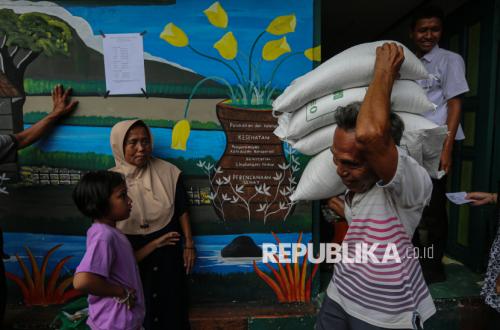
The government is preparing the distribution of Phase II Rice Food Assistance to 33.24 million beneficiary families across Indonesia. This programme forms part of efforts to maintain food access, protect public purchasing power, and strengthen rice price stability in the second half of 2026.
A total of 997.2 thousand tonnes of rice has been prepared to meet the assistance allocation for July, August, and September 2026. Each beneficiary family will receive 10 kilograms of rice per month, or a total of 30 kilograms, which is planned to be distributed all at once starting 17 August 2026. The one-shot distribution scheme for three months was chosen so that the benefits of the assistance can be received more quickly by the public.
The National Food Agency (Bapanas) has confirmed that the assistance uses the National Socio-Economic Single Data (DTSEN) version 3 of 2026. Updating beneficiary data is important to ensure the assistance reaches families who genuinely need it and to reduce the risk of misdirected aid.
Coordinating Minister for Food Zulkifli Hasan previously explained the scale of assistance prepared by the government. “Three times, or for three months, ten kilos times 33,244,000. So approximately one million tonnes,” said Zulkifli.
Funding certainty has also been secured. On 28 July 2026, Bapanas announced that the Ministry of Finance had approved an Additional Budget of Rp 17.52 trillion for the three-month rice food assistance. As such, the figure is no longer merely a proposal. Following approval, the budget is processed into a Budget Section Budget Allocation Determination Letter, or SP SABA, as part of the administrative stages before the assignment is carried out.
Bapanas Deputy for Food Availability and Stabilisation I Gusti Ketut Astawa confirmed that the distribution scheme will be carried out all at once for three months so that the assistance can be rolled out immediately.
“The approval is for 3 months. The budget of Rp 17.52 trillion has been obtained.”
Programme readiness is supported by the Government Rice Reserve, which remains at a very high level. An official Bapanas update on 28 July 2026 recorded Government Rice Reserve stocks in all Perum BULOG warehouses at 5.25 million tonnes.
Previously, Perum BULOG President Director Ahmad Rizal Ramdhani stated on 13 July 2026 that rice stocks controlled by BULOG were in the range of 5.4 million tonnes. The difference in figures reflects changes in stock levels due to procurement, processing, and distribution of various government programmes.
The large stock gives the government room to carry out food assistance without reducing its ability to maintain supply and price stability. At the same time, BULOG continues to absorb domestically produced grain and rice so that government reserves remain supported by national farmers’ output.
Bapanas also assesses that distributing nearly one million tonnes of rice directly to beneficiary families can help curb price pressure at the consumer level. When part of household needs is met through food assistance, demand pressure in the market can be reduced, so the programme functions not only as social protection but also as an instrument of price stabilisation.
Phase II Rice Food Assistance is a continuation of the first phase for the February and March 2026 allocation. The first phase reached 33.14 million families, or 99.7 percent of the target, with total rice distributed amounting to 664.88 thousand tonnes. If the Phase II target of 997.2 thousand tonnes is realised, total rice food assistance throughout 2026 could reach approximately 1.66 million tonnes.
The government has also requested that the quality of distributed rice be maintained. Perum BULOG carries out quality inspections and stock readiness checks before distribution, so that the assistance received by the public meets standards and is fit for consumption.
Ahead of the 81st Anniversary of the Republic of Indonesia, the distribution of Phase II Rice Food Assistance carries the message that the strength of food reserves must translate into tangible benefits for the public. Self-sufficiency and high rice stocks are reflected not only in full warehouses, but also in the state’s ability to ensure that vulnerable families continue to have access to food.
Through the distribution of 30 kilograms of rice for each beneficiary family, the government seeks to ensure that farmers’ production and national food reserves can serve as a buffer for the public while strengthening national food stability.
Source: jawawa.id (https://jawawa.id/newsitem/ahead-of-81st-independence-day-phase-ii-rice-aid-prepared-for-33-24-million-families-1786362810)
Originally published by Republika (https://news.republika.co.id/berita/tjjww7368/jelang-hut-ke81-ri-bantuan-tahap-ii-disiapkan-untuk-3324-juta-keluarga), translated from Indonesian