
Agriculture Ministry Targets Soybean Yields of 3 Tonnes per Hectare to Cut Imports
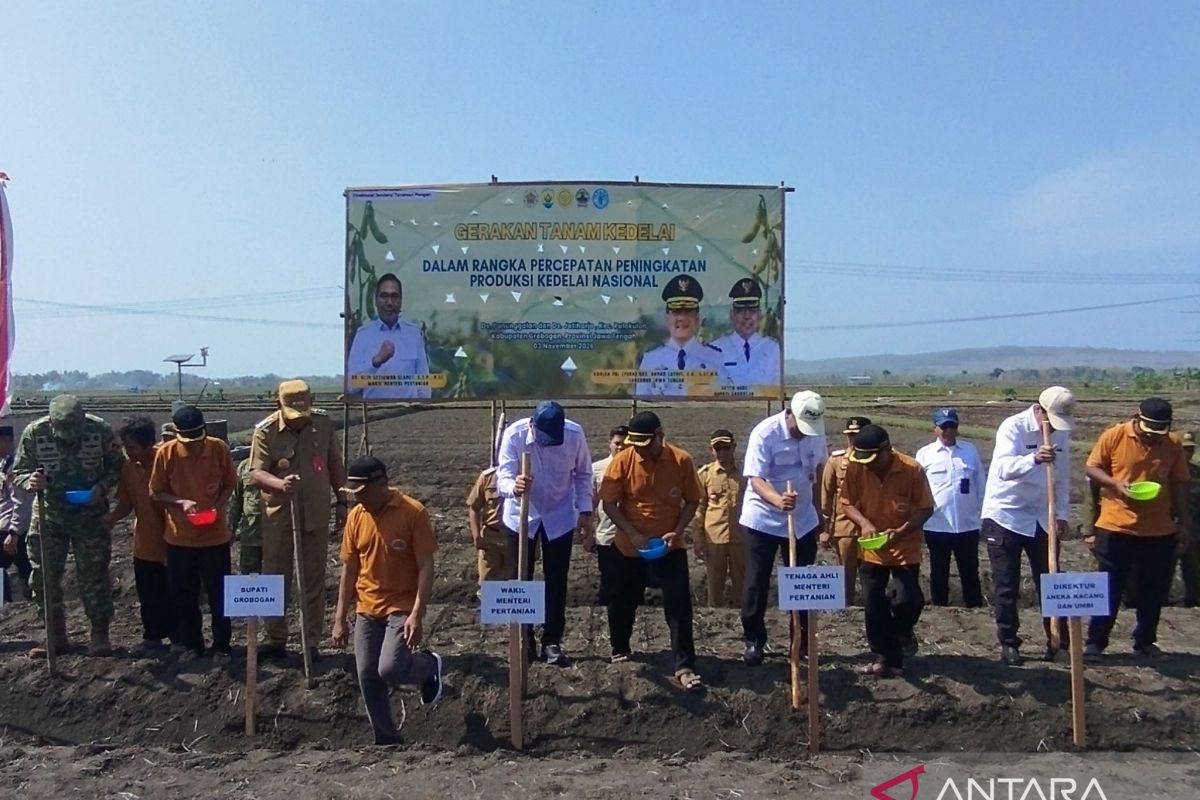
The Agriculture Ministry is seeking to increase soybean productivity to 3 tonnes per hectare across a target area of 50,000 hectares, in an effort to reduce dependence on imports.
“Soybean productivity has previously averaged 1.6–1.8 tonnes per hectare. We are now aiming to raise it to 3 tonnes per hectare. This effort will be carried out through a government seed assistance programme covering 50,000 hectares,” Deputy Agriculture Minister Alim Setiawan Slamet said on Tuesday at a soybean planting event in Panunggalan village, Pulokulon sub-district, Grobogan regency, Central Java. The event was held to accelerate growth in soybean production.
He said that if yields on the 50,000 hectares could be optimised to 3 tonnes per hectare, the government’s seed assistance programme could generate 150,000 tonnes of soybeans.
He added that increasing soybean production was one of the government’s efforts to reduce import dependence. Soybeans are a major source of protein for Indonesians, particularly as the raw material for tempeh and tofu. However, much of the country’s soybean demand is still met by imports.
The Agriculture Ministry estimates that soybean imports will reach 2.5–2.6 million tonnes this year. About 1.9 million tonnes had been imported by this month.
“Soybeans are one of the main sources of protein. Most people consume tempeh and tofu, but unfortunately we still import large quantities. That is why we are working to fulfil the President’s and the Agriculture Minister’s directives to reduce import dependence by increasing domestic production,” he said.
Grobogan was selected as one of the first locations for the planting initiative because of its long history as a soybean-producing centre. Soybean productivity in the regency is also considered higher than the national average.
The soybean production programme in Grobogan involves the Agriculture Ministry, the provincial and regency governments, universities and fertiliser companies.
The programme is supported by Gadjah Mada University (UGM) through the application of the Smart Agriculture Enterprise (SAIE) method, which integrates farm management from upstream to downstream.
“This is an outstanding collaboration. We also have support from UGM and a fertiliser company. We hope this programme can become a model for soybean development and help achieve self-sufficiency,” he said.
In Grobogan, the Agriculture Ministry has set a soybean cultivation target of 5,025 hectares. Assuming yields reach 3 tonnes per hectare, the programme is expected to produce more than 15,000 tonnes of soybeans.
UGM Faculty of Agricultural Technology Dean Prof. Dr Mirwan Ushada said Smart Agriculture Enterprise was an appropriate technology developed from research conducted by UGM researchers.
He said achieving food self-sufficiency required the involvement of multiple parties and could not rely on a single institution.
“The Smart Agriculture Enterprise approach is interdisciplinary and involves multiple stakeholders. We will oversee the application of this technology while also creating opportunities to incorporate local values that can provide an advantage in supporting food self-sufficiency,” he said.
Source: jawawa.id (https://jawawa.id/newsitem/agriculture-ministry-targets-soybean-yields-of-3-tonnes-per-hectare-to-cut-imports-1793692649)
Originally published by Antara (Indonesian) (https://www.antaranews.com/berita/5828615/kementan-genjot-produktivitas-kedelai-3-ton-ha-untuk-kurangi-impor), translated from Indonesian