
Agriculture Ministry targets 1 million hectares for modern rice farming system by 2026
The Ministry of Agriculture (Kementan) is targeting the cultivation of rice using mechanisation and modern technology, known as the Modern Advanced Agriculture System (PM-AAS), to reach 1 million hectares by 2026.
Amin Nur, Head of the Centre for Assembly and Modernisation of Rice Crop Agriculture (BRMP Padi) at Kementan, said the PM-AAS cultivation technology is not new and is often already applied by farmers.
However, he said in Jakarta on Thursday, several inputs have been introduced to make rice cultivation more efficient and effective, increase production, and reduce capital and production costs.
Through the application of appropriate technology, he said during the “Webinar: Modern Advanced Agriculture System (PM-AAS)”, farmers also have the opportunity to obtain more optimal harvests and greater profits.
“This year we hope its spread can reach 1 million hectares and gradually next year the area will become 3 million hectares,” said Amin Nur.
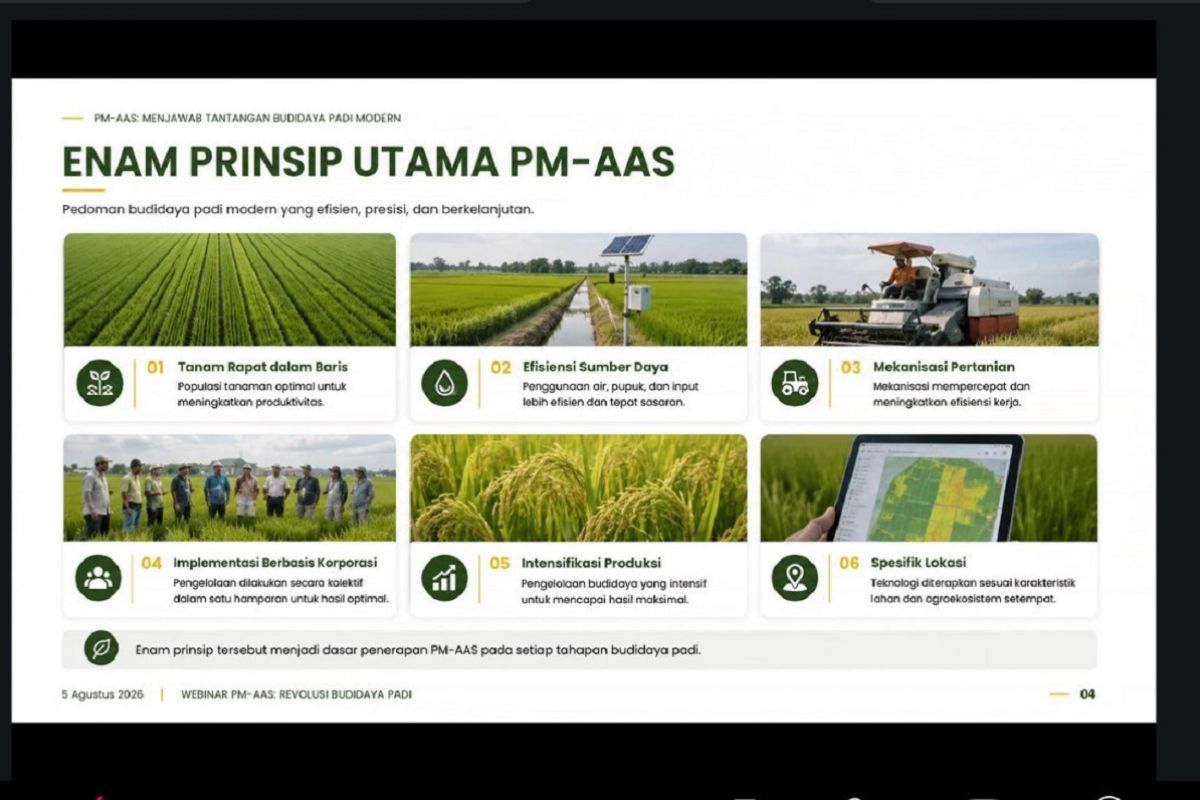
He explained that PM-AAS cultivation has six main principles. First, using the direct seeding method (tabela) with plants spaced more closely in rows.
Second, efficient and targeted use of water, fertiliser and inputs. Third, the use of agricultural mechanisation to accelerate work and increase efficiency. Fourth, corporate-based implementation.
The fifth principle is intensive rice cultivation management to achieve maximum results, and the sixth is location specificity. The technology used can be adapted to the characteristics of the land and local agroecosystem.
“PM-AAS presents a modern rice cultivation system based on technology, precision and corporate principles. With PM-AAS, it is hoped that production will increase, but costs will not be too high,” he said.
Saptorini, Head of the Planning and Evaluation Division at the Agency for Agricultural Extension and Human Resources Development (BPPSDMP) of Kementan, said the success of PM-AAS rice cultivation technology cannot be separated from the role of agricultural extension workers in the field.
“The role of agricultural extension workers starts from preparation, implementation to monitoring and supervision of activities in the field,” she said.
For this reason, she added, BPPSDMP provides assistance and PM-AAS training for agricultural extension workers, and has also published training and assistance modules for PM-AAS rice cultivation referring to the technical guidelines from BRMP.
In accordance with the instruction of the Minister of Agriculture, she said, agricultural extension workers have been given targets for assisting PM-AAS cultivation land: 100 hectares per extension worker in Java and 50 hectares per extension worker outside Java.
Meanwhile, Gita Bina Nugraha, Senior Vice President of the Indonesia Agrichemical Research Institute at PT Pupuk Indonesia, said that to support the PM-AAS programme, fertiliser volumes are sufficient to meet the needs of domestic farmers. Total urea production capacity is 9.4 million tonnes, NPK 4.6 million tonnes, and other fertilisers around 0.8 million tonnes.
“In terms of production capacity and infrastructure, we are ready to support the government’s food self-sufficiency programme,” he said.
As of 3 August, subsidised fertiliser stocks stood at 1.076 million tonnes spread across warehouses and distributors. This volume is sufficient to meet needs for 36 days at an average daily redemption rate of 30,000 tonnes.
“We have also prepared non-subsidised fertiliser with a stock of 405,880 tonnes,” said Gita at the event organised by Tabloid Sinar Tani together with PT Pupuk Indonesia.
For monitoring the distribution of subsidised fertiliser, Pupuk Indonesia already has an integrated system called iPubers, so the risk of delays can be detected quickly and accurately.
From the seed supply side, Dias Agriana, Vice President of Supply Chain Management at PT Sang Hyang Seri (SHS), estimated that with a seed requirement of 70-80 kg per hectare, 50,066 tonnes of rice seed will be needed for the PM-AAS programme in 2026-2027.
However, he added, PT SHS’s seed availability in the second half of 2026 is only 14,063 tonnes.
In the PM-AAS programme, the recommended rice seeds are lodging-resistant, resistant to bacterial leaf blight (HBD), blast-resistant, and have a productivity of up to 10 tonnes per hectare.
Source: jawawa.id (https://jawawa.id/newsitem/agriculture-ministry-targets-1-million-hectares-for-modern-rice-farming-system-by-2026-1785996074)
Originally published by Antara (Indonesian) (https://www.antaranews.com/berita/5682128/kementan-targetkan-budi-daya-pmaas-capai-1-juta-hektare-pada-2026), translated from Indonesian