
Agriculture Ministry Says 2026 Dry Season Differs from 2015 and 2023, Here's Why
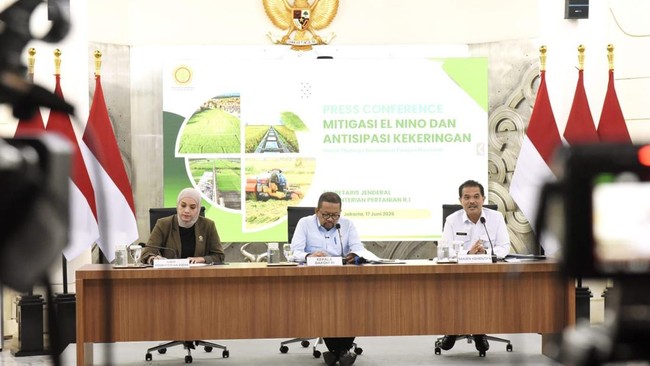
The Ministry of Agriculture (Kementan) has confirmed that the dry season expected in 2026 cannot be compared to the extreme drought phenomena caused by strong El Niño events, such as those experienced in 2015 and 2023. The government remains optimistic that national food production will remain stable and that food self-sufficiency targets can be maintained.
Secretary General of the Ministry of Agriculture, Suwandi, stated that based on climate data monitoring from BMKG and NOAA satellites, the 2026 dry season conditions are expected to be at a more controllable level compared to the previous two periods that significantly pressured agricultural production. “Looking at the data we monitor daily, the 2026 conditions are not as severe as 2015 or 2023. Therefore, what needs to be done is to increase vigilance and preparedness, rather than causing excessive concern,” Suwandi said in a statement on Wednesday.
He noted that the food sector is a primary foundation of national resilience, prompting the government to prepare various anticipatory measures to face climate challenges. “Food is not just a basic necessity, but a strategic national need. Safeguarding food means safeguarding the sovereignty and the future of the nation,” he added.
He explained that, following the directives of President Prabowo Subianto, the agricultural sector is a vital part of the national development agenda for the next five years. In addition to supporting food self-sufficiency targets, this sector also supports the Free Nutritious Meal (MBG) Programme, biofuel development, and agricultural downstreaming.
Suwandi assessed that Indonesia is entering the dry season with much better preparedness than in previous years. Various production strengthening programmes have been implemented, ranging from land optimisation, paddy field expansion, and the development of pump-based irrigation to the provision of superior seeds and strengthened coordination between central and regional governments.
Despite the more controllable climate conditions, the Ministry of Agriculture is increasing vigilance, noting that the period from July to September marks the peak of the dry season in Indonesia. The Minister of Agriculture, Amran Sulaiman, has instructed all regional governments since the beginning of the year to strengthen anticipatory steps against potential drought.
Through a letter sent to governors and regents on 9 March 2026, regional governments were requested to map drought-prone areas, strengthen early warning systems, repair irrigation networks, normalise water channels, and optimise the use of small dams (embung) and reservoirs.
Furthermore, the Ministry of Agriculture continues to update weather and climate information through BMKG and NOAA satellite monitoring so that farmers can adjust planting patterns to field conditions. The government has also prepared various superior varieties that are more resistant to drought, such as Inpari, Inpago, Situ Bagendit, Situ Patenggang, Pajajaran, and several other early-maturing varieties.
In terms of adaptation, the government is encouraging the use of water-saving technologies, short-duration varieties, accelerated planting after harvest, and more efficient planting pattern management. One strategy being promoted is increasing the planting index through accelerated planting periods. The Ministry aims for the gap between harvest and replanting to be no more than 14 days to increase planting frequency.
“If previously we planted twice a year, we are pushing for three times. Where it was once, we are pushing for twice. With the same land, production can increase because the planting frequency increases,” he said.
Farmers are also encouraged to utilise land more optimally through intercropping with commodities such as peanuts, mung beans, or vegetables to increase productivity and income. Interestingly, according to Suclandi, the dry season is not always synonymous with a decline in agricultural production. With good water management, dry weather can actually be an opportunity to increase yields.
“During the dry season, sunlight is excellent, so plant productivity can increase. This is actually an opportunity to boost production if managed with the right technology,” he said.
To strengthen mitigation, the government continues to develop pump-based irrigation systems as a mainstay against climate change. This year, the government is preparing additional pumps capable of serving approximately one million hectares of agricultural land. This programme complements the existing pumping system that previously supported the irrigation of about two million hectares in various regions.
“Our main strength in facing the dry season is the pumping system, and the management of water sources from reservoirs, small dams, rivers, or wells connected with adequate technology and energy,” said Suwandi.
The Ministry of Agriculture is also strengthening coordination with the Ministry of Public Works, PLN (State Electricity Company), and the Ministry of Energy and Mineral Resources (ESDM) to ensure the availability of water and energy to support pump operations in the field.
On the side of farmer protection, the government is preparing the Rice Farming Business Insurance (AUTP) programme with coverage of up to Rp6 million per hectare for lands experiencing crop failure due to disasters. Farmers affected by drought will also receive free seeds, production facilities, agricultural machinery, and assistance for accelerated replanting.
To support national preparedness, the government has allocated approximately 57,000 water pump units and various other agricultural machinery throughout 2026. With these steps, the Ministry of Agriculture is confident that national food production can be maintained despite the challenges of the dry season.
Source: jawawa.id (https://jawawa.id/newsitem/agriculture-ministry-says-2026-dry-season-differs-from-2015-and-2023-heres-why-1781704369)
Originally published by CNBC Indonesia (https://www.cnbcindonesia.com/news/20260617174756-4-743462/kementan-sebut-kemarau-tahun-2026-beda-dari-2015-2023-ini-alasannya), translated from Indonesian