
Agriculture Ministry Reveals Indonesia Has Rice Varieties Resistant to Iron Toxicity
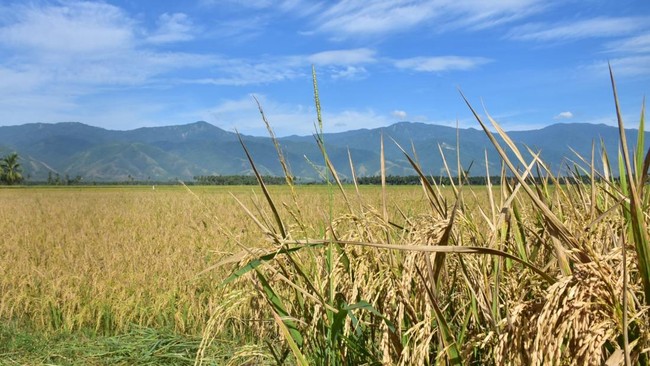
Jakarta, CNBC Indonesia – The Ministry of Agriculture (Kementan) says farmers need no longer worry about planting rice in land with difficult growing conditions, thanks to innovations in rice varieties.
Amin Nur, head of the ministry’s Centre for Rice Crop Assembly and Modernisation (BRMP), said one successful agricultural innovation was the development of improved rice varieties, which have been adopted by nearly 90% of the public.
“One of the innovations currently available for rice is our improved varieties, nearly 90% of which have been adopted by people across Indonesia,” Amin said at CNBC Indonesia’s World Food Day event on Friday (30 October 2026).
Amin said these improved varieties could be planted in otherwise challenging conditions, including dry land, swamps and brackish water.
“Our improved varieties could be described as climate-smart. For example, we have Inpari 32 and Inpari 42, which can be cultivated in various conditions. We also have varieties for dry land, such as Inpago 1, Inpago 2 and others,” Amin said.
He explained that some varieties have distinctive characteristics. Inpari rice, for example, can withstand brackish water with relatively high salinity.
“These varieties also have specific advantages: some tolerate acidic soils; some Inpari varieties tolerate brackish water with high salinity, while others tolerate drought,” Amin said.
Other varieties can be grown on wetter land, such as swamps. These include the Inpara variety.
“We also have varieties specifically suited to swamps or peatland. Inpara varieties are resistant to iron and aluminium toxicity,” Amin said.
The varieties are also supported by agricultural mechanisation and a modern farming system known as the Modern Agriculture–Advanced Agriculture System (PM-AAS).
“Our innovation is accompanied by the development of agricultural mechanisation,” he said.
Co-operation with BRIN
Previously, Coordinating Minister for Food Zulkifli Hasan, known as Zulhas, said existing rice varieties had been around for a long time, dating back to the era of President Soeharto. He said research was needed to develop new varieties.
“We need to research new varieties, because the rice varieties we have today are inherited from Pak Harto [Soeharto], and we have not conducted new research. We therefore need to work with BRIN to develop new varieties, including for specific areas such as brackish-water land,” Zulhas said.
He added that agricultural mechanisation also needed to be expanded to raise productivity.
“Mechanisation is also necessary. Agriculture cannot be done without it today, because that would mean low productivity and we would not be able to compete. For example, planting rice by hand requires 24 people per hectare. With a machine, one machine can cover 24 hectares in a day. So, inevitably, we have to embrace technology,” Zulhas said.
Source: jawawa.id (https://jawawa.id/newsitem/agriculture-ministry-reveals-indonesia-has-rice-varieties-resistant-to-iron-toxicity-1793353871)
Originally published by CNBC Indonesia (https://www.cnbcindonesia.com/news/20261030160154-4-780992/mantap-kementan-ungkap-ri-punya-varietas-padi-kebal-keracunan-besi), translated from Indonesian