
Agriculture Ministry Plans to Convert Tea Plantations into Garlic Fields, Approaches West Java Governor
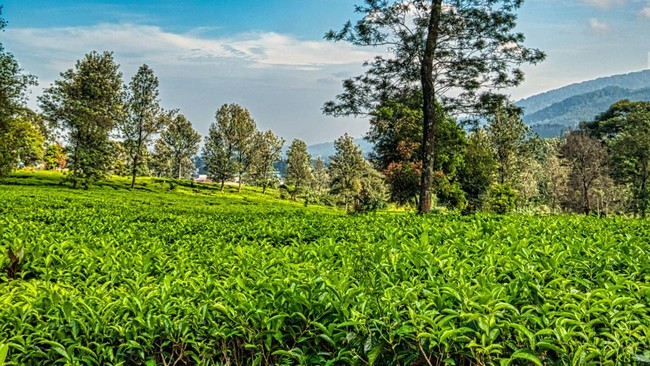
The Ministry of Agriculture (Kementan) is currently assessing the utilisation of several unproductive tea plantation lands in the Bandung region, West Java, to support the garlic self-sufficiency programme. This step is part of the government’s effort to prepare approximately 100,000 hectares of garlic planting land in the coming years.
Deputy Minister of Agriculture Sudaryono stated that land availability is a crucial aspect of the garlic self-sufficiency programme. This is because garlic cannot be cultivated in all regions and requires highland areas with specific climatic conditions.
“To meet national demand, we need approximately 100,000 hectares. The first challenge is finding locations, as garlic cannot be planted everywhere; it must be in highland areas,” Sudaryono said during a press conference at his office in Jakarta on Wednesday.
Currently, the government has established several garlic development centres that also serve as national seed nurseries, including Sembalun in West Nusa Tenggara (NTB), Temanggung in Central Java, and Humbang Hasundutan in North Sumatra.
However, to achieve self-sufficiency targets, the government requires additional land on a large scale. Consequently, the Ministry of Agriculture has begun engaging several State-Owned Enterprises (SOEs) operating in the food and plantation sectors to support the development of this commodity.
“Discussions have been held with garlic farmer associations, Bulog, ID Food, and PTPN. Therefore, SOEs are involved. The off-takers for these nurseries will be ID Food and Bulog,” he noted.
Under the scheme being prepared, PTPN will not only provide land but will also participate directly in garlic cultivation activities in suitable locations.
One area currently under discussion is the tea plantation land in Bandung, parts of which are no longer utilised for production.
“We are in talks with Dedi Mulyadi (KDM), the Governor of West Java, regarding how some non-operational tea plantations in the Bandung area can be converted into garlic land,” he said.
Sudaryono emphasised that the Ministry of Agriculture has mapped out a requirement of around 100,000 hectares to support the self-sufficiency target. According to him, the availability of potential highland land is still quite abundant, so finding land is not the primary obstacle.
“The Ministry of Agriculture has identified the needs. Finding 100,000 hectares of land is actually not difficult because we do have the locations,” Sudaryono added.
Nevertheless, he admitted that the greatest challenge lies in seed provision. Currently, more than 90% of national garlic needs are met through imports, meaning domestic seed production capacity must first be strengthened.
According to Sudaryono, using imported seeds directly for such vast planting areas cannot be done haphazardly. These seeds must undergo an adaptation and breeding process to suit Indonesia’s agro-climatic conditions.
“If seeds from abroad are planted directly across 100,000 hectares, they may not grow optimally. There must be agro-climatic adjustments and a breeding process first,” he explained.
For this reason, the government estimates that the garlic self-sufficiency target will take several years to realise. In addition to expanding planting areas, the government must gradually build domestic seed availability to meet national needs.
During this period, the government plans to continue reducing dependence on imported products by increasing the productivity of local farmers.
“As this progresses, God willing, we will continue to reduce import quotas by boosting our domestic productivity,” said Sudaryono.
The government aims that within the next three to four years, the foundation for garlic self-sufficiency will begin to take shape, both in terms of land availability and seed supply.
With this, Indonesia’s dependence on imported garlic is expected to decrease gradually until it can finally be met by domestic production.