
Agriculture Ministry and Java Livestock Agencies Strengthen Poultry Data and Farmer Business Stability
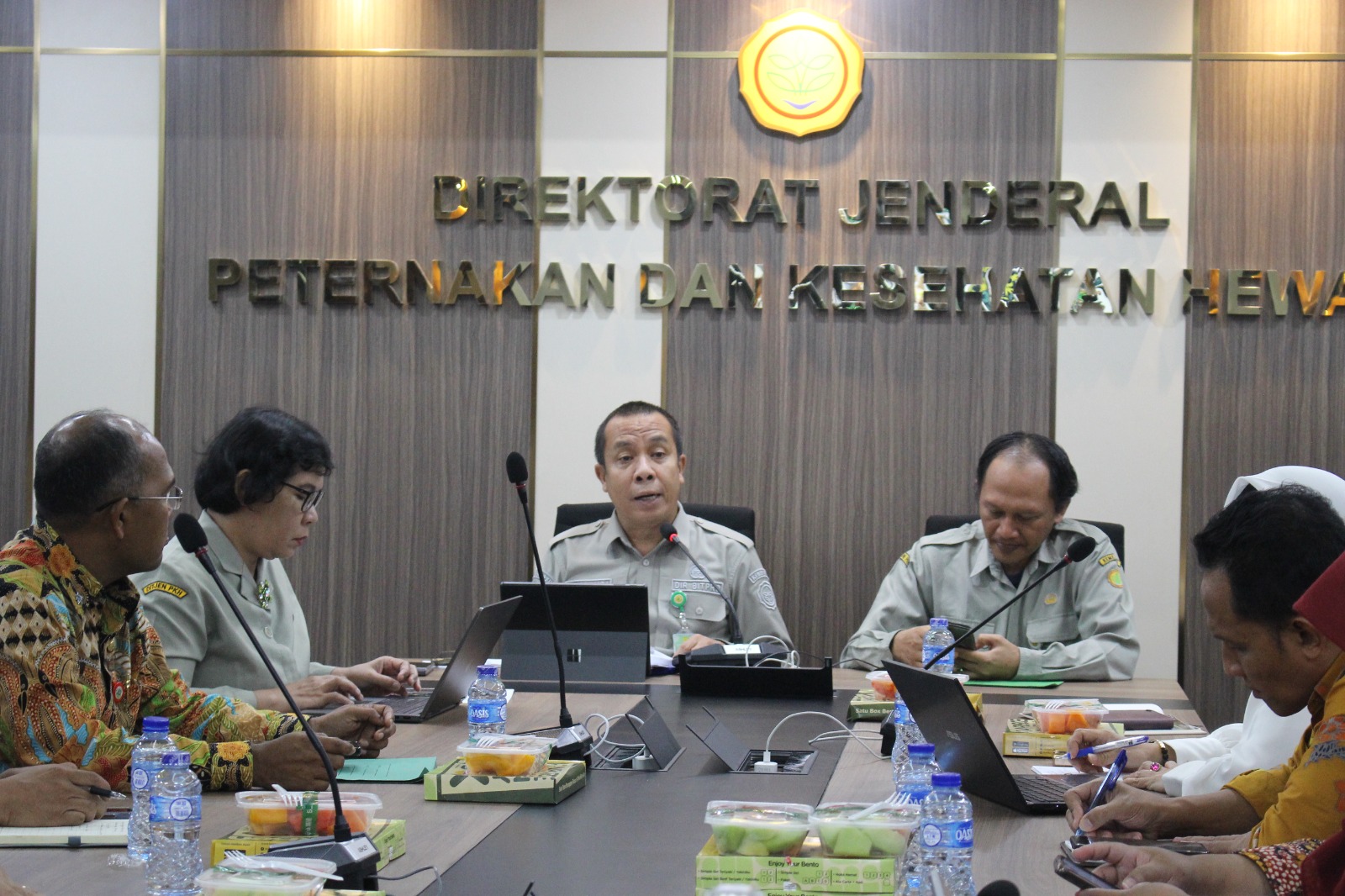
The Ministry of Agriculture (Kementan) together with agencies responsible for livestock functions across Java are strengthening measures to control the recent decline in live bird and purebred chicken egg prices at the farm level. These efforts are accompanied by the reinforcement of national poultry data as a basis for formulating more targeted policies.
Director of Livestock Breeding and Production at the Ministry, Hary Suhada, stated that the Ministry continues to monitor the development of live bird prices at the farm level. Based on monitoring results, the price decline is influenced by supply conditions that are higher than the market’s absorption capacity, causing prices in several regions to fall below the farmers’ basic production costs.
According to Hary, this situation requires joint handling between the central and regional governments so that the various policies pursued can run effectively. “Today we invited all agencies responsible for livestock in Java to jointly find solutions. This problem cannot be solved by the central government alone. Collaboration, coordination, and a shared sense of responsibility between the central and regional levels are needed so that the condition of farmers can improve soon,” Hary said during a coordination meeting held at the Ministry of Agriculture’s Central Office on Thursday (25/6/2026).
He added that the government has taken various steps to assist farmers and maintain the stability of the poultry business. Some of these include encouraging the absorption of live birds and eggs, controlling the production of broiler Final Stock (FS) Day Old Chicks (DOC), issuing appeals to cull laying hens that have reached an age of over 90 weeks, and making various policy adjustments to create a healthier and more sustainable poultry business chain.
The Ministry also highlighted the importance of accurate and integrated poultry data between the central and regional governments. This data is considered the main foundation for formulating holistic policies that are appropriate to conditions on the ground. “We hope there will be synchronised data between the central and regional governments. Therefore, we need the active involvement of relevant agencies to jointly develop mechanisms and technical steps for obtaining accurate poultry data,” Hary stated.
He revealed that the initial phase of coordination is focused on Java because the region is the main centre of national poultry production. “We are starting with Java first because approximately 63 per cent of the national supply of chicken meat and eggs comes from Java. Going forward, similar coordination will also be expanded to provinces outside Java so that the data system and policies built can cover all regions of Indonesia,” he said.
On the occasion, Head of the Banten Province Food Security Agency, Nasir, expressed support for the various steps taken by the central government. According to him, the Banten Provincial Government is also continuously strengthening supervision and the implementation of regulations in the poultry sector. “We are committed to enforcing the regulations set by the government. For the time being, we are not issuing new business permits in the poultry sector. In addition, the Governor of Banten has also invited business actors and farmers to discuss finding solutions to the current market conditions,” Nasir said.
Meanwhile, Head of the East Java Province Livestock Agency, Indyah Aryani, assessed that the problems currently faced by farmers require the involvement of all parties to resolve. “The current poultry problems are quite complex. Farmers are not only facing a decline in the selling price of chickens and eggs, but they also still have to bear bank credit obligations, while production costs, including feed, are also experiencing increases. This condition certainly burdens them further,” Indyah said.
According to her, the regional government has made various efforts to help absorb farmers’ production. Nevertheless, market conditions still require support from follow-up measures to maintain the balance between supply and demand. “We have taken various steps, such as appealing to civil servants to increase egg consumption and encouraging the Nutrition Fulfilment Service Units (SPPG) to absorb eggs from farmers. However, market conditions still require stronger intervention so that prices can improve again,” she said.
Indyah hopes the government can prepare a more structured egg absorption scheme as has been done for the rice commodity. “If for the rice commodity there is an absorption mechanism by Bulog when a production surplus occurs, we hope a similar scheme can also be applied to eggs. Thus, excess production can be absorbed and distributed to areas that still need it,” she said.
Regarding the strengthening of national poultry data, Indyah affirmed that the regional government is ready to fully support the steps being developed by the Ministry of Agriculture. “We fully understand that accurate data is a primary requirement in policy formulation. Therefore, we fully support the central government’s efforts to build a better, valid poultry data system that can serve as a basis for making the right decisions,” she concluded.
Through this coordination, the Ministry of Agriculture hopes that various control and strengthening measures for the poultry sector can run more effectively. Collaboration between the central government, regional governments, and business actors is expected to maintain price stability, protect farmers, and ensure the supply of animal protein for the community is maintained.