
Agriculture Ministry and Coordinating Ministry for Community Empowerment join forces to tackle poverty
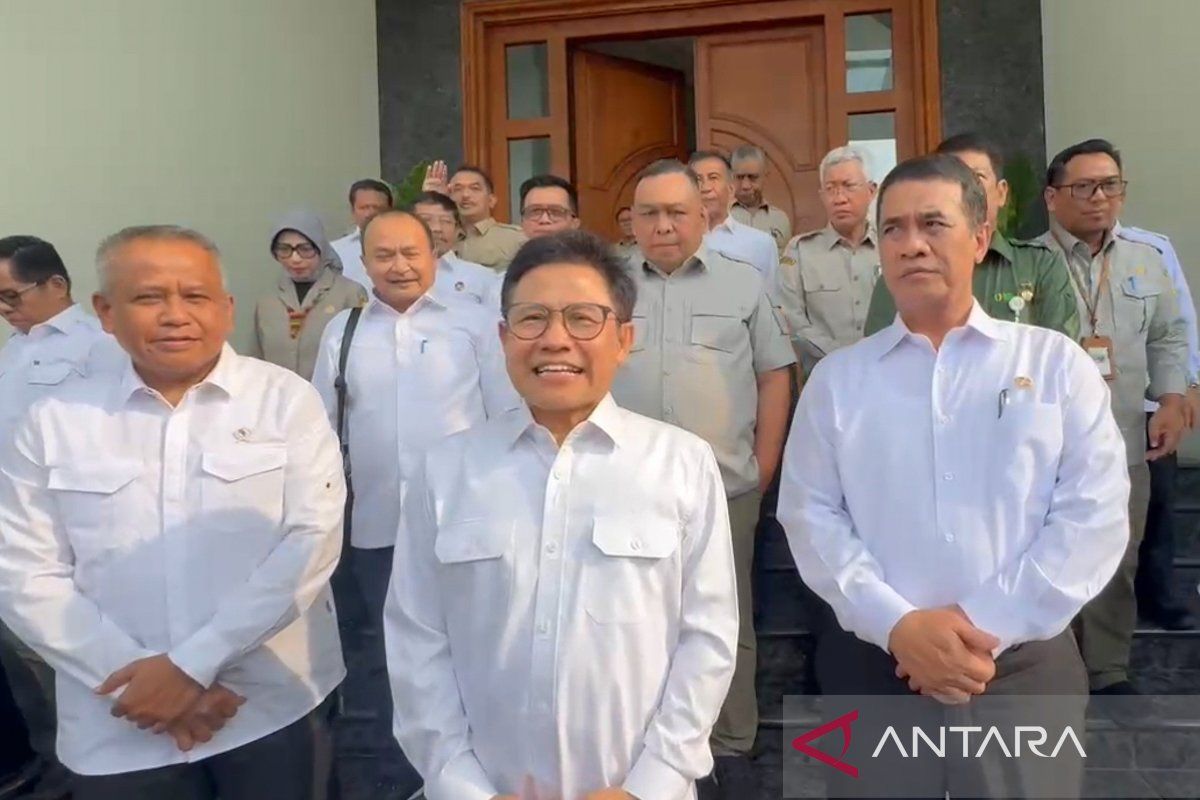
Jakarta (ANTARA) – The Ministry of Agriculture and the Coordinating Ministry for Community Empowerment are strengthening their collaboration to accelerate poverty reduction through agricultural economic empowerment.
“The most effective and appropriate way to tackle poverty is through empowerment,” Coordinating Minister for Community Empowerment Muhaimin Iskandar, also known as Gus Imin, said during a meeting with Agriculture Minister Andi Amran Sulaiman in Jakarta on Monday.
The strategy is intended to make communities more productive, develop businesses and increase incomes sustainably.
The two ministries discussed developing leading commodities, strengthening production, and expanding downstream processing and marketing as part of an empowerment ecosystem that directly benefits communities.
Gus Imin stressed that empowerment is an important approach for the government under President Prabowo Subianto to break the cycle of poverty. People should not only receive help to meet basic needs, but also be encouraged to build their economic capacity so they can become self-reliant and develop businesses.
“Empowerment-based work reduces poverty while also reducing the number of people receiving subsidies,” Gus Imin said.
He said the Ministry of Agriculture had significant potential to strengthen this approach because agriculture has an extensive economic value chain, from raw-material production through to processing and marketing.
“If every link in the chain is connected, people will not only produce goods but also gain added value and greater business opportunities,” he said.
The government has designated 88 districts and cities as priority locations for poverty alleviation. To speed up results, it will refine the selection of pilot locations based on need, regional potential and budget availability.
Commodities under consideration include chillies, cassava and poultry. They are seen as offering opportunities for development suited to local characteristics while also stimulating economic activity in communities.
“We look not only at whether an area is poor, but also at its commodities and at empowerment models that can deliver results quickly. These might include livestock, growing commodities such as coffee, chillies or cassava, or poultry farming. That is what can accelerate poverty reduction,” Gus Imin said.
He emphasised that empowerment must go beyond increasing production. The government needs to ensure that community businesses’ output generates added value, meets market demand and has a guaranteed buyer.
Cross-ministerial collaboration is therefore needed to connect commodity development with processing, packaging, distribution and marketing.
Gus Imin cited the downstream development of coconut by the Ministry of Agriculture, which has produced higher-value goods and opened export markets.
He said the model could be replicated with other commodities so that more regions could develop sustainable sources of economic growth.
“The minister has succeeded in creating a concrete downstream coconut product, from upstream production to the finished product. It has already gone straight to export,” he said.
Agriculture Minister Andi Amran Sulaiman said tackling poverty through agriculture required an ecosystem connecting different parties, rather than standalone programmes operating separately.
Synergy between central and local governments, businesses and communities is key to turning agricultural potential into productive economic activity.
“If the two of us meet, it won’t be enough. But if we build the ecosystem — starting with comparative advantage, collaboration, empowerment and the upstream-to-downstream chain — then the ecosystem will be in place,” the minister said.
The Ministry of Agriculture will strengthen an approach based on the potential of commodities and regions, connecting farmers’ production with processing and market access.
The development of chillies, cassava, poultry and downstream coconut processing are examples of opportunities that can be adapted to local needs.
Through this collaboration, agriculture is expected not only to increase food production but also to create business opportunities, expand employment and raise incomes in priority areas.
With an integrated upstream-to-downstream ecosystem, agricultural empowerment is expected to become a measurable and sustainable driver of faster poverty reduction.
Source: jawawa.id (https://jawawa.id/newsitem/agriculture-ministry-and-coordinating-ministry-for-community-empowerment-join-forces-to-tackle-poverty-1792381869)
Originally published by Antara (Indonesian) (https://www.antaranews.com/berita/5795769/kementan-kemenko-pm-entaskan-kemiskinan-lewat-pemberdayaan-pertanian), translated from Indonesian