
Agriculture Minister Visits East Java, Acquires ITS Innovations: Corn Seeds, Amphibious Tractor, and Coconut Climbing Tool
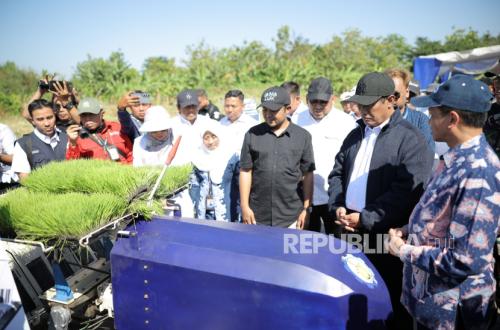
Agriculture Minister (Mentan) Andi Amran Sulaiman began his day at 06.00 WIB by flying to East Java to visit the Sepuluh Nopember Institute of Technology (ITS) Buncitan branch in Sidoarjo on Wednesday (22/7/2026). During the visit, the minister immediately purchased various innovations created by the nation’s own talent, ranging from superior maize seeds worth Rp 10 billion and an amphibious (electric) tractor to coconut-climbing devices.
The move follows President Prabowo’s directive that the government prioritise products and innovations produced by universities in supporting national development, particularly in the agricultural sector.
Amran said Indonesia must give space to campus-born innovations so they do not remain mere research outputs but are genuinely utilised by farmers and become solutions for increasing national food production.
“This morning, we are proud of the ITS Rector. It was extraordinary; we saw firsthand the work of our nation’s children. There are superior maize seeds producing 10 tonnes per hectare. Then there is a coconut-climbing device, and an amphibious tractor that can work in upland areas as well as swamps,” Amran said.
As a concrete show of support, the Ministry of Agriculture immediately purchased ITS hybrid maize seeds for planting across 13,000 hectares, worth Rp 10 billion.
“Today we are directly buying maize for 13,000 hectares — that’s Rp 10 billion. We are proud because the productivity is above the national average. We must oversee this together. Later, these seeds will be distributed to farmers free of charge,” he said.
According to Amran, if maize productivity can be pushed to an average of 10 tonnes per hectare through superior seeds and technological assistance, national production will rise significantly without opening new land.
“If that happens, what does it mean? National maize production increases without adding land. That is what we need. Just like rice, which now reaches 10 to 12 tonnes. We will develop both the methods and the seeds,” he said.
Beyond the maize seeds, Amran also decided to buy an amphibious tractor capable of operating on both dry land and swamps, as well as coconut-climbing devices previously ordered by the Ministry of Agriculture. According to him, these innovations will improve farmers’ work efficiency while reducing the risk of accidents when harvesting coconuts.
“Last year we ordered the amphibious tractor and the coconut-climbing device. Our poor farmers risk their lives climbing coconuts, at heights of up to 20 metres, even 25 metres. Now we use machines. With machines, productivity is high. We are the world’s largest coconut producer, so this is what we will push, along with downstream processing,” Amran said.
He affirmed that the government will continue to prioritise university research as part of the innovation- and technology-based transformation of national agriculture.
“Once again, we appreciate ITS, the Rector and his entire team who have worked hard on new technological discoveries. This is the President’s instruction: prioritise the outputs and products of universities. Seeds, tractors, agricultural equipment — prioritise them. Today we transacted the purchase directly,” Amran said.
Meanwhile, ITS hybrid maize breeder Muryono said the MTE 09 maize seed developed by his team is ready for mass production to meet farmers’ needs.
“We are confident in seed provision and ready to supply planting needs from October onwards. We will also provide direct assistance down to the farmers to ensure the cultivation SOP is applied optimally,” Muryono said.
He explained that with proper cultivation technology, maize productivity can not only reach an average of 10 tonnes per hectare but potentially be increased to around 20 tonnes per hectare.
“We optimise according to the cultivation SOP. The target is productivity of up to 20 tonnes per hectare with a minimum of two cobs per plant. Our seed production is centred in East Java, but distribution covers various regions across Indonesia,” he said.
Muryono expressed enthusiasm that the innovation developed by ITS is no longer confined to research but has become a real solution for farmers’ needs.
“What is most gratifying is that this innovation has reached the solution stage. Hybrids are not just about seeds, but about how the cultivation technology is applied in the field. We will continue innovating according to the challenges farmers face,” he said.
Rector of the Sepuluh Nopember Institute of Technology (ITS), Bambang Pramujati, expressed appreciation for the Ministry of Agriculture’s trust in directly utilising the campus’s innovations. He affirmed ITS’s commitment to supporting food self-sufficiency through the development of superior seeds, agricultural mechanisation and other technologies.
“We are ready to work alongside the government to achieve food self-sufficiency. If field trials prove successful, we will partner with industry to mass-produce these innovations so that campus research genuinely benefits society,” Bambang said.
Source: jawawa.id (https://jawawa.id/newsitem/agriculture-minister-visits-east-java-acquires-its-innovations-corn-seeds-amphibious-tractor-and-coconut-1784695947)
Originally published by Republika (https://ekonomi.republika.co.id/berita/tik6kt368/mentan-terbang-ke-jatim-borong-inovasi-its-benih-jagung-traktor-amfibi-hingga-alat-panjat-kelapa), translated from Indonesian