
Agriculture Minister reveals rice milling cartel profits Rp2 trillion monthly at public's expense
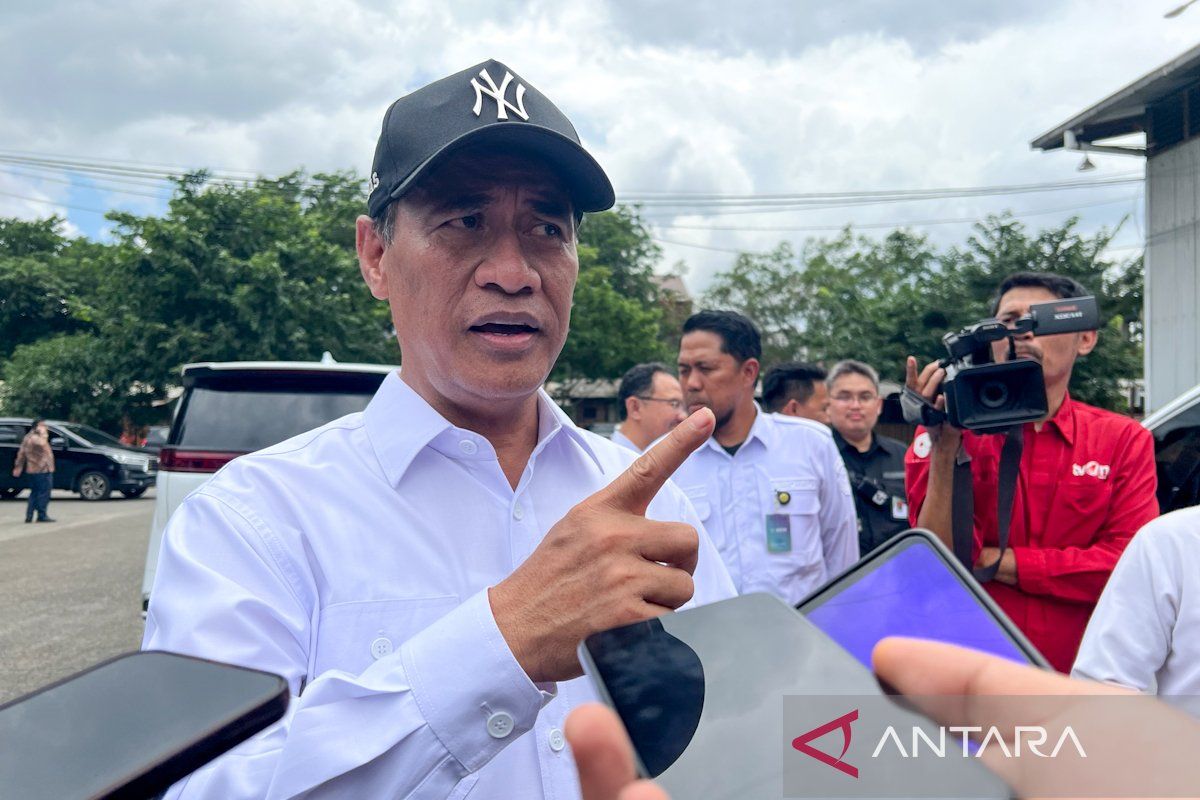
Jakarta (ANTARA) – Minister of Agriculture Andi Amran Sulaiman has revealed practices generating profits of up to Rp2 trillion per month, allegedly reaped by a single rice milling group, at the expense of the people’s rights.
“This is based on an in-depth analysis of the national rice trade under the title ‘Rice Mafia Emergency’,” the Minister said in Jakarta on Thursday.
He presented the analysis results showing losses of Rp98 trillion caused by premium rice circulating below quality standards, plus potential consumer losses of up to Rp71.9 trillion per year from the circulation of substandard fortified rice.
“These trillion-rupiah figures are not legitimate business profits. This robs the people of their rights,” Amran stressed.
He noted that the 2025 food security budget stands at Rp144.6 trillion, disbursed through ministries and agencies of Rp59.42 trillion, state-owned enterprises Rp63.00 trillion, Regional Transfers Rp22.17 trillion, and financing Rp0.05 trillion.
From these subsidies, Amran continued, national rice production is worth Rp537 trillion, with rice output of 34.69 million tonnes, based on the Highest Retail Price (HET) of Rp13.5 million per tonne and the average price according to the Ministry of Trade of Rp15.5 million per tonne.
“Yet the distribution of profits is lopsided. Farmers only receive household income of Rp1.87 million from an allocation of Rp215 trillion,” he explained.
Rice milling entrepreneurs, or RMU, instead received the largest share of Rp259 trillion, with the specific finding that one group of companies reaped illegitimate profits of up to Rp2 trillion per month from quality fraud.
The Minister set out the results of the government rice subsidy analysis. The rice supply chain is controlled by big business or conglomerates. The conglomerates exploit government subsidies for commercial activities of up to 40 per cent, and maximise profits by raising prices above the HET.
“Recent field findings show much of the premium rice fails to meet Indonesian National Standards, with a violation rate of 85.56 per cent,” Amran said.
As much as 39.75 per cent of all premium rice in circulation, equivalent to 12.2 million tonnes, is estimated to breach standards or constitute consumer fraud, with total losses reaching Rp98 trillion.
The National Police’s Food Task Force recorded that between 2024 and 2025 it handled 93 food mafia cases with a total of 77 suspects, comprising 46 rice cases, 27 fertiliser cases, 16 cooking oil cases, and 4 cases involving internal officials. In addition, 2,231 fertiliser retailer and distributor permits have been revoked.
For rice criminal cases specifically, 30 cases with 36 suspects were recorded throughout 2025. Entering 2026, enforcement continued with 2 cases and 6 suspects.
Meanwhile, the National Police’s Food Task Force, as of 30 July 2026, cited different figures: 38 cases with 39 suspects for 2025, of which 21 cases have reached the P-21 stage and are in trial. There were 2 cases with 1 suspect for 2026.
Furthermore, Amran explained that of the total national unhusked rice production of 65 million tonnes per year, large-scale mills with a capacity of 20 tonnes per hour, numbering 1,056 units, control 40 per cent of the unhusked rice supply, or 25 million tonnes per year.
Small-scale mills with a capacity of 0.5 tonnes per hour, despite being far more numerous at 161,401 units, also absorb 40 per cent, or 25 million tonnes per year. Meanwhile, medium-scale mills, 7,332 units, absorb 20 per cent, or 15 million tonnes per year.
“This pattern confirms that large mills, despite being far fewer in number, are able to control an unhusked rice supply equivalent to all the small mills numbering in the hundreds of thousands,” he said.
Under the current staple food trading supply chain, rice flows from farmers through collecting traders, distributors, sub-distributors, wholesale traders, and retail traders before reaching end consumers. This long chain generates intermediary middleman profits of Rp313.08 trillion.
Therefore, the government is promoting an alternative scheme through the Red-and-White Village or Urban Village Cooperatives, which cut the distribution chain directly from farmers to end consumers. This scheme could yield fairer margins of Rp50 trillion for farmers and consumers.
The Minister added that farmers buy unhusked rice at Rp6,000 per kilogram, then are paid Rp7,000 per kilogram, yet the processed rice is sold to the market at prices far above reasonable standards.
“This is a clear form of injustice. The perpetrators must be punished as severely as possible,” the Minister said.
Minister Amran also highlighted the impact of the government’s policy of not importing rice over the past two years following the achievement of self-sufficiency. According to him, this policy has actually prevented the mafia from acting freely, as their room to manoeuvre is narrowing.
Minister Amran asked law enforcement to continue hunting the rice mafia networks down to their roots. He also called on the public to actively report any indications of price manipulation and rice hoarding that harm farmers and consumers.
Source: jawawa.id (https://jawawa.id/newsitem/agriculture-minister-reveals-rice-milling-cartel-profits-rp2-trillion-monthly-at-publics-expense-1785383628)
Originally published by Antara (Indonesian) (https://www.antaranews.com/berita/5672109/mentan-ungkap-praktik-penggilingan-untung-rp2-t-tapi-rampas-hak-rakyat), translated from Indonesian