
Agriculture Minister Responds to Controversy Over Rice Milling Company's Rp 2 Trillion Revenue
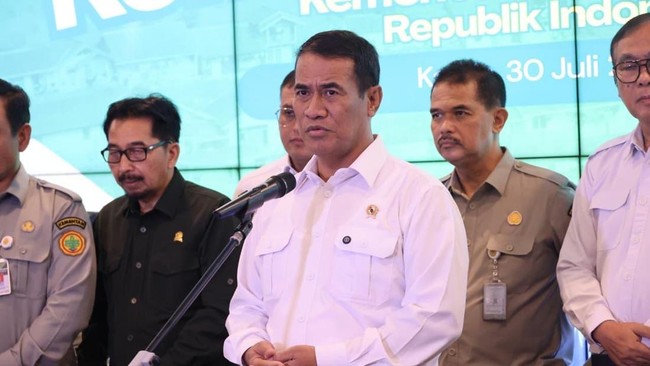
Jakarta, CNBC Indonesia – Agriculture Minister Andi Amran Sulaiman has responded to the polemic that has recently developed in society regarding President Prabowo Subianto’s statement about a rice milling company allegedly pocketing Rp 2 trillion per month.
Amran believes the figure does not represent normal profit from milling operations, but rather an estimate of the value of alleged fraud against consumers through the sale of premium rice that does not comply with government-established quality standards.
He stressed that the public must not get trapped by the size of the Rp 2 trillion figure. The public must understand the substance of the issue being uncovered by the government.
“Do not divert the issue from fraud to the issue of one mill earning Rp 2 trillion. Do not focus on the calculation, focus on the crime. This is not business profit, this is fraud,” Amran asserted in a statement written on Thursday (30/7/2026).
The alleged fraud came to light after the Ministry of Agriculture tested 212 premium rice brands circulating in the market. The results showed that around 86% of samples failed to meet premium rice quality standards.
One of the main findings was the high content of broken rice, which should be a maximum of 14.5% under the rules, but in several samples reached more than 40% or even approached 60%. Even so, such products continued to be marketed as premium rice and sold at premium prices.
According to him, the practice is equivalent to selling 18-carat gold whilst claiming it is 24-carat gold. Consumers pay a premium price, but the quality of the goods received does not match what was promised. Therefore, the government views the practice as a form of fraud that must be processed legally.
Amran then explained the basis of the calculation that produced the figure of around Rp 98 trillion in annual losses. The calculation starts from total national premium rice production, which reaches around 39.75% of total national rice production, equivalent to about 12.2 million tonnes each year. Of that amount, monitoring results showed around 86% was suspected of failing to meet premium quality standards, putting the volume at an estimated 10.5 million tonnes.
Next, the Ministry of Agriculture calculated the difference in economic value paid by the public. Rice whose quality falls below premium standards is estimated to be worth around Rp 8,000 per kilogram, yet was sold as premium rice at around Rp 17,300 per kilogram.
This means there is a price difference of around Rp 9,300 per kilogram, or about Rp 9.3 million per tonne. When this price difference is multiplied by the estimated volume of rice suspected of failing to meet premium standards, potential public losses reach around Rp 97.7 trillion, rounded to around Rp 98 trillion to Rp 99 trillion in a single year.
“Of the total losses of around Rp 98 trillion, there is one company which, based on our calculations, is worth around Rp 2.08 trillion per month. But do not stop at that figure. What must be pursued is the fraud, the corrupt actors, and the mafia,” Amran said.
Amran stressed that the Rp 2 trillion figure was in no way calculated based on the production capacity of a single rice milling unit, as debated by several parties. The amount is an estimate of the alleged profit obtained by one corporation from the practice of selling rice that does not meet quality standards. Therefore, according to him, what concerns the government is not the size of business profits, but the alleged quality manipulation that harms the public.
“It is not the factory’s profit that we are questioning. What we are questioning is the fraud. The goods sold do not match the quality the public is paying for. This is what we have reported to the Food Task Force,” he said.
He added that all laboratory test results along with the calculations have been submitted to the National Police’s Food Task Force to be processed in accordance with legal provisions. According to him, the government will continue to crack down on food mafia practices that harm farmers, consumers, and the state, in line with President Prabowo Subianto’s directive to create a food trading system that is fair, transparent, and aligned with the people’s interests.
Source: jawawa.id (https://jawawa.id/newsitem/agriculture-minister-responds-to-controversy-over-rice-milling-companys-rp-2-trillion-revenue-1785401591)
Originally published by CNBC Indonesia (https://www.cnbcindonesia.com/news/20260730152129-4-755122/mentan-tanggapi-polemik-perusahaan-penggilingan-padi-raih-omzet-rp-2-t), translated from Indonesian