
Agriculture Minister Purchases ITS Innovations, from Superior Corn Seeds to Amphibious Tractors
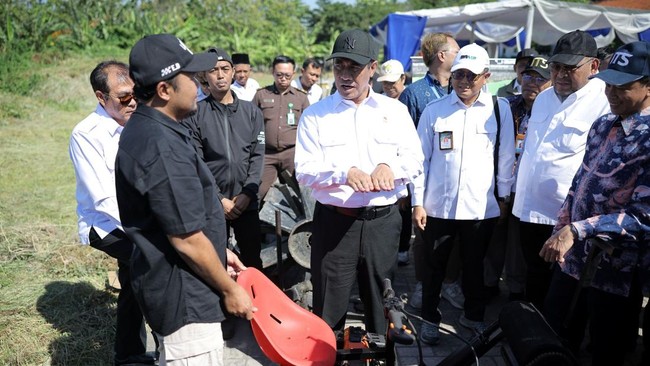
Agriculture Minister Andi Amran Sulaiman flew to East Java to visit the Sepuluh Nopember Institute of Technology (ITS) Buncitan campus in Sidoarjo on Wednesday (22/7/2026). During the visit, Amran directly purchased a range of innovations produced by the nation’s own talent, from superior maize seed worth Rp10 billion to an amphibious (electric) tractor and a coconut-climbing device.
The move follows President Prabowo Subianto’s instruction for the government to prioritise products and innovations developed by universities in support of national development, particularly in the agricultural sector.
Amran said Indonesia must give the fullest possible space to campus-born innovations so they do not remain mere research output, but are genuinely used by farmers and become solutions for raising national food production.
“Today, this morning, we are proud of the ITS Rector. It was extraordinary; we saw the work of our own people first-hand. There is superior maize seed yielding 10 tonnes per hectare. Then there is a coconut-climbing device. And an amphibious tractor that can work in upland fields as well as swamps,” Amran said in a written statement on Wednesday (22/7/2026).
As a tangible form of support, the Ministry of Agriculture immediately purchased ITS hybrid maize seed to cover planting on 13,000 hectares, at a value of Rp10 billion.
“Today we are buying maize seed for 13,000 hectares straight away — that is Rp10 billion. We are proud because its productivity is above the national average. This is something we must safeguard together. The seed will be distributed to farmers free of charge,” he explained.
He said that if maize productivity could be pushed to an average of 10 tonnes per hectare through superior seed and technological assistance, national output would rise significantly without any need to open new land.
“If that happens, what does it mean? National maize production increases without adding farmland. That is what we need. It is the same as rice now, where yields reach 10 to 12 tonnes. We will develop both the methods and the seed,” he said.
Beyond maize seed, Amran also decided to buy an amphibious tractor capable of operating on both dry land and swamps, along with the coconut-climbing device previously ordered by the ministry. In his view, these innovations will improve farmers’ working efficiency while reducing the risk of accidents when harvesting coconuts.
“Last year we placed orders saying we needed amphibious tractors and coconut-climbing devices. It is pitiful that our farmers risk their lives climbing coconut trees up to 20 metres, some even 25 metres. Now we use machines. With machines, productivity is high. We are the world’s largest coconut producer. This is what we will push, along with downstream processing,” he explained.
He further stressed that the government will continue to prioritise university research output as part of a national agricultural transformation driven by innovation and technology.
“Once again, we appreciate ITS, its Rector and the whole team who have worked hard on these new technological discoveries. This is the President’s instruction. Prioritise the output and products of our campuses. Seed, tractors, agricultural equipment — prioritise them. Today we transacted and bought them directly,” Amran affirmed.
Meanwhile, Muryono, the ITS hybrid maize breeder, said the MTE 09 maize seed developed by his team is ready for mass production to meet farmers’ needs.
“We are confident about seed supply and ready to meet planting needs from October onwards. We will also provide direct assistance down to the farmers so that the cultivation SOP can be applied optimally,” Muryono said.
He added that with the right cultivation technology, maize productivity could not only reach an average of 10 tonnes per hectare but potentially rise to around 20 tonnes per hectare.
“We optimise according to the cultivation SOP. The target is productivity of 20 tonnes per hectare with a minimum of two cobs per plant. Our seed production is centred in East Java, but distribution covers various regions across Indonesia,” he said.
Muryono said he was enthusiastic because the innovation developed by ITS is no longer confined to research, but has become a real solution for farmers’ needs.
“What makes us proudest is that this innovation has reached the solution stage. Hybrid development is not only about the seed, but also about how the cultivation technology is applied in the field. We will continue innovating in line with the challenges farmers face,” he explained.
The Rector of ITS, Bambang Pramujati, welcomed the Ministry of Agriculture’s trust in directly utilising the campus’s innovations. He affirmed ITS’s commitment to supporting food self-sufficiency through the development of superior seed, agricultural mechanisation and other technologies.
“We are ready to work with the government to achieve food self-sufficiency. If field trials go well, we will partner with industry to produce these innovations at scale so that campus innovations genuinely benefit society,” Bambang said.
Source: jawawa.id (https://jawawa.id/newsitem/agriculture-minister-purchases-its-innovations-from-superior-corn-seeds-to-amphibious-tractors-1784699486)
Originally published by CNBC Indonesia (https://www.cnbcindonesia.com/news/20260722113237-4-752840/amran-borong-inovasi-its-ada-benih-jagung-hingga-traktor-amfibi), translated from Indonesian