
Agriculture Minister Partners with UNESA to Develop Soybeans and Curb Imports
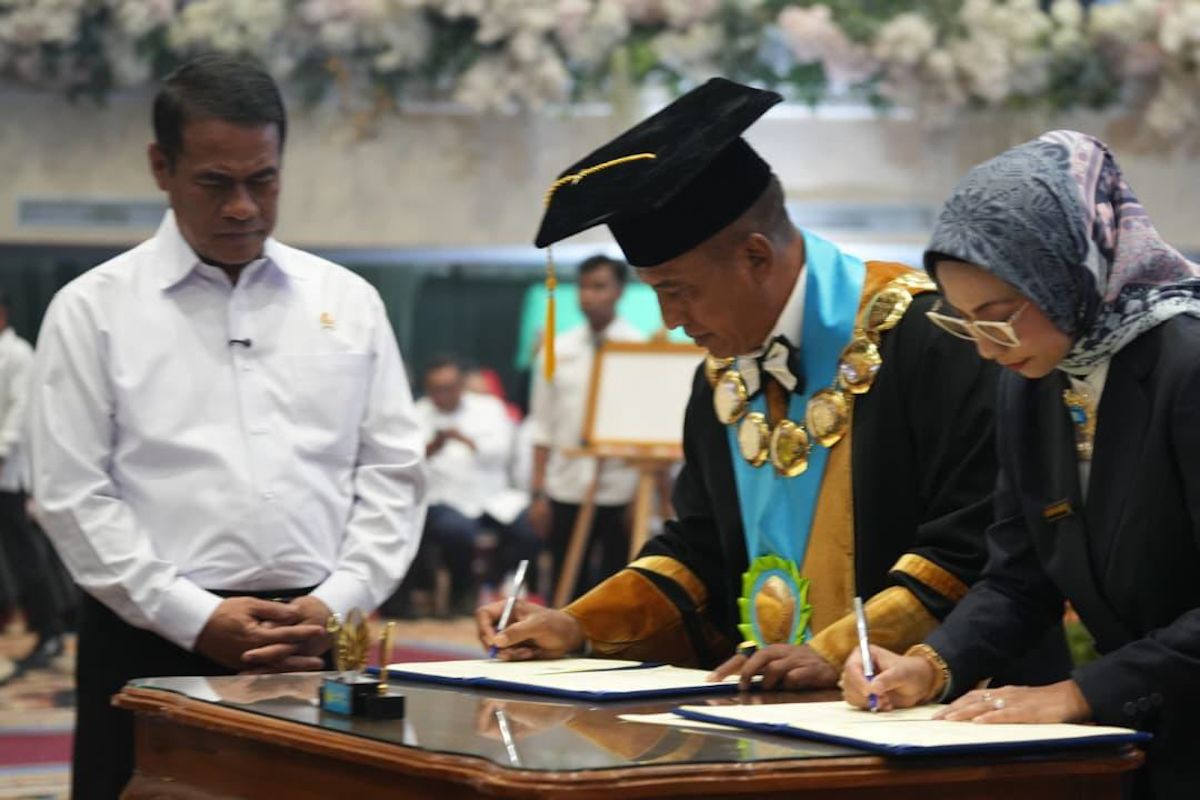
Agriculture Minister Andi Amran Sulaiman is partnering with Surabaya State University (UNESA) to develop soybean seed production using 56 hectares of land as part of efforts to reduce national dependence on soybean imports.
Amran said the move is part of connecting university research strengths directly with agricultural production. The commitment was marked by the signing of a memorandum of understanding (MoU) between the Ministry of Agriculture and UNESA.
“We thank the Rector, excellent. We immediately signed the MoU and then we will follow up on soybeans. UNESA has 56 hectares of land, we will provide free seeds and agricultural machinery, including four-wheel tractors,” said the Minister after the MoU, according to a confirmed statement in Jakarta on Wednesday.
He stressed that the synergy is being carried out by the Ministry of Agriculture to build a quality soybean seed production base in East Java.
The 56 hectares of UNESA-owned land will be planted with soybeans with support of free seeds and agricultural machinery from the Ministry of Agriculture, while all the seed produced will be purchased by the government and then redistributed free of charge to the public.
Amran is targeting the land to produce soybeans with high productivity, at least 3.5 tonnes per hectare and hopefully reaching 4-5 tonnes per hectare.
Lecturers will be involved in cultivation and research so that the area also becomes a space for developing innovation and soybean production technology.
Furthermore, Amran said the Ministry of Agriculture is not only providing support at the production stage, but will also act as the offtaker by purchasing all seeds produced from the 56 hectares. The seeds will then be distributed free of charge to expand soybean development in East Java.
“If production can, God willing, reach 4 tonnes, 5 tonnes, at least 3.5 tonnes per hectare, we will buy all seeds from the 56 hectares. The offtaker is the Ministry of Agriculture. After that we will give them free of charge to the people of East Java,” he stressed.
According to Amran, this pattern is part of efforts to strengthen national soybean production sustainably. Universities are encouraged not only to produce research, but also to bring their innovations to the production stage so that they can provide direct benefits to the public.
“We continue to develop soybeans because President Prabowo has asked us to always strengthen soybeans. Then for active universities, we divide according to their respective commodities and capabilities,” he said.
The Minister said the collaboration with UNESA is part of a broader scheme to involve universities in developing strategic commodities. The Ministry of Agriculture has previously developed cooperation with a number of campuses based on their respective competencies and potential.
The scheme is a follow-up to the synergy between the Ministry of Agriculture and the Ministry of Higher Education, Science, and Technology.
Minister Amran opened opportunities for other universities to cooperate in developing commodities as well as agricultural technology and equipment.
“We have already signed an MoU with the Minister of Higher Education, Science, and Technology. Whoever is interested in agricultural commodities, including agricultural equipment, can immediately sign an MoU with us. Rather than buying products from abroad, we should be proud of our own university products,” he stressed.
The Minister described the collaboration as a concrete implementation of the triple helix concept, with the government providing policy support, academics producing innovation and technology, while the business world drives economic activity.
“If the triple helix is implemented well, the government as regulator, industry as entrepreneur, and academics creating new innovations, this country is strong. Very strong,” he said.