
Agriculture Minister Amran Offers Free Seeds for 20,000 Hectares for Farmers
JAKARTA — Agriculture Minister Andi Amran Sulaiman has prepared a permanent solution to strengthen the national livestock ecosystem from upstream to downstream. It includes supplying feed ingredients, partnerships between livestock producers and maize farmers, purchasing harvests and developing the livestock-product processing industry. The measures are intended to secure feed supplies, stabilise prices, expand markets and ensure livestock producers earn a reasonable return.
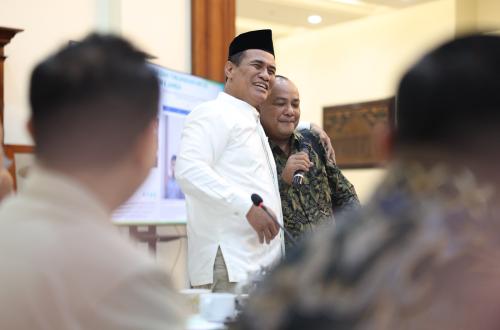
The proposals were discussed at a meeting between Amran and representatives of livestock producers, cooperatives and livestock associations in Jakarta on Friday (9 October 2026). Amran said the government wanted to build a system that would prevent producers from repeatedly facing problems with feed supplies and prices, particularly from September to December, when demand for maize rises and prices often come under pressure.
“Today’s meeting produced several policies that, God willing, will provide a permanent solution. The President’s direction is to listen to the people, to Indonesian livestock producers and farmers. Make regulations that benefit them and stand on their side,” he said.
Amran said the key to resolving problems in the livestock sector was to build an interconnected ecosystem. Livestock producers would not only use feed ingredients, but could also support maize farmers as suppliers, buy their harvests and use cooperatives to store and manage stocks.
“First, we are building a healthy ecosystem. We must safeguard every stage, from upstream to downstream. We are building a good system,” he said.
Upstream, the Ministry of Agriculture is preparing free maize seeds to develop 20,000 hectares of land by December 2026. The programme is intended to strengthen partnerships between livestock producers and maize farmers, enabling domestic production to meet demand for feed ingredients.
Under the scheme, livestock producers will support groups of maize farmers and buy their harvests. If production exceeds their needs, Bulog will act as a buyer of last resort, absorbing the surplus. The maize will then be stored and made available again when market supplies decline.
“Livestock producers will have supported farmers growing maize. The Ministry of Agriculture will provide free maize seeds for up to 20,000 hectares by December. After it is planted, livestock producers will buy the crop. If there is a surplus, Bulog will be the offtaker,” Amran said.
The government is also preparing agricultural machinery to support the programme. Initially, it plans to provide 20 tractors, with the number potentially increased depending on requirements in the field. The assistance is expected to help farmers expand maize production and provide livestock producers with greater certainty over supplies.
Amran also asked Bulog to maintain maize stocks during the critical period from September to December. The government is targeting stocks of 250,000 tonnes during those months to ensure livestock producers’ needs can be met when production and distribution come under pressure.
“We have asked them to maintain stocks of 250,000 tonnes during the critical months,” he said.
In addition to direct purchasing, the government is strengthening the warehouse-receipt system to address financing constraints faced by farmers and cooperatives. Under the arrangement, if a cooperative or livestock producer cannot afford to buy the entire harvest, Bulog can purchase and store the maize in a warehouse.
The stored stock will remain the property of the cooperative or other relevant party, according to the agreed mechanism. The maize can be used when livestock producers need supplies, or sold to another buyer with the owner’s approval.
“For example, livestock producers have bought part of the harvest, but some remains unsold because of limited funds. Bulog buys and stores it in a warehouse. It remains the cooperative’s property, its savings. When needed, the stock can be retrieved,” Amran said.
He said the system would ensure farmers’ harvests are purchased even when buyers have limited funds. At the same time, livestock producers would have a reserve of feed ingredients to draw on when maize prices rise or market supplies fall.
Source: jawawa.id (https://jawawa.id/newsitem/agriculture-minister-amran-offers-free-seeds-for-20-000-hectares-for-farmers-1791532376)
Originally published by Republika (https://ekonomi.republika.co.id/berita/tmmpnt423/mentan-amran-beri-benih-gratis-20-ribu-hektare-bagi-petani), translated from Indonesian