
Agriculture Minister Amran Launches Fertiliser Export to Australia Worth Rp7 Trillion
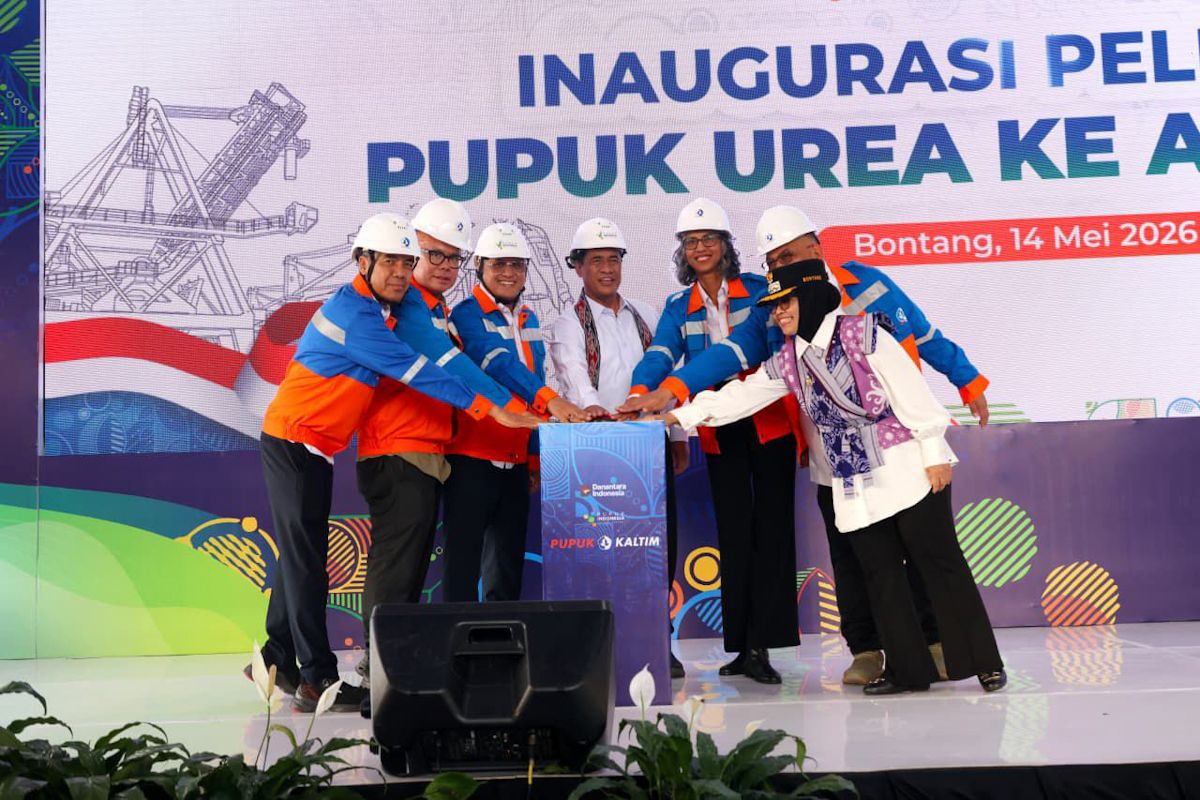
Indonesia has recorded a new milestone in the transformation of the national fertiliser industry through the export of urea fertiliser to Australia valued at approximately Rp7 trillion.
Jakarta (ANTARA) - Agriculture Minister (Mentan) Andi Amran Sulaiman launched Indonesia’s fertiliser export to Australia worth Rp7 trillion as a step to strengthen the competitiveness of the national fertiliser industry in the global market.
“Indonesia has recorded a new milestone in the transformation of the national fertiliser industry through the export of urea fertiliser to Australia valued at approximately Rp7 trillion,” the Minister stated in Jakarta on Thursday.
The Minister conveyed this while directly attending the launch of the inaugural export of PT Pupuk Indonesia (Persero)’s urea product via PT Pupuk Kalimantan Timur to Australia at Bontang Port, East Kalimantan.
According to him, this achievement symbolises the strengthening of Indonesia’s position in the global fertiliser supply chain and marks a shift from a country previously facing supply issues to one with a surplus in national fertiliser production.
The launch serves as a new milestone in strengthening cooperation in the fertiliser sector through a government-to-government (G2G) scheme between Indonesia and Australia.
Amran explained that the inaugural export launched today amounts to 47,250 tonnes of urea fertiliser valued at approximately Rp600 billion. This export is the initial phase of a cooperation commitment of 250,000 tonnes and will continue to be increased to 500,000 tonnes with a total value of around Rp7 trillion.
“Our plan is to export 250,000 tonnes to Australia and then increase it to 500,000 tonnes,” he said.
The Minister stated that this success demonstrates the strengthening competitiveness of the national fertiliser industry and opens up new market opportunities in various countries.
Following Australia, the government is beginning to direct the strengthening of national fertiliser export markets to other strategic countries such as India, the Philippines, Brazil, and Bangladesh.
“In addition, the Indian Ambassador has directly contacted me requesting 500,000 tonnes, and several other countries are also interested, namely the Philippines, Brazil, Bangladesh, and there are a few more countries; we received reports of countries interested in urea fertiliser from Indonesia. This is what we are grateful for and proud of,” Amran explained.
The Minister continued that this success is inseparable from various strategic policies of President Prabowo Subianto in overhauling the national fertiliser governance from upstream to downstream.
At the beginning of the administration, President Prabowo took a major step by restoring the allocation of subsidised fertiliser from the previous approximately 4.55 million tonnes to 9.55 million tonnes to support the acceleration of national food self-sufficiency.
This policy expands the reach of beneficiaries to around 160 million people directly involved in the agricultural sector.
Furthermore, President Prabowo also implemented a strategic policy of reducing the price of subsidised fertiliser by 20 per cent without additional burden on the state budget. This policy is accompanied by an increase in the volume of subsidised fertiliser by 700,000 tonnes to broaden farmers’ access to fertiliser.
“At a time when global geopolitics is heating up, Indonesia, Alhamdulillah, has reduced fertiliser prices by 20 per cent. Subsidised fertiliser for Indonesian farmers. Then the volume of fertiliser has increased. This is the happiness of 160 million Indonesian farmers and 115 million rice farmers,” the Minister explained.
The government has also carried out total deregulation of 145 regulations across ministries and agencies to accelerate fertiliser distribution. The distribution system has been simplified through a direct pattern from the Ministry of Agriculture–PIHC–Gapoktan/Cooperative–Farmers so that fertiliser reaches farmers more quickly.
In addition, the government has reformed the national fertiliser subsidy mechanism by eliminating various inefficient components such as raw material profits, bank interest burdens, and multiple VAT.
This reform is projected to save up to Rp14 trillion while lowering the national fertiliser production costs.
In addition to governance improvements, the government is promoting a large-scale revitalisation of the national fertiliser industry through seven strategic projects with a total investment of Rp72.84 trillion, involving PT Pupuk Indonesia (Persero), PT Pupuk Sriwidjaja Palembang, PT Pupuk Kalimantan Timur, PT Petrokimia Gresik, and PT Pupuk Kujang.
Modernisation is being carried out by replacing old energy-intensive factories with new, more efficient facilities. The efficiency in production costs for the new fertiliser plants is recorded at 26 per cent lower compared to the old factories.
Through subsidy scheme reforms and industry revitalisation, the government projects savings in fertiliser subsidies of up to Rp112 trillion by 2035, while curbing potential waste of Rp14.4 trillion per year.
The era of President Prabowo is also marked by the start of new strategic projects, including the groundbreaking of the NPK Nitrate Factory in Cikampek on 23 December 2025 and the revamping of the Ammonia Factory PKT-2 Bontang on 29 January 2026.
The government is also beginning to develop a national methanol project in Aceh and Bontang with a capacity of 2.5 million tonnes and an investment of approximately USD1.8 billion to support biodiesel needs and reduce dependence on imported industrial raw materials.
The Minister emphasised that all improvements in the fertiliser sector are aimed not only at strengthening the national industry but also at supporting food self-sufficiency, improving farmer welfare, reducing imports, and building self-reliance in the national fertiliser industry amid global food crisis and geopolitical challenges.
“Fertiliser is not just about production and distribution. Fertiliser is a strategic instrument towards national food sovereignty,” said Amran.