
Agriculture Minister addresses fertiliser and irrigation issues following student complaints
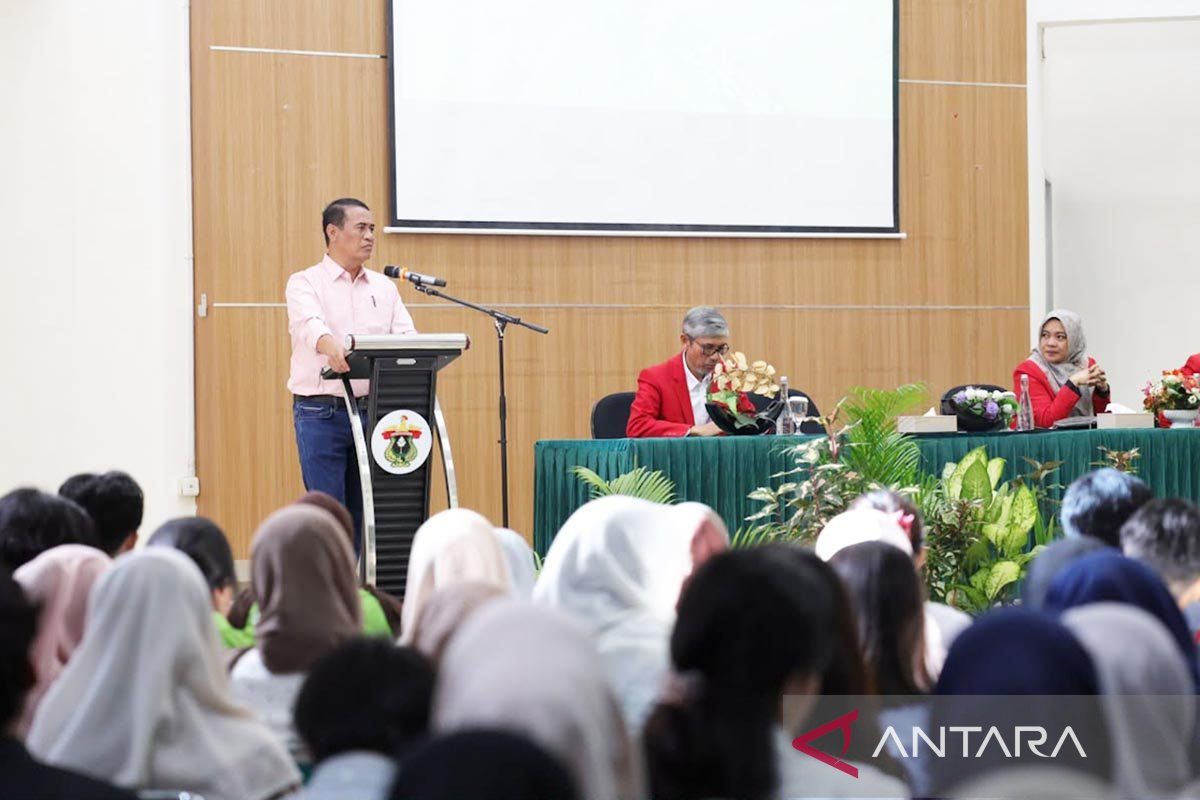
Jakarta (ANTARA) - Minister of Agriculture Andi Amran Sulaiman has moved to address fertiliser shortages and irrigation problems as part of an effort to strengthen agricultural productivity and support national food security, following various complaints from students of Hasanuddin University (Unhas).
“If it is true that there are distributors causing farmers difficulty in obtaining fertiliser, check them immediately. If proven to be in violation, revoke their licence,” said the Minister during a public lecture at the Faculty of Agriculture, Hasanuddin University, Makassar, South Sulawesi, on Tuesday.
The atmosphere of the public lecture transformed into a forum for resolving agricultural issues. When students presented farmers’ grievances regarding fertiliser and damaged irrigation in Gowa Regency, the Minister immediately ordered his staff to conduct field inspections and handling.
In front of approximately 300 students, the Minister opened a wide space for discussion, allowing participants to present criticisms, suggestions, and problems they had encountered directly within the community. Various strategic issues emerged, ranging from subsidised fertiliser, irrigation damage, and land conversion to strategies for maintaining food self-sufficiency and the development of agriculture-based renewable energy.
One student, Arham, raised the issue of fertiliser scarcity still being felt by farmers in Bontomarannu District, Gowa Regency. Upon hearing this, the Minister immediately telephoned the relevant director to conduct immediate verification and field investigation. Additionally, the student reported the condition of damaged irrigation networks in the same area.
Responding to these reports, the Minister instructed the Agricultural Assembly and Modernisation Agency (BRMP) of South Sulawesi to oversee the resolution of these issues to ensure they do not disrupt farmers’ activities and productivity. This rapid response drew significant attention from the lecture participants.
For the Minister, the problems faced by farmers must not end as mere discussion topics but must be followed up with concrete actions. During the dialogue session, students also questioned the government’s steps to maintain rice self-sufficiency amidst the challenges of climate change, land conversion, and increasing national food demand.
Answering this, Amran emphasised that the government continues to strengthen the production foundation through the construction and rehabilitation of irrigation, the provision of superior seeds, agricultural modernisation, land optimisation, and the protection of paddy fields from conversion.
He stated that the success of maintaining food security requires strict supervision and strong support for farmers. “Paddy field conversion must not be allowed. We must protect paddy fields and irrigation because they are the main foundation of national food security,” Amran asserted in a statement received in Jakarta.
Students also highlighted the development of renewable energy based on the agricultural sector. Responding to this, the Minister explained that the downstream processing of palm oil into biodiesel is one of the government’s major strategies to achieve energy independence while increasing the added value of domestic commodities.
According to him, Indonesia possesses sufficient resources to become a strong nation in both the food and energy sectors if managed optimally and sustainably.
The Minister also encouraged students to practice ‘tabayyun’—verifying the truth of information before drawing conclusions. He emphasised that criticism is an important part of development, provided it is based on data and facts.
“Criticism is important. An honest critic is a true friend. Therefore, every piece of information must be checked and viewed holistically so that we can make the correct decisions,” he said.
He also expressed his appreciation for the enthusiasm and courage of the students in presenting questions and aspirations. He expressed hope that the younger generation of agriculture could become part of the solution to various national problems through innovation, research, and community service.
“I am pleased with your questions. I want you to be better than me. You are the ones who will continue the struggle to build Indonesian agriculture in the future,” said Amran.