
Aggressive Emission Reduction Efforts Lead PGE to Secure PROPER Gold for 2025
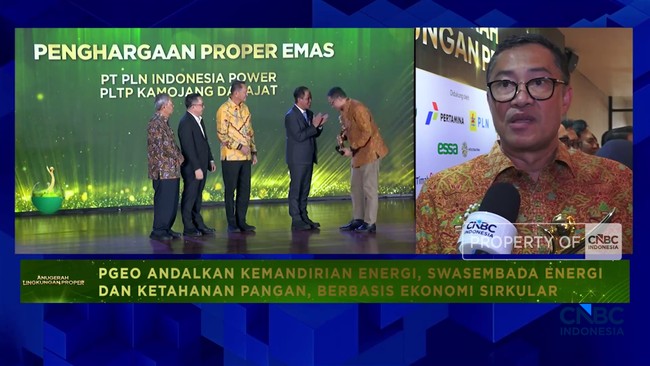
PT Pertamina Geothermal Energy Tbk (PGE) has successfully secured the PROPER Gold award for the 15th consecutive time in its Kamojang operational area and the 4th time for Ulubelu. This achievement stems from efforts in environmental management across operations and surrounding communities.
PGE’s Kamojang area has demonstrated its worthiness for the PROPER Gold rating. The success is evidenced by the company’s reduction in houseload electricity consumption by 187,257.312 kWh, achieving energy efficiency of 674,126 Gigajoules and savings of Rp 280,885,968 through the Energy Efficiency Innovation “SIGRA-35 (Gravity Reinjection System KMJ-35)”.
Another initiative by PGE Kamojang involves mitigating negative impacts on air quality, particularly reducing emissions by approximately 83,050 tonnes of CO2eq; 0.139 tonnes of SOx; 2.117 tonnes of NOx; 0.149 tonnes of PM10, along with cost savings of Rp 704,588,021 through the Emission Reduction Innovation “SIUNU (Steam Interconnection System for Production Well KMJ-18)”.
Additionally, PGE Kamojang successfully reduced NaOH waste generation by 0.378 tonnes through the innovation “NaOH-SAFE (Sustainable Allocation For Efficiency): Reduction of NaOH Waste for Cooling Tower System Efficiency in PLTP”.
Furthermore, the Energy Efficiency Innovation Programme “BTCS: Brine To Central Separator” has improved environmental quality by achieving 1,078.669 GJ in energy efficiency and savings or cost reductions of Rp 2,086,425,340.01, enabling PGE Ulubelu to earn PROPER Gold 2025. Another programme, the Emission Reduction Innovation “CO-ASST (Cooling Condenser Assistant)”, has improved environmental quality by reducing emissions by 181.118 tonnes of CO2 eq; 4.054 tonnes of H2S; and 0.075 tonnes of NH3, with cost savings of Rp 133,055,723.78.
PGE Ulubelu also successfully reduced hazardous waste in the form of used batteries by switching to higher-capacity dry batteries through the Hazardous Waste Reduction Innovation “DUBLIN: Dry-Battery Utilization For Battery Lifespan Increment”. This innovation improves environmental quality by reducing hazardous waste by 0.1372 tonnes.
PGE President Director Ahmad Yani stated that the achievements in the Kamojang area reflect the sustainability of the entire internal company efforts as well as collaboration with relevant stakeholders, such as the Ministry of Environment (KLH). In the PROPER 2025 event, PGE highlighted the major theme of energy independence, energy self-sufficiency, and food security.
“This is the basis of the secular economy that we launched within this PROPER programme, on how to utilise geothermal energy for community empowerment. These are various integrated activities, such as in the Kamojang area with Kanyaah (Kamojang Agri-Aquaculture, Energized by Geothermal for All’s Harmony),” said Ahmad Yani to CNBC Indonesia on the sidelines of the PROPER Environmental Award ceremony at Taman Mini Indonesia Indah (TMII), Jakarta, on Wednesday (8/4/2026).
In addition, Ahmad explained that the Kanyaah programme encompasses geothermal-based fertiliser provision, geothermal agriculture, and geothermal processing. As a result, this combination can enhance the value of the produced goods, thereby helping to boost community economic growth towards independence.
Ultimately, securing PROPER Gold is not merely a commitment but a culture internalised within the company’s geothermal business processes. PGE also remains committed to strengthening and accelerating government efforts in energy transition and realising energy self-sufficiency.
For information, the PROPER award has been held for three decades with the aim of encouraging company compliance with environmental regulations and governance. PROPER serves as a space for synergy with other compliance instruments. Through this programme, environmental quality improvement efforts can be carried out more efficiently and effectively.
The PROPER assessment criteria are divided into two categories: compliance and criteria exceeding regulatory requirements (beyond compliance). Compliance criteria are based on company efforts in fulfilling several aspects, including water pollution control, water source maintenance, air pollution control, hazardous waste management (B3), non-hazardous waste management, B3 management, land damage control, and waste management.
On the other hand, beyond compliance criteria are more dynamic as they are adjusted to technological developments, the application of best environmental management practices, and global environmental issues.