
Aftershocks in NTT Continue, Decline Pattern Expected Within a Month
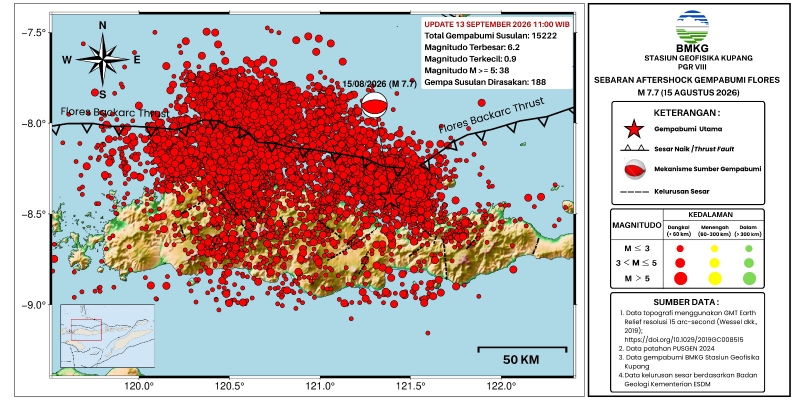
The series of aftershocks following the main 7.7 magnitude earthquake that struck Flores, East Nusa Tenggara (NTT) on 15 August 2026, is still ongoing as of Sunday (13/9).
As of 12:00 WITA, 15,222 aftershocks have been recorded, with the largest measuring magnitude 6.2. The Head of the Kupang Geophysical Station, Arief Tyast/stama, stated that the decay graph is beginning to show a downward pattern. This indicates that aftershock activity is gradually weakening, although the sequence is expected to continue for approximately one month following the main earthquake.
“From the decay graph, a downward pattern is becoming visible, so aftershocks are expected to persist for about one month,” said Arief in the BMKG earthquake monitoring report on Sunday (13/9).
During this period, 38 aftershocks were recorded with a magnitude above 5.0, while the smallest measured 0.9. A total of 188 aftershocks were reported to have been felt by the public.
On Sunday (13/9) at 11:14 WITA, a magnitude 4.7 tectonic earthquake struck the Flores region again. The epicentre was located at sea, approximately 48 kilometres northeast of Mbay, Nagekeo Regency, at coordinates 8.30° S and 121.52° E, at a depth of six kilometres.
The earthquake was felt with an intensity of II-III MMI in Nagekeo and Sikka Regencies, and II MMI in Manggarai Regency. Tremors were clearly felt by several people, with light hanging objects reported to be swaying.
Based on BMKG analysis, the M4.7 earthquake was a shallow earthquake caused by the activity of the Flores Back-Arc Thrust with an upward (thrust) movement mechanism. Tsunami modelling indicates that the earthquake does not pose a tsunami threat.
This M4.7 earthquake is part of the aftershock sequence following the M7.7 earthquake on 15 August 2026. BMKG will continue to monitor seismic activity developments and provide updates to local governments and the public. The public is advised to remain calm and not be influenced by unverified information. Residents are also requested to avoid buildings that are cracked or damaged due to the earthquake.
After nearly a month in an emergency response situation, the Provincial Government of East Nusa Tenggara, along with seven regency governments on Flores Island, is now entering the recovery phase. The National Search and Rescue Agency (Basarnas) officially closed the SAR Operation for the Flores Magnitude 7.7 Earthquake on Saturday (12/9) at 18:00 WITA.
The East Manggarai Regional House of Representatives (DPRD) office and several public facilities have been declared unsafe (red category) following the Flores earthquake, with building activities restricted for safety.
The government has deployed 19 aircraft for weather modification and patrol operations, as well as 36 aircraft for water bombing.
The Head of BNPB, Lieutenant General TNI Suharyanto, reported on the handling of the Anak Krakatau eruption, the Flores earthquake, forest fires, and the Aceh-Sumatra reconstruction-rehabilitation to President Prabowo.
PT Perdana Gapuraprima Tbk has distributed basic necessity aid worth Rp120 million through BNPB for the Flores earthquake survivors in NTT amidst the ongoing aftershocks.
BMKG has recorded 10,232 aftershocks following the M7.7 Flores earthquake. Although activity continues, the decay pattern is showing a significant decline. Tectonically, the centre of the main earthquake and the majority of the aftershock epicentres are located along the Flores Backarc Thrust zone.