
After Two Weeks Under Pressure, Global Gold Prices Begin to Climb Again
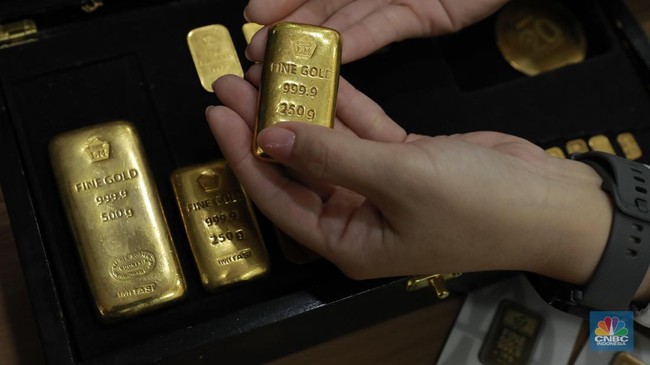
Jakarta, CNBC Indonesia – Global gold prices surged in Friday trading (9 October 2026), after falling for two consecutive weeks. The gains were supported by investors buying at lower prices, while markets assessed the outlook for US interest rates ahead of the latest inflation data release.
According to Refinitiv, gold closed at US$4,193.83 per troy ounce on Friday (9 October 2026), up 1.45% from the previous close of US$4,133.93 per troy ounce.
The rise extended gold’s gains to two consecutive days, following a drop to a two-month low on Wednesday (7 October 2026).
Gold gained 1.24% over the week, reversing a 3.36% fall the previous week. The increase also ended a two-week losing streak.
Bargain hunting supports gold prices
Reuters reported that the rise in gold prices was supported by investors buying the precious metal after its sharp decline over the past several weeks.
Rhona O’Connell, head of market analysis at StoneX, said investors were beginning to return to gold at lower prices, with the US$4,000-per-troy-ounce area providing one source of support.
She said expectations of Federal Reserve rate rises may already be reflected in gold prices. However, the potential for further gains remains limited in the absence of a major event that shifts market sentiment.
Gold’s recovery was also supported by easing pressure from the US dollar and US government bond yields.
The yield on 10-year US Treasuries briefly reached its highest level in more than two decades on Wednesday (7 October 2026), before falling over the following sessions.
On Friday, the 10-year yield rose by 2.8 basis points to 5.261%. However, it fell 3.5 basis points over the week, its largest weekly decline in two months.
The weekly fall in yields gave gold room to recover. Gold does not pay interest, so lower bond yields can make it more attractive.
A slight weakening of the US dollar on Friday also helped gold rise. A weaker dollar makes gold relatively cheaper for investors using other currencies.
Threat of Fed rate rises remains
Despite gold’s gains, the outlook for US monetary policy remains a challenge for the precious metal.
On Thursday (8 October 2026), St Louis Fed President Alberto Musalem said the US central bank still needed to raise interest rates to bring inflation back towards its 2% target.
According to Reuters, the CME FedWatch tool showed that market participants saw a 19% chance of a rate rise at the October meeting. The probability of at least one 25-basis-point increase by December stood at 84%.
Higher interest rates can reduce gold’s appeal, as investors tend to favour yield-bearing assets, including US government bonds.
Meanwhile, global oil prices remaining above US$100 a barrel are also a concern, as they could keep inflationary pressure elevated.
Brent crude closed at around US$104 a barrel on Friday, despite the US announcing an agreement with Russia to increase diesel supplies to the global market.
As a result, gold prices remain sensitive to changes in inflation expectations and US interest-rate policy.
Inflation data to set the tone next week
Investors are now focused on the release of the US Consumer Price Index (CPI), scheduled for next week.
The data is one of the key indicators for the Fed ahead of its monetary policy meeting on 27–28 October 2026.
Han Tan, chief market analyst at Bybit, said the upcoming inflation data could act as a catalyst for gold’s next major move.
He said that if inflation remains high and prompts the Fed to raise rates more aggressively, gold could retest the psychological level of US$4,000 per troy ounce.
Conversely, inflation below expectations could ease pressure for rate rises and give gold room to recover.
Physical gold demand in Asia is showing a different trend. Reuters reported that demand in India was subdued this week as prices rose, while trading activity in China was limited by a national holiday.
Although gold has rebounded after two weeks of losses, the durability of its gains will depend on US inflation data, movements in the dollar and bond yields, and the Fed’s policy direction over the coming weeks.