
After Two Decades of Stagnation, the Domestic Workers Protection Bill is Finally Passed by the DPR
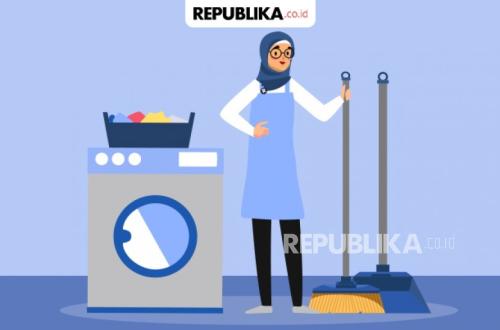
REPUBLIKA.CO.ID, JAKARTA – The DPR RI plenary session has officially passed the Domestic Workers Protection Bill (RUU PPRT) into law. The session, chaired by DPR RI Speaker Puan Maharani, took place in the Plenary Meeting Room at the Nusantara Building, Jakarta, on Tuesday (21/4/2026).
“Has the time come for me to request the approval of the factions on the Domestic Workers Protection Bill? Can it be approved to be enacted as a law?” asked Puan, who was answered with “Agreed!!!” by all the participants present, accompanied by applause and cheers of joy from the domestic workers attending the session.
The enactment of the Domestic Workers Protection Law (PPRT) is seen as an important step in providing legal certainty for workers in the domestic sector. “This law provides certainty and legal protection for domestic workers and regulates employment relations in the domestic sector in a fairer and more professional manner,” said Puan.
She added that the regulation structures employment relations, which have previously been informal, into a more organised framework without eliminating the ingrained family values. “Family values are still maintained, but complemented by a professional work framework that is recognised and protected by law, thus creating warm yet fair relations,” she further stated.
This PPRT Law is special for at least two reasons. First, it is the bill that has been discussed and passed for the longest time. The PPRT bill discussion has been advancing and retreating in the relevant commission for 22 years. Then, the PPRT Law was passed exactly on Kartini Day, 21 April, which commemorates national women’s rights.
The Chairman of the DPR RI Legislation Body, Bob Hasan, explained that there are 12 important material points regulated in the PPRT Bill. He emphasised that the discussion in the Working Committee (Panja) was dynamic with various constructive debates.
According to him, the process produced norm formulations that are expected to be solutions to various problems faced by domestic workers so far. “Several important and strategic materials in addressing domestic workers’ protection issues have been agreed upon by the Panja in the PPRT Bill,” said Bob.
This politician from the Gerindra Party faction also conveyed that after all the Problem Inventory Lists (DIM) were discussed intensively, the PPRT Bill was agreed to consist of 12 chapters and 37 articles arranged systematically. The number of DIM submitted by the government reached 409, with details of 23 fixed DIM, 55 editorial DIM, 23 new substantive DIM, and 100 DIM that were deleted.
Several involved parties include JALA PRT, Komnas HAM, Komnas Perempuan, religious organisations such as PP Aisyiyah, and academics. Their involvement is part of efforts to draft regulations that are responsive to the needs of domestic workers.
The substance of this law covers several important regulations, including the right of domestic workers to obtain health and employment social security, recruitment mechanisms that can be done directly or through placement companies, and the obligation for domestic worker placement companies (P3RT) to be legal entities and have business permits.
In addition, this law also regulates the prohibition for placement companies to deduct workers’ wages, as well as encouraging the provision of education and vocational training for prospective domestic workers.
From the supervision side, the central and regional governments are given roles in guidance and supervision, including involving community apparatus to prevent violence against domestic workers.
Bob Hasan stated that this law is based on the principles of family values, respect for human rights, justice, welfare, and legal certainty.
This Law also provides recognition and legal protection for domestic workers under 18 years old who have worked before this law comes into effect, as part of the transition period.
“The darkness is over, the light has risen. May this law become a guiding light of protection for all domestic workers,” said Bob Hasan before the plenary session at the Parliament Complex, Senayan, Jakarta, on Tuesday (21/4/2026).
The enactment coinciding with Kartini Day commemoration ends a long wait of nearly two decades and becomes an important momentum in the recognition and protection of millions of domestic workers in Indonesia.
Source: jawawa.id (https://jawawa.id/newsitem/after-two-decades-of-stagnation-the-domestic-workers-protection-bill-is-finally-passed-by-the-dpr-1776768733)
Originally published by Republika (https://news.republika.co.id/berita/tdu7ib475/setelah-dua-dekade-mandek-uu-perlindungan-pekerja-rumah-tangga-akhirnya-disahkan-dpr), translated from Indonesian