
After Trump, Xi Jinping and Putin Meet Today: What Was Discussed?
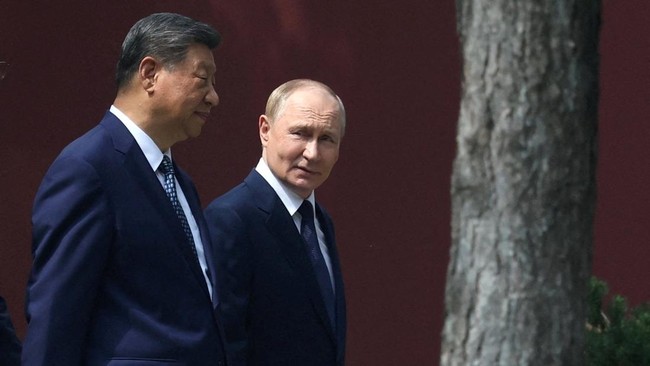
Jakarta, CNBC Indonesia – Russian President Vladimir Putin was reported to have arrived in Beijing, China, on Tuesday, 19 May 2026 for a summit with Chinese President Xi Jinping. In a statement from the ministry, the summit was held to deepen a strategic partnership that stretches from Scandinavia to Southeast Asia. China’s economic might, complemented by Russia’s large oil production, is likely to be a major focus of this week’s discussions.
What was discussed?
Details of the talks have not been published. However, AFP carried some facts about the meeting:
- 25th Visit
Putin is a regular visitor to China and has met Xi Jinping dozens of times. The two leaders often phone to convey messages, whether greetings (including personal ones) or condolences. According to the Chinese Foreign Ministry, this week marks Putin’s 25th trip. He last visited China in September as Xi Jinping’s guest of honour in a large military parade. Putin said this week that he is confident that he and Xi Jinping will “do everything possible to deepen the Russia-China partnership”. Beijing described its relationship with Moscow as being “solid”.
“This is a reminder to Washington that this is a solid relationship for more than 30 years,” said Natasha Kuhrt, an analyst at King’s College London. “That image is a priority for Putin, who calls Xi a close friend,” added Zhao Long, another analyst from the Shanghai International Studies Institute. “Moscow wants assurances that Russia still occupies a special place in China’s strategic calculus,” he said.
- China-Russia Trade Relationship
According to data from the Mercator Institute for China Studies (MERICS), bilateral trade has surged since Russia’s invasion of Ukraine, more than doubling the level seen in 2020. More than 70% of China’s imports from Russia consist of mineral fuels. Meanwhile, Russia’s oil exports to China rose by around 30% since 2022. However, imports from Russia accounted for only about 5% of China’s total imports in 2025, according to Beijing customs data. By contrast, China accounted for more than a third of Russia’s imports and more than a quarter of its exports in 2025, according to Russia’s TASS.
- Rivals & Friends in Common
The two countries share a border spanning 4,000 kilometres. Both China and Russia share similarities in resisting a world order dominated by the United States and the West. They are also long-time partners of Iran and North Korea. This is evident in statements on Iran in the context of the war against the US-Israel or North Korea’s support to Russia in facing the Moscow-Kyiv war, as well as Chinese support to North Korea related to Covid-19.
- Just a Few Days After Trump
Putin’s visit is his first foreign trip this year. It comes just days after US President Donald Trump visited Beijing. Experts say the sequence of these visits is “significant” even though the schedule had been set long in advance. The order of visits suggests that Xi Jinping can clearly brief Putin on key points from his meeting with Trump. “China and Russia often coordinate strategically before and after engagements with other major powers, which in itself reflects a high level of mutual trust,” said Zhao. “But the timing should not be over-interpreted,” he added. Xi himself spoke by phone with the leaders of the US and Russia on the same day in February. He first spoke with Putin via video before calling Trump a few hours later.
- Russia-Ukraine War
The four-year Russian invasion of Ukraine is among the thorny issues discussed by Trump and Xi Jinping last week. Trump told reporters aboard Air Force One after leaving the Beijing capital that Ukraine was a priority for Putin. However, while reaching a conclusion on Ukraine is a priority for Putin, China is believed to be unlikely to be the chief architect of a settlement. They are believed to discuss other international and regional issues of mutual concern. “International and regional issues of mutual concern,” said a spokesman for the Chinese Foreign Ministry on Monday. China regularly calls for talks to end the fighting, but has never condemned Russia for sending troops to Ukraine and presents itself as a neutral party. Beijing also denies providing weapons and components to Moscow’s defence industry.
- New Gas Pipeline
China is known to be the world’s largest buyer of Russia’s fossil fuels. This makes it Moscow’s key economic partner, even as Western sanctions on oil and gas remain in place due to the war in Ukraine. It is known that the two countries are discussing the construction of a major natural gas pipeline, the “Power of Siberia 2”, from Russia to China via Mongolia. This would provide a land route as an alternative to crude oil imported by sea from the Middle East.
“For Putin, this relationship is clearly more important than ever, particularly economically,” said Kuhrt.