
After Touching Rp18,000/US$ in First Half of 2026, Rupiah Remains Under Threat
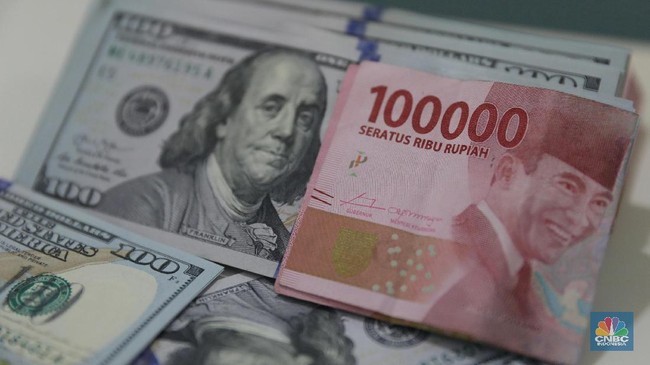
The exchange rate of the rupiah against the US dollar has continued to face pressure throughout the first half of this year. The peak occurred in early June 2 therefore, when the rate breached the Rp18,000 per US dollar level.
According to official reference rate data published by Bank Indonesia (BI), specifically the Jakarta Interbank Spot Dollar Rate (JISDOR), the rupiah hit this new psychological level on Thursday, 4 June 2026, at Rp18,039 per US dollar. Subsequently, pressure worsened to Rp18,171 per US dollar on 8 June 2026, before slightly retreating to Rp18,141 on 9 June 2026, and continuing to fluctuate around the Rp17,971 level.
By the end of June 2026, the rupiah remained positioned above the Rp17,800 level, specifically at Rp17,899 on 30 June 2026, before worsening to Rp17,961 per US dollar on 1 July 2026. Looking back to the start of the year, the rupiah was able to withstand US dollar pressure within the Rp16,700 range. For instance, on 2 January 2026, it held at Rp16,725 before moving to Rp16,801 on 8 January 2026.
This condition made the rupiah one of the worst-performing currencies in the world against the US dollar during the first half of 2026. Based on research by the CNBC Indonesia team, the rupiah ranked 8th out of the top 10 weakest currencies globally during the January-June 2026 period, with a point-to-point depreciation of 7.23%.
Indonesia’s currency performed only slightly better than the Tanzanian Shilling, which depreciated by 6.97%, and the Hryvnia at 5.84%. The weakest currencies were the Iranian Rial (3,173.8%), followed by the Venezuelan Bolivar (110.16%), Libyan Dinar (18.42%), and Turkish Lira (8.61%). Other notable weak currencies included the Sri Lankan Rupee (8.56%), Ghanaian Cedi (8.13%), and the South Korean Won, which sat one rank above Indonesia with a 7.26% depreciation.
To maintain the stability of the rupiah, Bank Indonesia Governor Perry Warjiyo has announced several strategies. These include raising the BI Rate benchmark interest rate to 5.75% in June 2026. “This increase is a follow-up measure to further strengthen the stabilisation of the Rupiah exchange rate amidst continued high global uncertainty,” Perry stated during an online press conference on Thursday (18/6/2026).
In addition to tightening monetary policy, BI is increasing the intensity of foreign exchange interventions to strengthen stability through Non-Deliverable Forward (NDF) transactions in overseas markets, as well as spot transactions and Domestic Non-Deliverable Forward (DNDF) in the domestic market. Furthermore, BI is maintaining the interest rate structure of the Rupia Securities Bank Indonesia (SRBI) across 6, 9, and 12-month tenors in line with the BI-Rate increase to remain attractive for foreign portfolio investment inflows.
Perry also noted that BI would continue providing a 10% reduction incentive on hedging swap rates for foreign investors to enhance attractiveness and compensate for costs borne by investors. Additionally, BI aims to maintain adequate liquidity in the money and banking markets by ensuring primary money growth exceeds 10% in line with monetary expansion, including reopening repurchase agreement (repo) auction windows for 3, 6, 9, and 12-month tenors.
Alongside strategies to strengthen the domestic US dollar supply, BI is implementing policies to curb high domestic demand for dollars. This includes expanding the Money and Foreign Exchange Market (PUVA) ecosystem to support Local Currency Transactions (LCT) with various trading and investment partner nations. Prudent principles are also being strengthened through a reduction in the threshold for cash foreign currency purchases without underlying documentation to US$10,000 per participant per month, effective 1 July 2026. Furthermore, reporting requirements for Foreign Exchange Flows (LLD) will be tightened, lowering the threshold for mandatory supporting documents for outgoing transfers from the equivalent of US$50,000 to US$25,000, also effective 1 July 2026.
Despite these efforts, many believe the threat to the rupiah will persist in the second half of the year, particularly after Indonesia’s trade balance recorded a deficit of US$1.61 billion in May 2026, breaking a 72-month consecutive surplus.
Economists from Bank Central Asia (BCA) suggest that exports will face several hurdles. First, with more hawkish policies from the Fed and other central banks, global demand may slow. Second, the mandatory B50 biodiesel programme could impact CPO export allocations, alongside ongoing weather factors. Third, policy uncertainty regarding production and export restrictions on commodities like coal and nickel remains a concern. Fourth, the impact of Danantara Sumberdaya Indonesia (PT DSI) may affect the trade balance in June. BCA economists also anticipate that rising imports may continue, as high government spending could offset the impact of currency depreciation on demand. “This combination of factors creates a feedback loop leading to rupiah weakness, which we expect will be addressed with an additional 50 bps increase in the BI policy rate,” they noted.
Source: jawawa.id (https://jawawa.id/newsitem/after-touching-rp18-000-us-in-first-half-of-2026-rupiah-remains-under-threat-1783302651)
Originally published by CNBC Indonesia (https://www.cnbcindonesia.com/market/20260706051321-17-748219/sempat-rp18000-us--di-semester-i-2026-rupiah-masih-terancam), translated from Indonesian