
After the Microphone is Turned Off: Indonesian Ulama Shift Focus to Economy, Education, and Technology
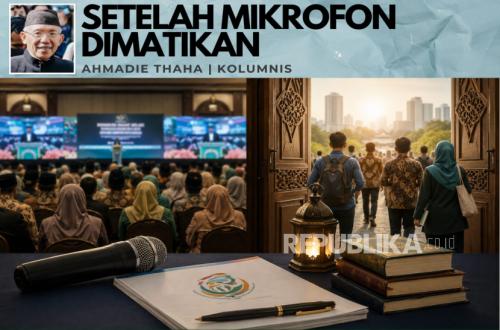
The microphone at Hotel Bidakara can finally rest. Over three days, the 8th Indonesian Muslim Congress (KUII VIII) from 24–26 July 2026 saw participants move from one session to another in a packed schedule. On Sunday evening, the congress concluded with the closing ceremony and the 51st anniversary of the Indonesian Ulema Council (MUI). More than 450 participants attended, including representatives from 87 national Islamic community organisations.
What remains after the stage is dismantled is not the microphone, but the decisions. At the closing, the draft resolution of Commission G, titled ‘Taujihat of the 8th Indonesian Muslim Congress 2026 for the Ummah, Nation, and State’, was read out. The forum also proposed an additional point, ensuring explicit support for the Palestinian people’s struggle to obtain their rights justly. Palestine, it seemed, could not be reduced to a mere sub-clause in global diplomatic discourse.
Reading the six-page Taujihat, it is striking to see not just what was decided, but what now occupies the minds of the ulama. The answer may surprise those who imagine a congress of religious scholars debating qunut, the number of tarawih prayer cycles, beard length, or the position of the index finger during tashahhud. The first three points of the Taujihat instead discuss the economy.
A literal word count reveals the focus: umat (16 times), bangsa (12), Islam (12), negara (10), penguatan/strengthening (10), ekonomi (8), pendidikan/education (8), syariah (7), and teknologi (7). The terminology employed is diverse, including the reactualisation of Pancasila Economics and Sharia Economics, Danantara Syariah, cooperatives, MSMEs, pesantren, agrarian reform, natural resource governance, strategic commodity exports, investment, and limiting oligarchic practices.
Education is the next major concern. The ulama recommend a reorientation of the national education system, equitable governance of religious education across ministries, and improved welfare for religious teachers, explicitly mentioning kiai, tuan guru, and ustaz in pesantren and madrasah. They also raised the constitutional mandate requiring a 20 per cent allocation of the state budget for education, insisting that official education budgets should not be included in this figure.
Science and technology form another critical focus. The Taujihat calls for a bold transformation of the nation from a technology user to a technology developer. It advises that science education must begin at the primary level, that scientific talent should be nurtured, and that Islamic sciences must converge with science, engineering, and computation. The document also urges the digitalisation of the Islamic intellectual heritage and directs research towards food, energy, health, and defence.
Other national issues causing concern among the ulama include LGBT matters, digital sovereignty, family resilience, Muslim unity, the institutionalisation of ethics, and strengthening Indonesia’s role in global diplomacy, particularly within the Organisation of Islamic Cooperation and the Global South. Almost no major issue facing the republic escaped the congress’s attention. This breadth demonstrates an appreciable shift: the horizon of the ulama has changed. Furu’iyah differences that once drained the ummah’s energy are increasingly marginal. The congress produced no resolution on whether to recite the basmalah aloud or softly. Instead, the ulama spoke of artificial intelligence, data, oligarchy, investment, agrarian reform, energy, computation, and strategic autonomy. This is no small change. Religion is striving to speak again about the real world where people work, eat, go to school, seek medical treatment, use gadgets, lose data, look for jobs, and face geopolitical shifts. While the issue of LGBT did receive a lengthy point and became major news, the Taujihat gives it a different proportion. It is merely one part of a much broader landscape, with the economy, education, science, technology, and sovereignty filling the greater portion of the document.
Source: jawawa.id (https://jawawa.id/newsitem/after-the-microphone-is-turned-off-indonesian-ulama-shift-focus-to-economy-education-and-technology-1785210713)
Originally published by Republika (https://analisis.republika.co.id/berita/tiv6h7415/setelah-mikrofon-dimatikan), translated from Indonesian