
After the Fires, Do Palm Plantations Emerge?
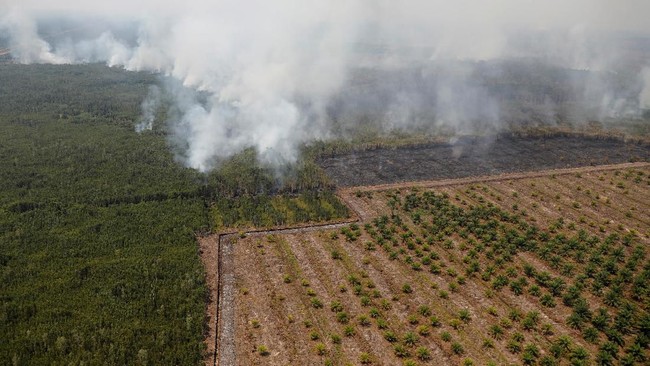
Each dry season, Indonesia once again faces forest and land fires. When fires break out, everyone’s attention turns to the number of hotspots, the area burned, air quality, and the capacity of the government and companies to extinguish them.
But what happens to the land after a fire? This is a far more important question that is often overlooked.
When the popular phrase “After the fires, palm oil emerges” appears in public discussion, this question becomes significant. Forest and land fires have complex causes, and not all palm oil plantations are established on land that has previously burned. Nevertheless, the phrase should be understood as a warning about land-based development management. The central issue is not only whether fires are deliberately set to clear land; it is whether our economic, investment and land-governance systems allow environmental damage to make nature more attractive for development. If that remains possible, Indonesia has a structural problem that needs urgent attention.
The land-investment paradox
Conventional investment thinking treats palm oil as a straightforward investment proposition. Investors calculate land value, development costs, productivity, crude palm oil (CPO) prices, cash flow, internal rate of return (IRR), net present value (NPV) and payback period.
The basic question is how much investment is required and how much profit it will generate.
Indonesia’s palm oil industry has expanded significantly under this model and has made a substantial contribution to the national economy. But the world has changed. Anyone investing in palm oil today must consider not only prices and production, but also fires, deforestation, carbon emissions, biodiversity, social conflict, market access, reputation, financing and regulation.
Plantations established in ecologically valuable areas, or exposed to market and financing pressures arising from sustainability risks, can become risky investments. As a result, the success of land-based investment can no longer be measured solely by financial returns. Investment must now move towards Integrated Value Return, which takes account of financial, natural and social value, as well as long-term resilience.
Fire must not become an economic instrument
This is where the issue of fires becomes critical.
Intact forests and landscapes have high ecological value, but conventional economic models and market prices do not always reflect it. Forests provide water, store carbon, protect soil, regulate local climates, provide wildlife habitat and sustain people’s livelihoods. Yet many of these benefits do not generate direct income, so forests are often inadequately valued on investment balance sheets.
By contrast, a degraded area may lose some of its ecological value yet still be viewed as having significant economic potential. This is a paradox that must be resolved. Development systems must not indirectly suggest that intact forests obstruct investment while damaged land offers an investment opportunity.
Environmental damage must not generate an economic incentive or profit. Fire must not be used to reduce an area’s ecological value and then make it more economically attractive.
After a fire, an area must not automatically be treated as vacant land. The response should be: Assess – Protect – Recover – Restore – Monitor. Not: Burn – Degrade – Convert.
Palm oil need not be linked to expansion
We must also take an objective view of the palm oil industry. Palm oil is one of Indonesia’s strategic sectors. It drives regional development and local economies, and provides income for millions of people. Discussion of palm oil should therefore go beyond a black-and-white debate about “palm oil or forests”.
The more important questions are where palm oil is grown and how it is produced, and how natural value can be maintained. The future of palm oil will not be determined by the amount of land cleared. Instead, it will depend on improved productivity, efficiency and technology; a circular economy; collaboration with smallholders; lower emissions; and biodiversity protection.
The paradigm must shift from the idea that more land produces more palm fruit to the view that better management creates more sustainable value. The concept of “the right land” can begin with recognising natural value as the basis for investment decisions.
Is this land suitable for development? This should be answered before discussing investment, plantation development or production. It is also necessary to ask whether the land is accessible. The fact that land is available does not prove that it is suitable for development.
Every land-based investment should consider legal status and certainty, carbon value, biodiversity, ecosystem integrity, water-management functions, fire risk, peatland risk, habitat connectivity, community values, conflict risk and resilience to climate change.
Based on this assessment, a landscape can be placed in one of three categories: a Protection Landscape, with natural values that must be protected; a Conditional Landscape, requiring further study and strict management conditions; or a Development and Optimisation Landscape, which is legally suitable and, according to research, carries relatively low ecological risks for development or optimisation.
The investment principle should therefore change to “Right Land Before Investment”, using the Natural Positive Index: a new instrument for land evaluation.
Natural Positive Index (NPI)
Indonesia needs a tool that incorporates natural value into policy and investment decision-making. One proposal is the Natural Positive Index. It can show the extent to which a landscape contributes positively to environmental sustainability, the economy and people’s lives.
The index could combine several important factors. The first is carbon value, indicating an area’s capacity to store and absorb carbon. The second is biodiversity value, reflecting species richness, habitat quality, and the presence of important species and ecosystems. The third is water and ecosystem-services value, which measures an area’s ability to regulate water and provide ecosystem services. The fourth is ecosystem integrity, indicating the health, condition and resilience of the ecosystem. The fifth is resilience to climate change and fires. The sixth is community value, encompassing social, cultural and economic benefits for local communities. The seventh is nature connectivity: the area’s role in maintaining links between ecosystems and habitats.
Each area could receive a Natural Positive Index score based on these parameters. A higher score would indicate greater strategic value as natural capital.
Areas with a high Natural Positive Index should therefore not be treated as land banks or development reserves. They should instead be regarded as natural assets that must be conserved.
From land banks to natural-capital banks
Land-based companies have traditionally regarded their land banks as evidence of strength. In future, they should begin developing the concept of a Natural Capital Bank.
Companies understand the natural value within and around their operating areas, as well as the amount of land they control. But how important is it to know the area’s carbon value? How significant is its biodiversity? How much land needs protection? Which water-management functions need to be maintained? What resources are needed for restoration? How do all these factors affect investment risk and resilience?
Under this approach, a business portfolio would no longer consist of land, plantations, mills and infrastructure, but of land, production, natural capital and community value. This represents a major change in how investment is viewed.
Right Nature: Nature as part of investment
If Right Land ensures that investment takes place in the right locations, Right Palm ensures that the right plantation practices generate economic value.
Expansion would no longer drive growth. Higher productivity, replanting, technology, precision agriculture, more efficient use of fertiliser and water, energy efficiency, waste utilisation, a circular economy, lower emissions and collaboration with smallholders can all create economic value. Increasing production does not always require developing new land. This is a more cost-effective and risk-resilient model for future palm oil investment.
Nature has often been seen as an obstacle to investment. In the future, it must be recognised as part of investment value. Economic sustainability depends on the services provided by forests and healthy ecosystems, including water, climate regulation, soil protection and resilience to disasters. Protecting areas with a high Natural Positive Index is therefore not only an environmental responsibility. It also manages investment risk and creates long-term value. When businesses protect their natural resources, they are better placed to build resilience, earn investors’ trust, gain access to sustainable finance and secure social legitimacy.
“After the fires, palm oil emerges” should become “After the fires, recovery emerges”. Ultimately, the best investment is not the one that produces the quickest profit. It is the one that generates economic value without undermining nature’s ability to sustain life and future growth.
RIGHT LAND. RIGHT PALM. RIGHT NATURE. Invest in the Right Land. Grow the Right Palm. Protect the Right Nature.